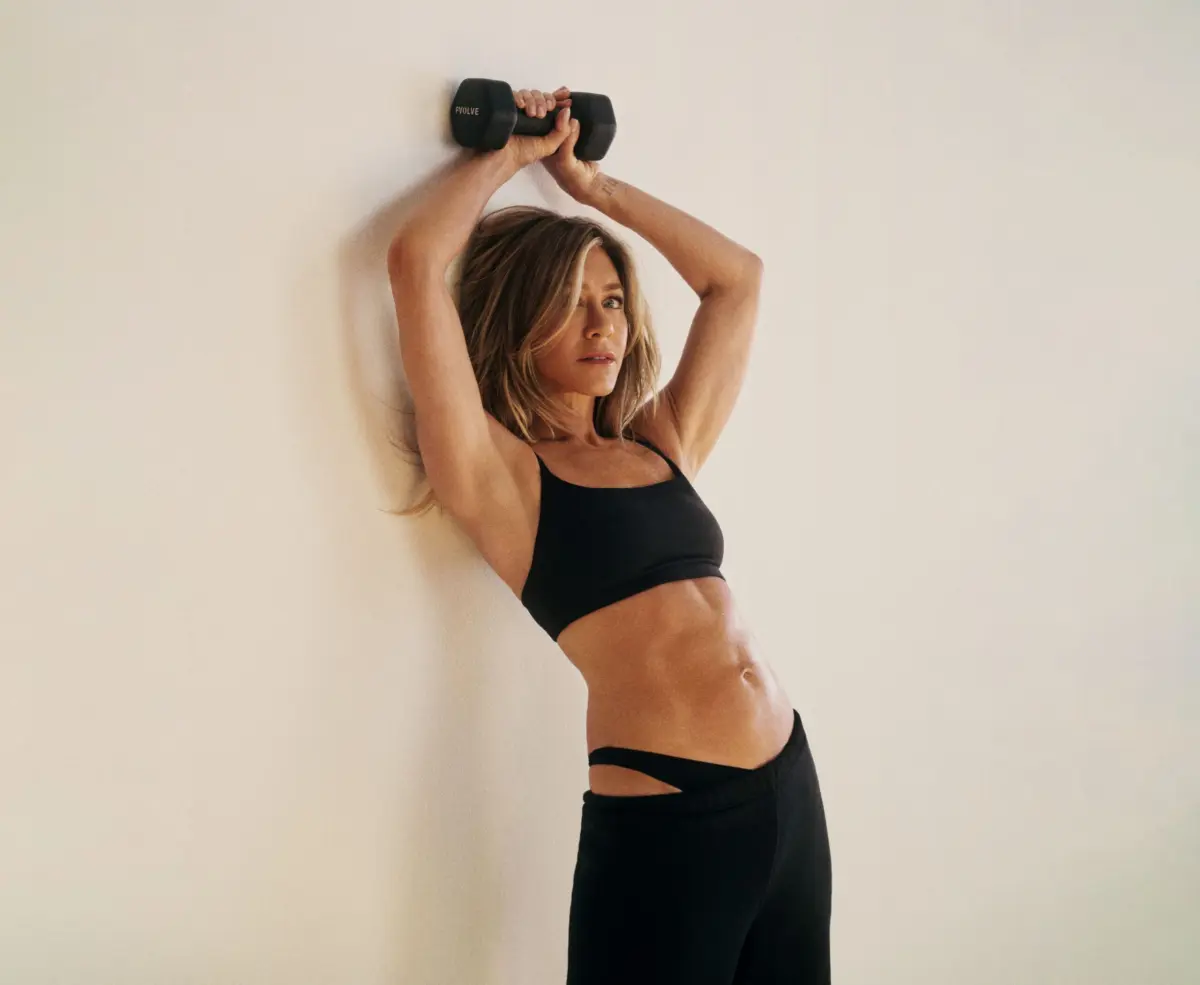
Recently, the beloved actress opened up about her wellness habits, sharing some of her favorite arms and abdominal moves from Pvolve, the functional fitness program she has practiced for several years. Unlike traditional high-impact routines that rely heavily on speed and heavy lifting, this specific workout style focuses on controlled resistance, intentional movement, and building functional strength designed to support the demands of everyday life.
According to Dani Coleman, Aniston’s personal trainer and the vice president of training at Pvolve, the program approaches upper body and core development through a very specific lens. Coleman explains that the routine builds strength through progressive overload, controlled resistance, and dynamic movement operating across all three planes of motion. Rather than rushing through repetitions or allowing momentum to do the heavy lifting, the fundamental goal of every movement is total physical and mental control.
Coleman notes that by keeping the focus entirely on the specific muscles performing the work, practitioners can develop intentional strength. This kind of targeted engagement not only elevates performance during formal workouts but also translates directly into how a person looks and feels during routine daily activities. For Aniston, adopting this focus on building a sustainable, long-term routine represented a major mental shift away from her former approach to physical fitness.
Reflecting on her earlier habits, Aniston admits that she used to view exercise through a much harsher lens. She recalls a time when she believed workouts had to follow an intense, punishing, no-pain-no-gain philosophy to be effective. Yet, looking back at all the different programs and methodologies she has tried over the years, her primary takeaway is remarkably simple: consistency is everything. She emphasizes the importance of stepping back, avoiding overexertion, and truly listening to the signals the body sends.
These days, Aniston points out that the single biggest factor keeping her consistent is paying close attention to the direct impact that movement has on her overall mood and daily energy levels. When her schedule gets chaotic and she goes without working out, she immediately notices a tangible difference. She describes how her mood dips, her daily endurance decreases, and even how her clothes fit differently. For Aniston, neglecting physical activity ultimately means failing to treat herself with the care she deserves, because moving the body is a vital form of self-care.
To maintain this habit, her strategy is remarkably straightforward: keep workouts manageable, even on the busiest days. She encourages people to view time constraints as surmountable, suggesting that waking up just fifteen minutes earlier to get a session in can make a massive difference. By simplifying the process and removing unnecessary barriers, fitness becomes much more digestible and realistic to maintain over a lifetime.
That philosophy forms the very foundation of the quick arms-and-abs routine that Aniston currently swears by. These specific movements are designed to build core strength, mobility, and stability all at once, maximizing efficiency without requiring hours at the gym. Aniston explains that this routine targets the arms and abs for a reason, noting that the midsection serves as the human center of gravity, while the arms are constantly in motion and visible throughout the day. Having a strong core is a personal priority for her, emphasizing that for her lifestyle, core stability is everything.
The routine itself incorporates specialized equipment, including a yoga mat, a stability ball, and a resistance band, to challenge the body in unique ways. Among her preferred exercises is the Curl Over Ball. Coleman explains that this specific movement strengthens the abdominal muscles by taking them through a fuller range of motion while the stability ball provides essential support for the lower back, allowing for deeper engagement without strain.
Another core staple of the routine is the Elevated Deadbug. Coleman describes this as a powerful core stability movement designed to improve neuromuscular coordination. The exercise teaches the body how to remain completely steady and controlled while the arms and legs move in tandem, challenging the midsection to resist rotational forces and maintain alignment.
To address rotational strength and lower-body stability, the routine features the Golf Swing. Coleman notes that this dynamic core exercise effectively strengthens the obliques while simultaneously activating the outer hips. The result is an improvement in overall balance and functional stability, mimicking the natural twisting motions of daily life.
Taking a traditional bodyweight movement to the next level, the Stability Ball Plank introduces an element of instability to the classic exercise. Coleman explains that adding the stability ball forces the core muscles to work significantly harder than they would on a flat surface, demanding continuous micro-adjustments to maintain complete control and proper form.
Finally, the Prone Back Extension with Lat Pull targets the posterior chain, focusing heavily on the muscles running along the spine. Coleman points out that this movement is essential for building back strength, supporting better posture, and actively counteracting the physical toll of long hours spent sitting at desks or in transit. Through this balanced combination of targeted resistance and mindful movement, Aniston continues to prioritize a sustainable approach to health that keeps her strong, centered, and ready for whatever the day brings.