
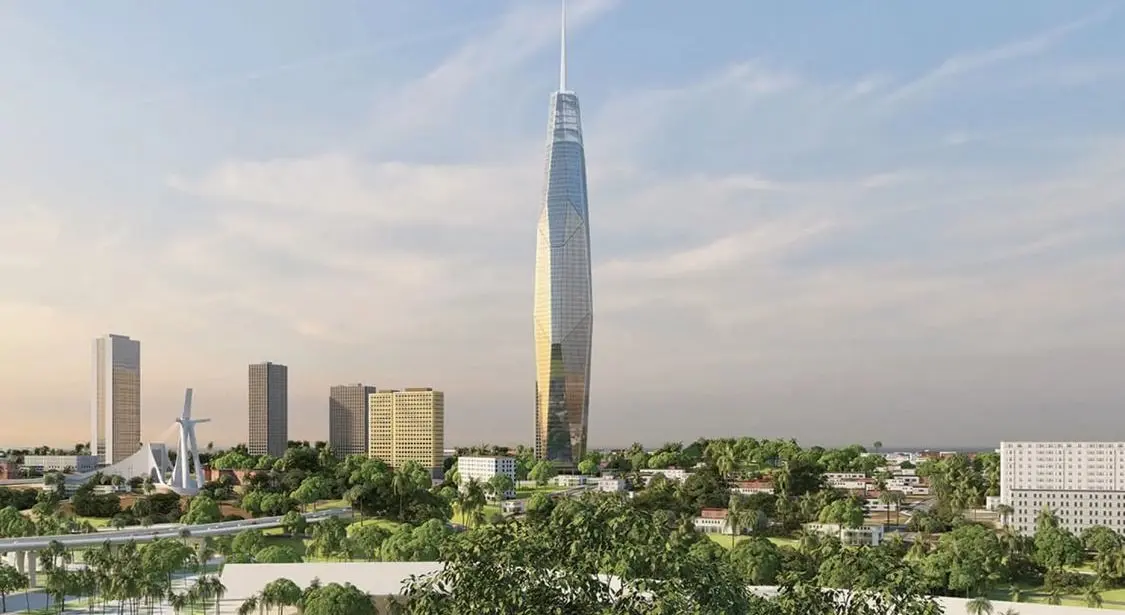
Towering 1,381 feet (421 meters) over the bustling streets of Abidjan, the nation’s economic capital, Tour F will officially take the title of Africa’s tallest tower once its final spire is installed. The 75-story supertall skyscraper has been designed to make a striking visual statement, drawing direct aesthetic inspiration from traditional West African masks. However, beneath its culturally significant and faceted glass facade lies a deeply functional, modern administrative hub designed to streamline governance and modernize the city’s infrastructure.
A Monumental Hub for Government Efficiency
Spanning 1.5 million square feet of interior space, Tour F has been conceived primarily as a centralized administrative powerhouse. The skyscraper will consolidate a wide array of government offices that are currently scattered across various locations in the metropolitan area. By bringing these disparate departments under one roof, the project aims to free up valuable real estate and historical buildings throughout the city while drastically improving inter-departmental communication.
For government employees, the transition means moving away from fragmented operations and stepping into a collaborative environment that fosters face-to-face coordination and streamlined daily workflows.
Beyond its logistical purpose, the building incorporates advanced sustainable engineering features designed to combat the tropical climate of West Africa. The exterior shell is mounted with 16,000 glass panels that have been specially glazed to reflect direct sunlight. This thoughtful architectural choice significantly reduces solar heat gain, thereby lowering the building’s overall demand for air conditioning and setting a new benchmark for energy-efficient skyscraper design on the continent.
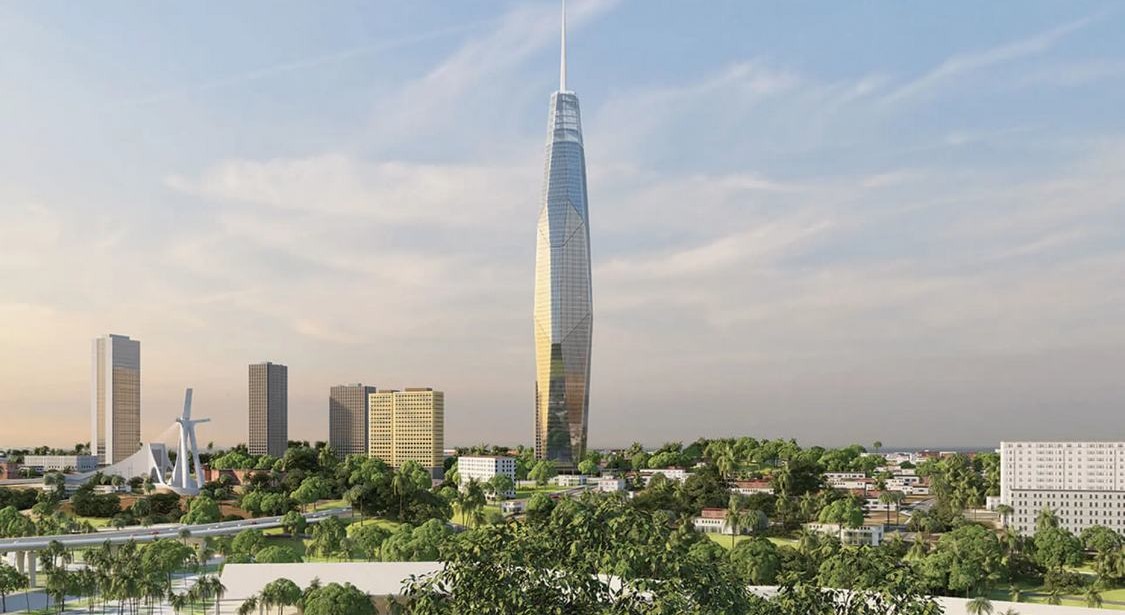
At the very summit of the massive structure sits the "lantern," an expansive, glass-enclosed observation deck rising nearly 100 feet high. Accessible via a high-speed panoramic elevator, this public viewing platform offers sweeping, unobstructed views of the sprawling city and the picturesque Ebrié Lagoon, welcoming both citizens and international visitors to experience Abidjan from an entirely new perspective.
Engineering Challenges on Swampy Ground
The realization of such a monumental skyscraper was no small feat, particularly given the geographical conditions of the building site. Constructed on unstable, swampy ground, the foundational engineering required unprecedented precision and heavy-duty intervention.
To anchor the massive structure securely, engineers had to drive hundreds of steel piles approximately 200 feet deep into the Earth until they reached solid bedrock. Once these deep-seated supports were firmly in place, they were securely attached to a massive, 30-foot-thick concrete slab. This extraordinary combination of deep steel piling and reinforced concrete was deemed absolutely necessary to support the staggering 170,000-ton total weight of the completed skyscraper.
Tour F takes its rather utilitarian name from an origin story that dates back more than five decades. In 1970, the Ivorian government initially embarked on a major urban development initiative to construct a series of five towers intended to house various state ministries. Those original structures were aptly named Towers A through E.
While planning for Tour F began during that initial era, the project was repeatedly derailed over the decades by successive waves of civil unrest, economic instability, and political upheaval. The fact that the tower is finally coming to fruition today speaks volumes about the nation’s remarkable political and economic stabilization. Currently, the Ivory Coast stands proudly as the third-largest economy within the Economic Community of West African States (ECOWAS) and ranks as the largest economy among the community’s French-speaking member states.
A Broader Symbol of National and Regional Resurgence
Writing for CNN, architectural commentator Oscar Holland noted that while the heritage symbolism of the building’s mask-inspired facade is striking, it ultimately pales in comparison to the powerful symbolism of the building’s completion for the country as a whole. For the Ivory Coast, Tour F serves as a tangible declaration that decades of historical hardship are firmly in the past. It stands as proof that an African nation possesses the capacity to independently produce monumental, world-class modern architecture.
Furthermore, the skyscraper is viewed as a physical manifestation of a broader regional upswing, with West Africa gaining significant economic and infrastructural momentum and the Ivory Coast leading the charge. This architectural triumph is just one piece of a larger wave of national modernization efforts, which includes ambitious new infrastructure developments such as a comprehensive mass-transit system and the planned Abidjan-to-Lagos superhighway.
The achievement is all the more striking when placed in a broader economic context. Observers note that the tallest tower on the African continent is not rising within one of the five largest continental economies, nor even among the top ten. Using a standard nominal GDP metric, the Ivory Coast currently ranks 11th in Africa. Yet, through vision, determination, and meticulous engineering, the nation is punching well above its weight on the global architectural stage.
With its impending completion, Tour F will officially dethrone Egypt’s iconic tower located in the New Administrative Capital, which stands at 400 meters (1,292 feet) tall, claiming the crown as the tallest building in Africa just as the calendar turns to a new year.