
Hallie Gould, the editor-in-chief of the popular digital beauty destination Byrdie, knows this paradox intimately. As the head of a major online publication dedicated entirely to skincare, hair, and makeup, Gould’s professional workspace serves as a literal landing strip for the beauty industry’s endless product pipeline. Packages arrive in a steady, relentless stream, turning her professional routine into a high-stakes curation challenge.

"I probably receive about 100 products a month and keep 20-ish on my desk at any given time," Gould shares, offering a glimpse into the sheer volume of goods that pass through her hands.
Multiply that monthly influx by a year, and the logistical nightmare of product accumulation becomes glaringly obvious. Serums, cleansers, moisturizers, and styling implements can easily end up stuffed into every available nook and cranny of a workspace. Beyond the office, the deluge extends straight to the home front, threatening to overtake bathrooms, bedroom furniture, and closet space. For many professionals in the beauty media landscape, managing the physical overflow of samples is just as demanding as evaluating their actual chemical formulations and cosmetic efficacy.
Despite the structural challenges of working in an industry built on perpetual novelty, Gould has managed to maintain a remarkably disciplined and relatively low product count within her Brooklyn apartment. Rather than letting the incoming tide of cosmetics swallow her living space whole, she relies on a strict regimen of curation, intentional testing, and organizational discipline.

According to Gould, the inventory in her home is kept to a manageable baseline. "There are tons of products strewn around my room, under my bed, packed away in my closet (shameful but true), and then those I actually use in my bathroom," she explains, offering an honest look at the messy reality behind her organizational philosophy. When pressed for an exact tally, she estimates her personal stash hovers around 50 products total, with only about 25 of those items earning a spot in her regular, day-to-day beauty rotation.
Keeping that number from spiraling out of control requires a proactive approach to home organization and lifestyle management. To achieve this balance, Gould relies on a foundational set of personal rules that govern how products enter, stay in, and eventually leave her living space.
Embrace the One-In-One-Out Philosophy
The cornerstone of Gould’s domestic product management is a simple, uncompromising mathematical rule borrowed from minimalist wardrobe curation: the one-in, one-out philosophy. In a world where free samples arrive by the dozen, establishing a hard limit on physical inventory is the only way to prevent domestic chaos.

"If I bring in a new product, I usually get rid of one I haven’t used in a while to make room," Gould explains.
This policy prevents accumulation fatigue before it can even begin. However, daily maintenance is only part of the equation. To keep the collection truly streamlined, Gould pairs her daily tracking method with a more aggressive seasonal reset. Every three months, she conducts a thorough, unsparing audit of her beauty inventory.
During these quarterly purges, she does not hesitate to discard items that have overstayed their welcome. Products that have lingered untouched since the day they arrived, formulations she has sampled and realized she dislikes, and bulky items that consume an unjustified amount of square footage are ruthlessly cleared out. This periodic reset ensures that her apartment remains a functional living space rather than an overflow warehouse for the beauty market.
Test Before You Commit
Because Gould’s professional existence is inextricably tied to an environment overflowing with beauty innovations, setting clear boundaries between her working life and her personal sanctuary is essential. To keep her home from turning into an extension of her office, she employs a rigorous screening process before any cosmetic item is allowed to cross the threshold of her front door.
"Because my job very literally is to be surrounded by beauty products all day long, I make sure to try a product for a few days at my desk before deciding whether or not to take it home," she notes.
This interim trial period acts as a filter against impulse curation. Every product must pass through a strict series of evaluations while still at the office, but the ultimate deciding factor is a single, grounding question: Do I actually need this?

By forcing potential additions to justify their existence through utility rather than novelty, Gould filters out the items that might look appealing on a shelf but offer no functional improvement to her existing routine. As a practical example of this discipline, she enforces a replenishment-only rule for essential staples, noting that she tries to bring home a replacement moisturizer only when she has completely finished her current jar.
Organize According to Frequency of Use
Once a curated selection of products successfully passes the office screening phase and makes its way to her Brooklyn apartment, strategic placement is key to maintaining daily order. Rather than storing items randomly, Gould categorizes her collection based strictly on how often she actually reaches for them.
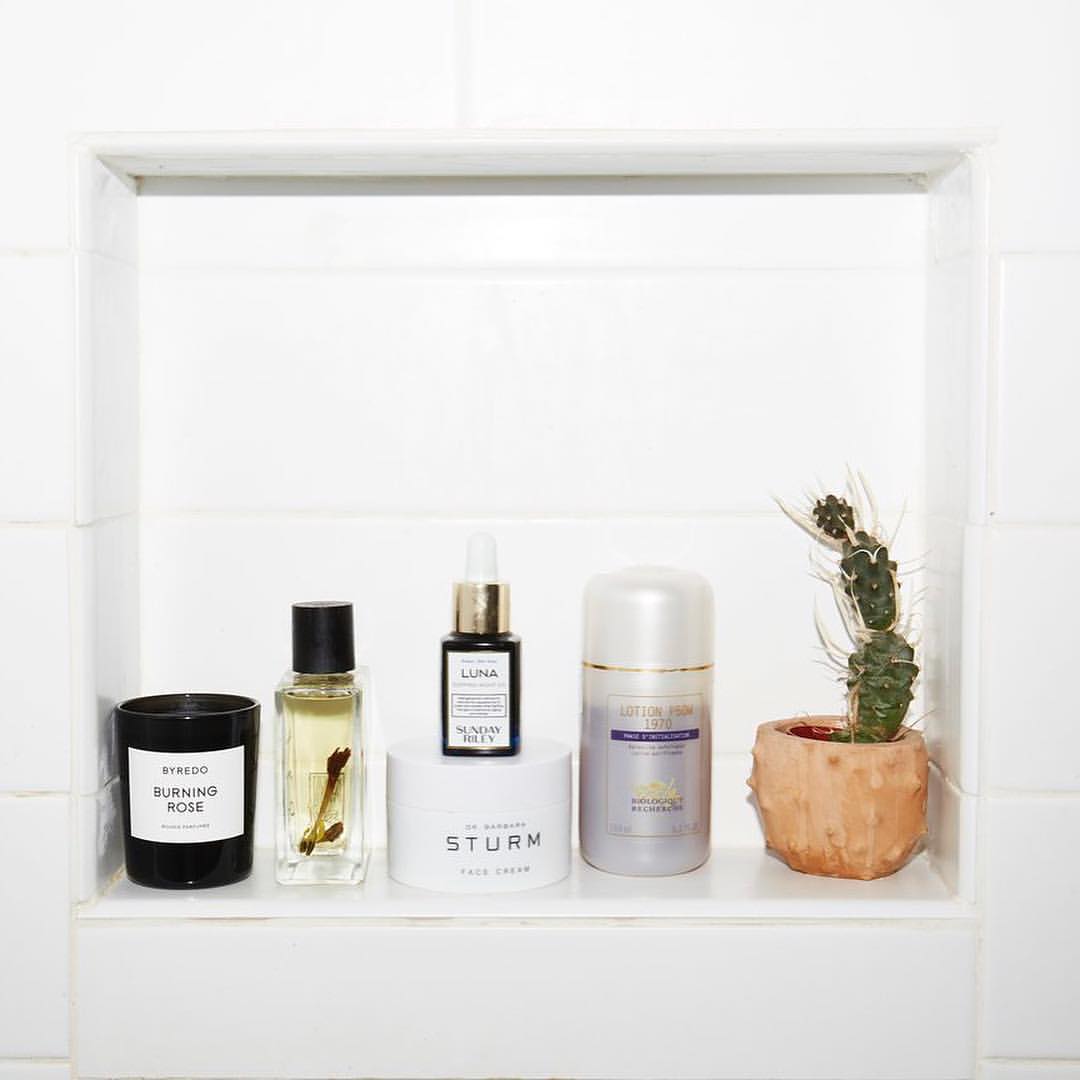
Her primary storage strategy relies heavily on the architecture of her bathroom. Haircare essentials and skincare items find a home within the medicine cabinet positioned directly above her sink. Meanwhile, makeup—the category most prone to chaotic dispersion—is sequestered into the drawer located just below the sink.
Within the makeup category, Gould further refines her system by frequency of application. The cosmetic items that form the backbone of her daily routine are consolidated inside a large, portable makeup case, keeping them easily accessible for rushed mornings. Conversely, products destined for occasional use—those reserved for special events or experimental looks—are tucked away into a series of clear plastic organizers, keeping them visible yet out of the way.
As for the miscellaneous overflow that comes with working in beauty, Gould admits to maintaining a designated zone for the unexpected extras. Body care products, hair dryers, curling irons, and various styling accessories find a temporary home in a classic catch-all space—what she cheerfully describes as a bit of a junk drawer situation.
For Gould, managing the relentless tide of beauty samples is an ongoing exercise in mindfulness and organization. By combining a strict replacement philosophy, a rigorous screening process at the office, and intentional spatial allocation at home, she manages to navigate the demanding intersection of a product-heavy career and a calm, orderly living space.