
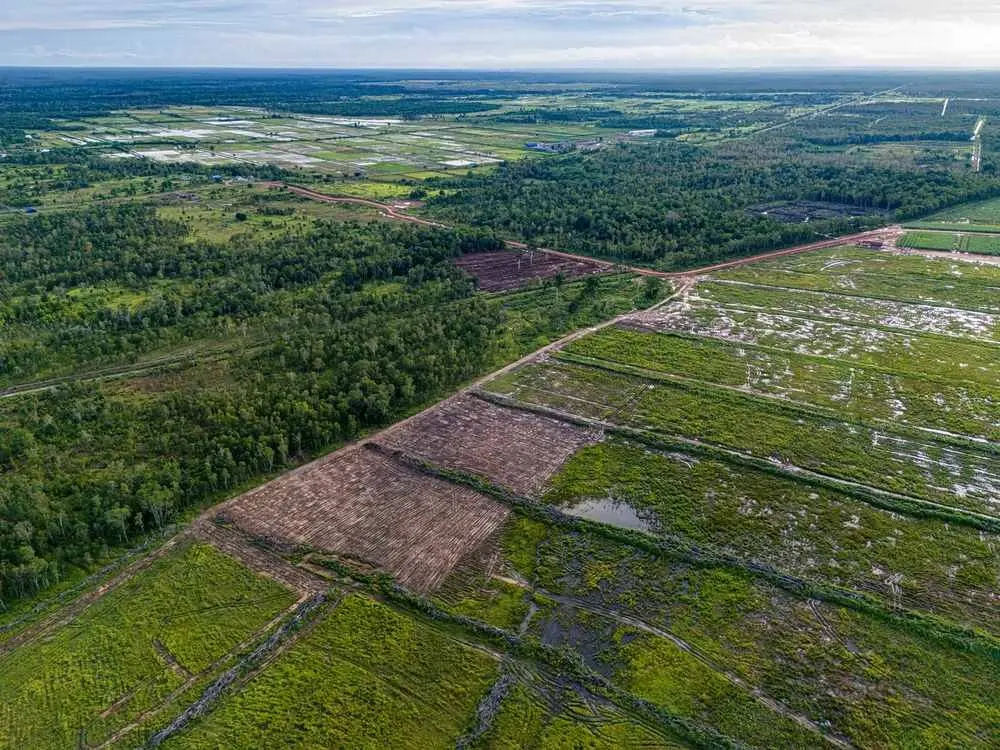
Following a remarkably successful agricultural push that allowed the Southeast Asian nation to achieve self-sufficiency in rice cultivation roughly three years ahead of its original government schedule, approximately 4 million acres of pristine rainforest, delicate swamps, and vital peatlands across Indonesia’s vast island territories will be spared from the chainsaw.
While the ultimate legal and ecological destiny of these massive land tracts remains under discussion, a decisive agreement was recently forged between the Indonesian Ministry of Agriculture, the Ministry of Forestry, and the Indonesian National Economic Council. Under this new policy framework, any future agricultural expansion projects will be strictly redirected to lands that have already been converted for productive use, leaving untouched forest ecosystems out of the equation.
The policy shift was publicly confirmed in early October during a high-profile sustainability forum held in the capital city of Jakarta. Hashim Djojohadikusumo, Indonesia’s special envoy for climate and energy and the younger brother of the Indonesian president, announced to the assembly that 4.4 million acres of forest areas—which had previously been earmarked to become sprawling rice plantations—will remain entirely undisturbed.
The ambitious executive initiative to secure complete national self-sufficiency in rice production was originally projected to extend across those millions of acres through at least 2029. However, a combination of targeted government incentives, rapid improvements in agricultural crop varieties, and robust government fertilizer subsidies propelled the country to reach its production goals years ahead of schedule.
Along the way, the massive undertaking had drawn intense scrutiny and fierce resistance from a broad coalition of international environmental organizations, local grassroots advocacy networks, and indigenous communities who warned of catastrophic ecological and cultural consequences.
Addressing the sustainability forum on behalf of the Agriculture Ministry, Mr. Hashim stated that the government now "sees no further need to expand rice cultivation in so-called forest areas." His remarks referred specifically to targeted tracts of land located on the island of Kalimantan and in the remote region of South Papua on the western half of the island of New Guinea.
Reinforcing this message, Mari Elka Pangestu, the deputy chair of the National Economic Council, told forum attendees that national planning has firmly shifted gears. "Moving forward, we will be using degraded land," she explained, noting that the country possesses more than 28 million acres of already-degraded land that can be viably repurposed for agricultural development without destroying natural habitats.
According to reports from the Jakarta Post, Mr. Hashim, Ms. Mari, and the respective ministers of agriculture and forestry reached a unified consensus. They agreed that any subsequent expansion of state-subsidized agriculture—whether intended for staple food crops or bioethanol production—must be strictly confined to these degraded landscapes rather than expanding further into virgin forests.
The decision marks a critical turning point for some of the planet’s most ecologically significant regions. Known to the Western world primarily as Borneo, the massive island is largely governed by Indonesia, whose provinces of North, South, East, West, and Central Kalimantan encompass roughly 73 percent of the island’s total landmass. This includes the vast majority of the most biodiverse and pristine segments of the legendary Borneo forest ecosystem. These ancient woodlands serve as a vital sanctuary for numerous endangered and fascinating species, including wild orangutans, endemic proboscis monkeys, elusive clouded leopards, and countless other forms of flora and fauna found nowhere else on Earth.
Despite the immense ecological value of Kalimantan, it was the expansive rice and sugarcane estates originally envisioned by the government for South Papua, located on the island of New Guinea, that sparked the most intense controversy and concern. In that region, planners had targeted fragile peatlands and complex swamp ecosystems. These waterlogged landscapes are scientifically recognized for their ability to sequester substantially more carbon per acre than typical tropical rainforests, making the prospect of disturbing them a severe threat to global climate mitigation efforts.
Satellite data compiled by the environmental watchdog group Mighty Earth reveals that since 2024, approximately 90,000 acres of these sensitive Papuan landscapes had already been cleared and converted into active plantations in alignment with the early phases of the national food-growing program.
Despite the clearing that has already taken place, Glenn Hurowitz, CEO of Mighty Earth, praised the Indonesian government’s new stance, describing it as "a globally significant decision for people, nature, and climate."
"Mighty Earth and allies will be closely monitoring implementation and supporting work with local communities in Papua to heal the damage that’s been done," Hurowitz said in an official statement. "We are hopeful about the potential of this decision to drive a continued shift to protecting and restoring nature and to sustainable agriculture."