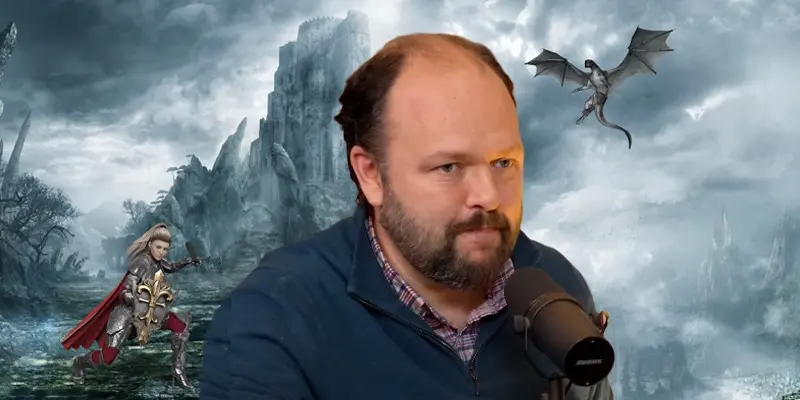
Now, that Tolkien-esque inclination is taking tangible, printed form. For those unfamiliar with the expansive lore that Douthat has quietly cultivated, The Falcon’s Children plunges readers into a densely layered geopolitical and historical landscape complete with intricate nomenclature, regional conflicts, and theological underpinnings. The narrative ecosystem features elements like the Emperors of Narsil, the Mandoran Invasion of Brethony, the Skalbard Coast, Cranholt on the Mersana River, and fictional historiography such as Pharazel Maheris’s Lives of the Great Viceroys.
True to the traditions of classic epic fantasy, the project does not skimp on supplemental world-building documentation. Aspiring travelers into Douthat’s fictional universe can explore extensive lore drops, including deep dives into the history of the Narsil Empire, notes on the Nine Archangels, and, naturally, a hand-drawn map of the realm—because, as any veteran of the genre might argue, a fantasy world is hardly legitimate until it is accompanied by cartography. Those curious about the tone and prose style can already sample snippets of the narrative, including the opening chapter, which is available to read for free online.
However, the transition from Substack serialization to traditional print has not been without its early hurdles and critical skepticism. When the opening pages of the project first surfaced, they received a notably chilly reception from literary critics. Writing for Slate back in 2023, book critic Laura Miller reviewed the novel’s introductory chapters and expressed deep reservations about the prose and execution, remarking bluntly that if the rest of the book matched the opening chapter, it required a comprehensive top-to-bottom rewrite.
Beyond literary critiques, Douthat’s broader professional trajectory has also undergone significant shifts. The author recently concluded his long-running role as a columnist at the New York Times op-ed page, transitioning away from the newspaper of record to join Bari Weiss’s media venture. This career move has placed him in new journalistic waters, prompting cultural commentators to compare his evolving public persona to a modern-day, politically aggrieved equivalent of Andy Rooney—albeit one more preoccupied with theological debates, institutional decline, and modern shifts in religious authority.
The publication of The Falcon’s Children through Word on Fire’s Luminor imprint also highlights an ongoing conversation about the state of contemporary Christian and Catholic fiction. While the release offers a high-profile entry point for readers seeking explicitly faith-aligned speculative fiction, it arrives in a literary landscape already towering with monumental works by foundational giants like J.R.R. Tolkien and C.S. Lewis. Critics of contemporary genre trends often question the necessity of reinventing the wheel when centuries of rich imaginative literature already exist within both secular and sacred traditions.
For readers interested in exploring spiritual depth, imaginative prose, and thoughtful Christian reflection without stepping into the realm of dense, politically charged fantasy epics, literary critics often point toward alternative voices. The poetry and reflective essays of Christian Wiman—found in works such as My Bright Abyss and Zero at the Bone—offer deeply human, open-hearted explorations of faith, suffering, and existential inquiry. Similarly, classic speculative milestones such as Ursula K. Le Guin’s Earthsea series continue to stand as benchmarks for complex, beautifully realized world-building that resonates across generations.
As The Falcon’s Children prepares to make its way from digital newsletters to physical bookshelves, it remains to be seen how a broader audience of readers, fantasy enthusiasts, and political observers will receive Douthat’s ambitious literary experiment. Whether the novel finds a permanent place on the shelves of fantasy lovers or remains a niche curiosity for dedicated followers of the author’s commentary, the project underscores a persistent desire among contemporary thinkers to build alternative worlds on the page.