
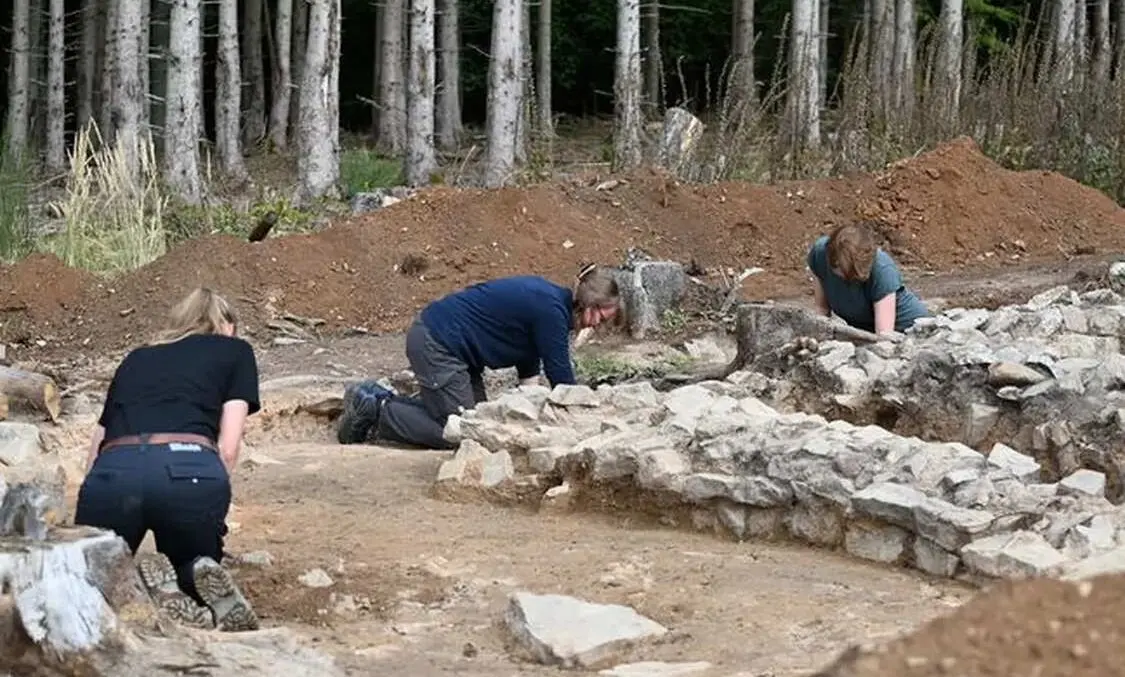
The exciting discovery was made along the Upper Germanic-Rhaetian Limes, a sprawling 342-mile fortified border that once stretched from the Rhine to the Danube rivers, marking the absolute limits of Rome’s military might and cultural expansion. Designated a UNESCO World Heritage Site in 2005, the limes have long been a fertile ground for historical research, yielding dozens of significant archaeological treasures over the decades.
However, the recent finds at Kapersburg—a Roman fort nestled in the picturesque foothills of the eastern Taunus Mountains—stand out for their exceptional preservation. Since 2024, state archaeologists from Hesse, working alongside researchers from the University of Frankfurt, have been meticulously excavating the site to piece together its rich history.
According to researchers, the unique geographic context of the site has played a crucial role in safeguarding its antiquities for nearly two millennia. Unlike many archaeological sites across Europe that have been repeatedly churned up by centuries of intensive farming and modern development, Kapersburg has remained largely undisturbed beneath a dense canopy of trees.
“We have conservation layers here that are otherwise unparalleled in Hesse, because no agriculture has passed over them,” explained Dr. Kai Mückenberger, a state archaeologist who serves as the Limes Coordinator, in a translated statement. “The forest has preserved everything over the last few centuries and largely preserved it for us in such a way that we find layers that are otherwise always gone.”
Most recently, the Hessian archaeological team turned their attention to the civilian and support settlement attached to the fort, known as a vicus. Inside this military camp, researchers successfully mapped the complex floorplans of ancient living quarters, specialized craft centers, and a prominent temple that experts now believe was dedicated to Mars, the Roman god of war.
The newly uncovered temple measures approximately 16 feet in length and features a classic rectangular design. At its structural heart lies a smaller, three-walled inner room, known as the cella, where sacred rituals and worship would have taken place. Inside this sacred space, archaeologists recovered inscriptions that explicitly reference Mars. Furthermore, the excavation brought to light delicate fragments of a statue depicting Victoria, the Roman goddess of victory, recognizable by her carved wings and traditional laurel wreath.
In Roman culture, Mars and Victoria were frequently worshipped side-by-side. While their veneration was widespread throughout the empire, this pairing held special significance for military personnel stationed on volatile frontiers, where battlefield success and protection were matters of daily survival.
The architectural layout and artifacts recovered from the temple also capture the remarkable longevity of Kapersburg. Constructed during the reign of either the Emperor Trajan or his successor Hadrian, the fort successfully held the northern frontier for roughly 150 years. For much of this period, the defense of the outpost relied heavily on the strength and dedication of a specific military unit known as the Numerus Nidensium.
The designation “Nidensium” refers back to a nearby, larger Roman settlement called Nida, the remains of which eventually evolved into the modern-day Heddernheim quarter of Frankfurt. Historical estimates suggest that the Numerus Nidensium likely comprised around 160 soldiers. Meanwhile, the adjacent vicus would have bustled with activity, hosting an estimated 700 support staff, merchants, tradespeople, and camp followers who sustained the garrison.
Beyond the religious and military structures, the excavations have shed light on the dynamic evolution of the settlement before its eventual abandonment in the third century. The team uncovered extensive physical evidence of bustling craft activities, including the precise footprint of an ancient blacksmith’s shop. Additionally, researchers found fascinating architectural proof that the Romans dynamically reshaped their environment over time, at one point deliberately leveling a portion of the camp village to clear the way for newer residential developments.
As the collaborative project between Hessian state archaeologists and the University of Frankfurt continues, these pristine forest layers promise to yield even more secrets about the men and women who lived, worked, and worshipped at the edge of the Roman world.