
At the time, Kim had no inkling that her loyal companion was attempting to sound the alarm on a life-threatening medical emergency unfolding quietly within the infant’s tiny body. It was only after Alexander subsequently grew visibly upset, appeared unwell, and began acting out of sorts that his mother decided to trust her instincts—and the frantic cues of her dog—prompting a rushed trip to the hospital that ultimately saved the baby boy’s life.
Upon arrival at the emergency room, medical professionals examined the infant and discovered a staggering reality: Alexander was suffering from a dangerously rapid heart rhythm, with his pulse racing at an alarming 280 beats per minute.
Reflecting on the harrowing experience, Kim recalled how the Doberman’s acute perception made all the difference. “Saraya knew his heart rate was higher than it should’ve been. She sensed it,” the Somerset mother said. “I had no idea. I dread to think what would have happened if I just put him in the cot and walked away.”
At the hospital, the medical team worked swiftly to stabilize the infant. It required three separate doses of medication to finally bring Alexander’s dangerously fast heart rate down to a safe level. Once stabilized, the family was transferred by ambulance to a specialized facility for further observation and testing.

Following two intensive days in the hospital, doctors delivered a definitive diagnosis: Alexander was suffering from Wolff-Parkinson-White (WPW) syndrome. The congenital condition involves an extra electrical pathway in the heart, causing rapid heart rates. While manageable and generally not dangerous if properly diagnosed and treated, left completely untreated, the condition can potentially prove fatal.
During the initial emergency room visit, Kim had briefly worried that she might be wasting the medical staff’s time, especially because Alexander had temporarily stopped crying by the time they walked through the doors. However, her underlying anxiety—fueled entirely by Saraya’s relentless determination—kept her pushing for answers.
“It was bugging me that Saraya was trying to tell me that something wasn’t right,” Kim explained. “It certainly added to my concern, and made us go in to get checked.”
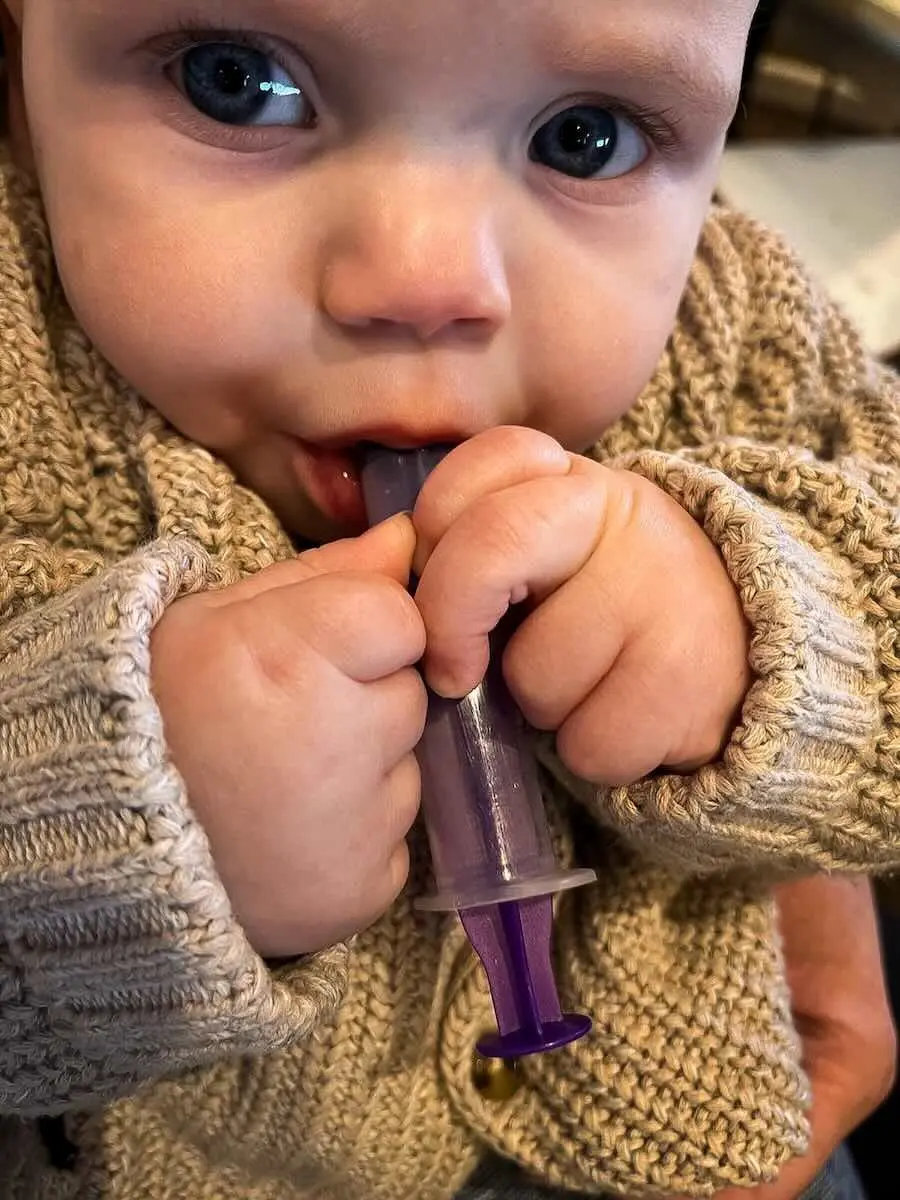
Now nine months old, Alexander is managing his condition under a regular treatment plan. He takes the beta blocker propranolol orally three times a day to keep his heart rhythm stable. According to his mother, the baby has adapted remarkably well to the routine, already recognizing that the medication helps him feel better. Kim noted that Alexander now drinks the liquid directly from the oral medicine syringe himself, completely hassle-free.
The Doberman Then Diagnosed a Second Problem
Just when the family thought they had weathered the worst of their medical scares, Saraya proved her protective instincts extended beyond a single incident. Earlier this month, the vigilant pooch once again began displaying distinct behavioral changes whenever she was near Alexander.
“He was in his bouncer and she was next to him, licking his hands, looking at me,” Kim described. “My first thought was, ‘Oh God, are we going to go into SVT again?’”

Recalling the terrifying episode months prior when her son suffered from supraventricular tachycardia, Kim immediately sprang into action. She carefully checked the infant’s pulse and inspected him closely. While his heart rate appeared steady this time, she noticed that his throat looked visibly red and inflamed. Acting on her renewed trust in the dog’s intuition, she packed up the baby and headed straight back to the hospital.
Medical examinations at the facility confirmed Saraya’s suspicions once more. Doctors diagnosed Alexander with bacterial tonsillitis and promptly prescribed a course of penicillin to clear up the infection.
The repeated medical alerts have completely transformed Kim’s perspective on her pet. “Now, I 100% trust Saraya,” she stated. “She’s not trained or a registered assistance dog, but every opportunity I have, she will be by his side.”
Looking back on the tumultuous months since Alexander’s birth, Kim emphasizes the importance of sharing their story to help educate other parents about hidden infant health conditions. She points out that the congenital heart issue had completely slipped through the cracks during routine checks.
“It’s been a whole experience. It’s really important to raise awareness. You wonder how many babies have SVT and don’t realize,” Kim noted. “I’d never heard of the syndrome—and it wasn’t picked up at birth or at previous hospital visits.”