

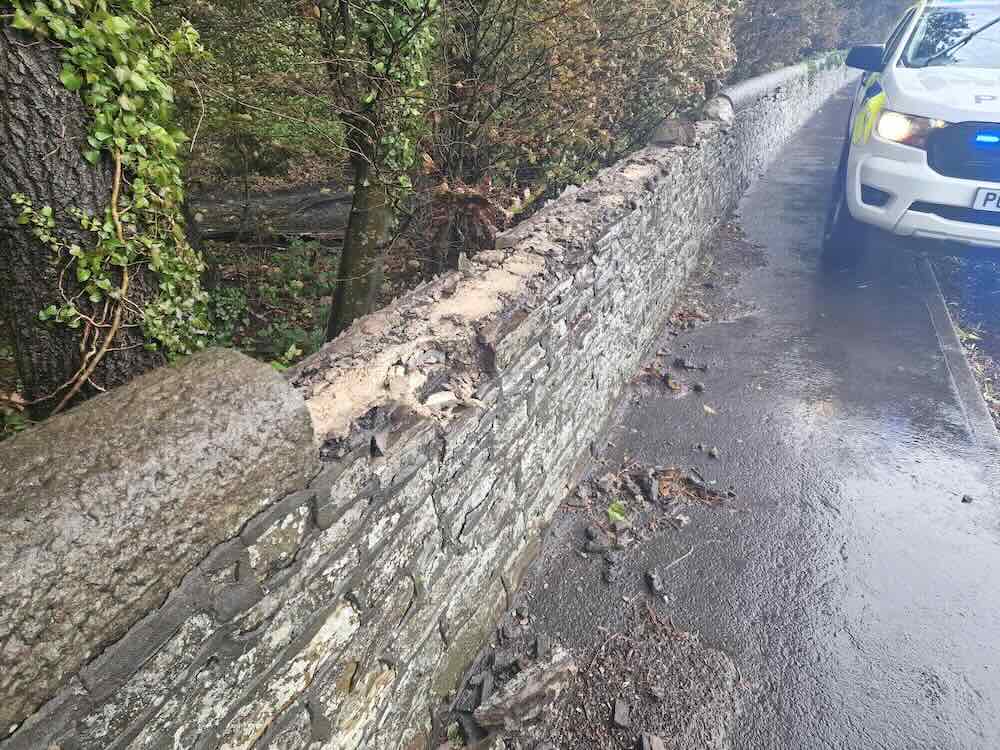
When a wave of mysterious thefts began plaguing a quiet English village, local authorities found themselves at a standstill. Over a period of several months, approximately 30 historic capstones—dating back nearly three centuries—were systematically looted from an 18th-century stone wall running alongside a half-mile stretch of road leading into Rufford, Lancashire. Faced with local police departments struggling to pursue leads due to a lack of closed-circuit television coverage and forensic evidence, a local official decided to channel his inner detective.
Councillor Matt Smith, alongside other concerned residents of the small hamlet, chose to take matters into their own hands rather than tolerate the gradual erosion of their community’s history. Employing a mix of modern consumer technology and clever resourcefulness, Smith planted an Apple AirTag inside one of the remaining loose capstones. His hope was straightforward: if the stone were targeted by the thief, the internal GPS tracker would broadcast the perpetrator’s exact location straight to his smartphone.
The strategy worked brilliantly, culminating in the recovery of thousands of pounds worth of stolen heritage material, the arrest of a suspect, and a stern reminder of the lengths to which communities will go to protect their local history.
The ordeal for the residents of Rufford began in May, when villagers first noticed that sections of the ancient stone boundary had been dismantled and stones were missing. For a community deeply connected to its architectural landscape, the brazen thefts felt like a personal violation. Further raids followed in quick succession, with additional stones vanishing during subsequent incidents in June and October.
The wall itself holds significant historical importance to the area. It is believed to have been constructed around 1730 to enclose the grounds of the historic Grade II-listed Rufford New Hall. Over the centuries, the estate transitioned through various uses, serving as a hospital during the 1900s before eventually being converted into private residential apartments. The wall remained a steadfast landmark framing the approach to the village, until criminals began targeting it for its valuable, weathered stone.

Frustrated by the ongoing vandalism, local residents initially tried traditional deterrent methods. They posted homemade signs warning potential thieves that the area was under surveillance, reading, "Smile, you’re on camera." However, the bluff failed to deter the criminal, who returned undeterred. Residents briefly considered installing a private CCTV system to monitor the half-mile stretch of road, but ultimately dismissed the idea because the equipment proved to be far too expensive for the small hamlet to finance independently.
Following a third targeted raid in early October, Matt Smith—who works professionally as a landscaping contractor running M.Smith Gardens & Landscapes—decided to escalate the response. Drawing on his practical knowledge of stone and landscape work, the 43-year-old local official identified a loose coping stone still resting on the wall, discreetly concealed an Apple AirTag within it, and waited.
"The audacity of him to steal from the community for his own personal gain," Smith reflected, noting the frustration shared by his neighbors. "That isn’t what we stand for."
The waiting period did not last long. Within weeks of planting the tracker, Smith woke up to automated notifications pulsing from his mobile phone. The digital alerts revealed that the rigged stone had been physically moved overnight, and the live GPS tracking data plotted a clear course away from Rufford. Acting swiftly on the intelligence provided by the tracker, Smith contacted Lancashire Police and passed along the precise geographic coordinates of the stolen property.
Law enforcement officers executed a search at a residential property in Manchester, where they discovered a 41-year-old man who was subsequently arrested and sentenced in connection with the thefts.
Upon arriving at the scene, police recovered a substantial quantity of coping stones originating from the vandalized Rufford wall. While initial estimates placed the value of the recovered local stones at approximately £7,000, or roughly $9,300, Smith revealed that the scope of the operation turned out to be much larger. According to the local councillor, investigators found dozens of additional stones gathered from various other locations across the country, pushing the estimated total value of the recovered materials to an astonishing £40,000.
For Smith and the residents of Rufford, seeing the perpetrator caught and held accountable provided a deep sense of validation. Despite the unconventional methods required to crack the case, Smith noted that the community’s collective effort was well worth the trouble, bringing a satisfying conclusion to months of anxiety over the disappearing landmark.
"It was a great feeling to know we had found the man responsible," Smith said. "I’m glad we stood up, and didn’t just tolerate it."
Heritage preservation experts have since praised the successful outcome of the grassroots investigation, highlighting the crucial partnership between everyday citizens and law enforcement in safeguarding antiquities. Mark Harrison, Head of Heritage Crime at Historic England, emphasized the broader implications of the community’s vigilance.
"The successful return of these historic coping stones demonstrates the important contribution that local communities and the police can make to safeguard our heritage," Harrison stated. "Traditional stone walls are an intrinsic part of the Lancashire landscape and their protection helps to maintain its distinctive character for future generations."
With the stolen stones safely recovered and restoration work underway to rebuild the gaps in the 300-year-old barrier, the village of Rufford has reclaimed a vital piece of its historical identity, thanks to a resourceful councillor, a tiny tracking device, and a community that refused to let its history be quietly carted away.