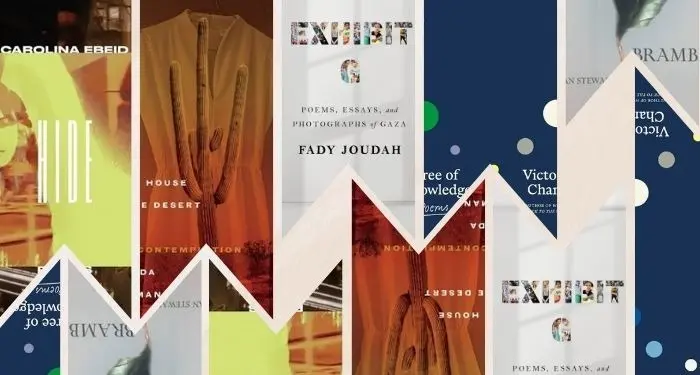
Among the most closely watched divisions is the poetry category, which showcases five distinct collections that explore the depths of human emotion, historical trauma, ecological consciousness, and personal ancestry. The five books named to the shortlist for the 2026 National Book Award for Poetry reflect a diverse array of poetic forms and lyrical approaches, capturing the attention of critics, fellow authors, and the National Book Awards committee alike.

Tree of Knowledge by Victoria Chang
Published by Farrar, Straus and Giroux, Victoria Chang’s Tree of Knowledge has drawn significant critical acclaim for its vibrant imagery and profound conceptual weight. Critics have frequently compared the collection’s artistic impact to the visionary works of artist Hilma af Klint. The Cincinnati Review noted that "like af Klint’s artworks, Chang’s poems are vibrant and conceptually deep," highlighting the collection’s striking visual and intellectual resonance.
Furthermore, Mother Jones observed the masterful balance struck throughout the volume, noting that "Chang writes in both absolutes and inquiries as she artfully taps into what it means to be human while parsing through both personal and collective histories." Through her precise lyricism, Chang navigates the delicate intersections of individual memory and broader societal narratives, establishing Tree of Knowledge as a standout contribution to contemporary verse.
Hide by Carolina Ebeid
Carolina Ebeid’s Hide, published by Graywolf Press, offers a profound exploration of identity, lineage, and geographic displacement. The collection masterfully bridges multiple languages and cultural traditions, interweaving American English, Palestinian Arabic, and Cuban Spanish. According to the National Book Awards committee, Ebeid utilizes this linguistic multiplicity "as she excavates memories—of her Palestinian father and Cuban mother’s forced migrations—in order to reconstruct her own ancestry and chart her path forward."

This intricate excavation has resonated deeply with literary critics as well. Publishers Weekly praised the collection as one that "adds up to a memorable and skillful excavation of identity and inheritance," recognizing Ebeid’s ability to translate complex familial and historical traumas into deeply evocative and resonant poetry.
Still House in the Desert: An eco-contemplation by Brenda Hillman
In Still House in the Desert: An eco-contemplation, published by Wesleyan University Press, acclaimed poet Brenda Hillman brings a sweeping four-part poetic project to its breathtaking conclusion. The National Book Awards committee highlighted the significance of the release, noting that "Brenda Hillman concludes her masterful quartet about time with an ecological journey into a family home of the mid-20th century."
Set against the backdrop of the desert landscape and domestic spaces, the collection merges environmental awareness with intimate reflection. The committee added that within the book’s pages, "magical poems explore rooms as opportunities for dream, and domestic objects as the dream-shapes where culture and imagination inform each other," showcasing Hillman’s enduring mastery of eco-poetics and temporal exploration.

Exhibit G: Poems, Essays, and Photographs of Gaza by Fady Joudah
Fady Joudah’s sixth collection, Exhibit G: Poems, Essays, and Photographs of Gaza, published by Milkweed Editions, stands as a groundbreaking multimedia work that directly engages with contemporary history. Writing for Lit Hub, critic Bilal Urick observed that "Fady Joudah’s Exhibit G is among the first of its kind," describing the multimedia poetry collection as being "assembled in the diaspora, and yet, across form, content, and voice, never anywhere but Gaza—charts Palestinian life under genocide."
Joudah’s stylistic approach has also received widespread praise from literary reviewers. The L.A. Review of Books commended the volume, stating that Joudah’s work is "animated by repetition and contradiction, [and] is stunning in its refusal to indulge categorical imperatives." By combining poetry, essays, and photography, the collection forces an unflinching confrontation with reality, grief, and survival.
Bramble by Susan Stewart
Rounding out the poetry shortlist is Bramble by Susan Stewart, published by the University of Chicago Press. The National Book Awards committee praised the collection for its rich intertextual framework, noting that the book "evokes ballads, fairy tales, and the biblical book of Judges in a three-part contemplation on contradiction, entanglement, and struggle."

Stewart’s work delves into the complexities of personal suffering and evolutionary change, seamlessly translating an internal philosophical inquiry outward. As the National Book Awards noted, the collection succeeds in "exploring personal suffering and change, applying that philosophy to the world around us," making it a vital and contemplative addition to the year’s slate of finalist titles.