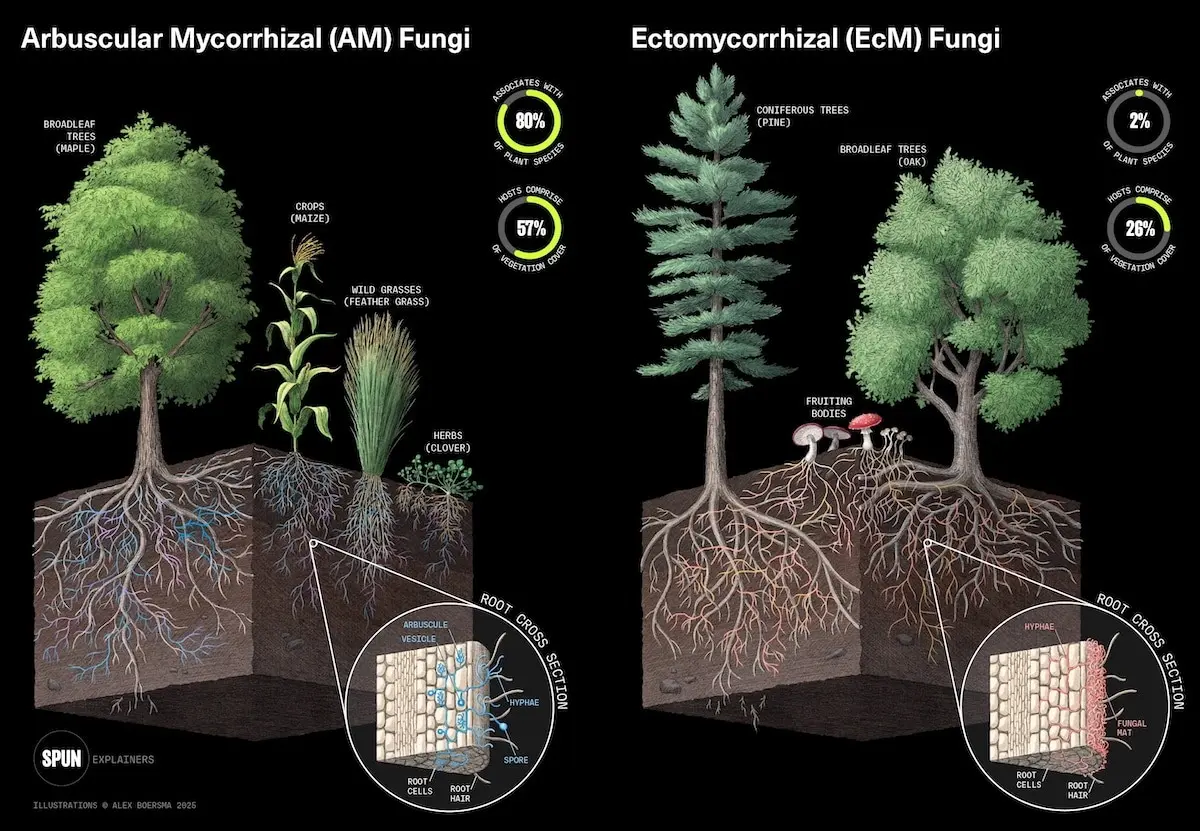
The alarming finding suggests that the very foundations of global plant health, soil regeneration, and carbon sequestration are dangerously exposed to human-driven disruption, agricultural expansion, and climate change. Scientists warn that failing to safeguard these subterranean ecosystems could accelerate biodiversity loss, hinder carbon emission reduction goals, and severely weaken the resilience of forests and agricultural lands against extreme weather events.
The Planetary Circulatory System Hiding Beneath Our Feet
Mycorrhizal fungi operate as a vital planetary circulatory system, forming vast, unseen webs beneath the soil that intertwine with plant roots. Through this symbiotic relationship, fungi deliver essential nutrients and water to plants while receiving photosynthesized carbon in return. According to SPUN, these underground networks draw more than 13 billion tons of carbon annually into the soils, accounting for roughly a third of all global fossil fuel emissions.
Dr. Toby Kiers, executive director of SPUN, emphasized the foundational role these organisms play in Earth’s history and modern survival. "When we disrupt these critical ecosystem engineers, forest regeneration slows, crops fail, and biodiversity above ground begins to unravel," Dr. Kiers said. She noted that approximately 450 million years ago, plant life did not exist on land; it was through the colonization of these mycorrhizal fungal networks that plants were able to take root, eventually paving the way for the development of complex terrestrial life and human existence. "If we have healthy fungal networks, then we will have greater agricultural productivity, bigger and beautiful flowers, and can protect plants against pathogens," she added.
Despite their critical importance in regulating global nutrient cycles and climate stabilization, mycorrhizal fungi have historically been overlooked in mainstream conservation agendas, international climate strategies, and large-scale restoration efforts. Conservationists argue that this widespread oversight—often described as "fungus blindness"—has left critical underground habitats vulnerable to environmental degradation.
Mapping the Subterranean World for the First Time
To better understand the distribution of these vital organisms, researchers utilized a massive dataset comprising over 2.8 billion fungal sequences gathered from 130 countries. By analyzing this vast repository of genetic information, scientists were able to construct high-resolution, predictive biodiversity maps illustrating the global distribution of underground mycorrhizal fungal communities.

This research represents the first large-scale scientific application of SPUN’s world-mapping initiative, which was originally launched in 2021. Prominent advisors supporting the initiative include conservation icon Jane Goodall, authors Paul Hawken and Michael Pollan, and Fungi Foundation founder Giuliana Furci.
"For centuries, we’ve mapped mountains, forests, and oceans. But these fungi have remained in the dark, despite the extraordinary ways they sustain life on land," Dr. Kiers stated. "This is the first time we’re able to visualize these biodiversity patterns—and it’s clear we are failing to protect underground ecosystems."
The newly released maps highlight several unique and highly concentrated fungal communities across the globe, including West Africa’s Guinean forests, Tasmania’s temperate rainforests, and Brazil’s Cerrado savanna. However, the data reveals a stark conservation gap: only 9.5 percent of global fungal biodiversity hotspots currently fall within existing protected areas.
"For too long, we’ve overlooked mycorrhizal fungi," said Dr. Merlin Sheldrake, impact director at SPUN. "These maps help alleviate our fungus blindness and can assist us as we rise to the urgent challenges of our times."
Guiding the Future of Conservation and Ecosystem Restoration
Published under the title "Global hotspots of mycorrhizal fungal richness are poorly protected," the study aims to provide policymakers, legal experts, and conservation groups with the empirical data needed to make informed decisions regarding land use and environmental protection.
Dr. Michael Van Nuland, lead data scientist at SPUN and lead author of the study, stressed that the newly developed maps serve as more than just academic instruments. "These maps are more than scientific tools—they can help guide the future of conservation," Dr. Van Nuland noted. "Food security, water cycles, and climate resilience all depend on safeguarding these underground ecosystems."

SPUN’s leadership envisions a future where subterranean biodiversity data becomes as fundamental to environmental decision-making as satellite imagery is today. The platform enables decision-makers to search for underground ecosystems predicted to host unique, endemic fungal communities, opening up new possibilities for establishing designated underground conservation corridors.
Furthermore, these high-resolution maps are expected to play a crucial role in the ecological restoration of degraded lands. Historically, environmental restoration efforts have focused predominantly on aboveground flora, occasionally resulting in incomplete or unsuccessful recovery projects.
"Restoration practices have been dangerously incomplete because the focus has historically been on life aboveground," explained Dr. Alex Wegmann, a lead scientist at The Nature Conservancy. "These high-resolution maps provide quantitative targets for restoration managers to establish what diverse mycorrhizal communities could and should look like."
Expanding Global Research and Sampling Efforts
To continually refine and expand these predictive models, an international network of nearly 400 scientists and 96 field researchers, known as "Underground Explorers," are actively sampling remote and previously unmapped underground ecosystems across approximately 80 countries. Expeditions span challenging environments in regions such as Bhutan, Mongolia, Ukraine, and Pakistan.
Although current sampling covers only a tiny fraction of the Earth’s surface, SPUN’s expanding database already catalogs more than 40,000 physical specimens representing an estimated 95,000 mycorrhizal fungal taxa.
As researchers continue to decode the hidden complexities of the soil microbiome, scientists emphasize that immediate action is required to bridge the gap between aboveground conservation policies and the subterranean networks that sustain them. "These maps reveal what we stand to lose if we fail to protect the underground," Dr. Kiers concluded.