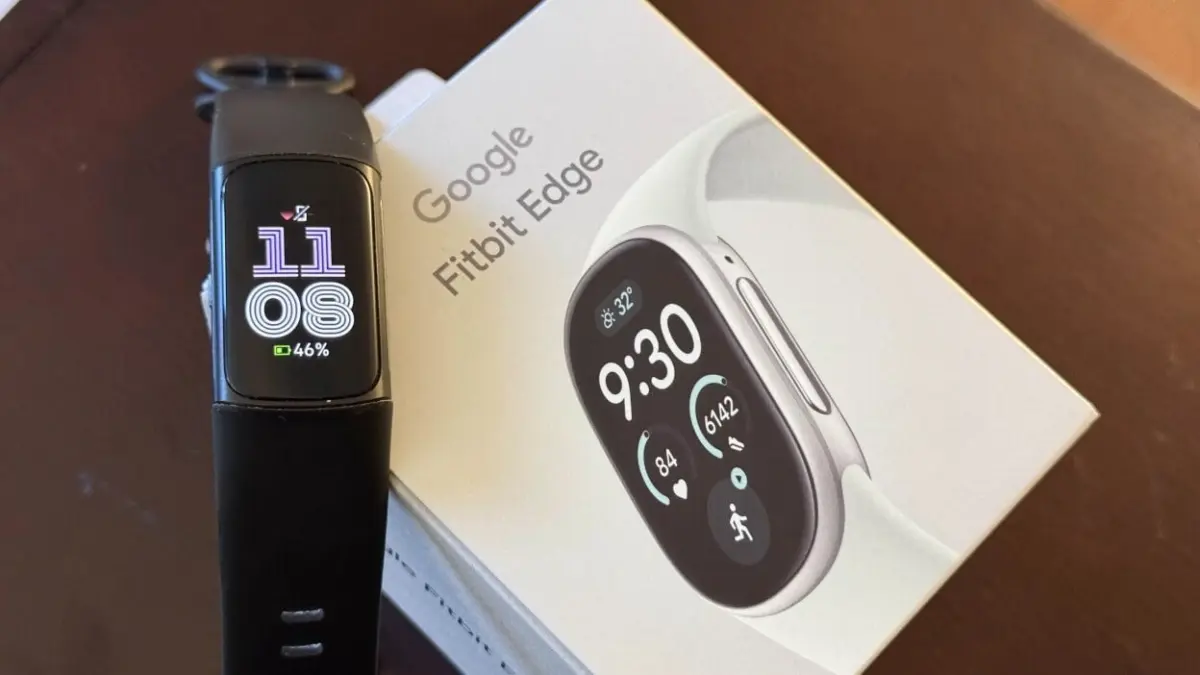
Evaluating the differences reveals a shifting hardware philosophy at Google, which owns the brand. The Edge positions itself carefully within the modern wearable ecosystem, sitting neatly between the screenless Fitbit Air and the smooth, curved glass of the Pixel Watch. Running on the same operating system software as the Fitbit Air—a platform that differs slightly from the dedicated software powering Pixel watches—the Edge maintains broad compatibility by pairing seamlessly with both iOS and Android smartphones. To understand whether the new device is a worthy successor, it helps to examine the specific hardware additions Google has introduced alongside the features left on the cutting room floor.
The Fitbit Edge Has a Real Side Button
One of the most immediate physical changes becomes apparent the moment you take the device out of the box. Early review units dispatched to tech journalists confirm that the Fitbit Edge incorporates a genuine, physical button on the right side of its casing. Unlike capacitive touch areas or flush surfaces, this mechanical button provides a distinct, audible click when pressed, registering input reliably even when the device is completely powered down.
This represents a notable refinement over the Charge 6, which relied on a haptic touch zone rather than a moving part. On the older model, the haptic "button" often required an exact squeeze that frequently failed to register, leaving users waiting for a vibration response that might never come. By returning to a tactile, mechanical control mechanism, Google has addressed a common point of frustration for users trying to navigate menus mid-workout or with sweaty fingers.
The Fitbit Edge Has an Altimeter and an Allegedly Better GPS Chipset
Beneath the exterior, the Fitbit Edge introduces significant upgrades to its sensor suite, headlined by the inclusion of an altimeter. This hardware component has been absent from Fitbit fitness bands since the Charge 4. By measuring barometric pressure changes, the altimeter enables the device to track altitude accurately and compute the number of "floors" climbed throughout the course of a day. For runners and hikers navigating hilly terrain, this sensor provides a much more precise picture of elevation changes during outdoor workouts.
Both the Charge 6 and the newer Edge feature built-in GPS capabilities, allowing users to track outdoor routes, pace, and distance without needing to carry a smartphone along for the run or walk. (This stands in contrast to the lower-tier Fitbit Air, which lacks onboard GPS and must rely entirely on a connected phone’s location data.) However, the Charge 6’s GPS implementation faced criticism for architectural flaws, such as an antenna layout susceptible to strain if the wristband was fastened too tightly, resulting in distorted and inaccurate route maps. Google asserts that the Fitbit Edge incorporates significantly improved GPS hardware to resolve these tracking anomalies.

The Fitbit Edge Does Not Have Google Pay or NFC Capabilities
Despite these hardware improvements, the transition to the Edge involves at least one major compromise. Most notably, the Fitbit Edge completely drops NFC capabilities and support for Google Pay. On the Charge 6, users could configure Google Wallet to make contactless payments directly from their wrist—a popular convenience for individuals who prefer to leave their wallets and phones behind during a workout but might want to purchase a post-run beverage.
The removal of NFC is likely a design concession made to accommodate other internal components within the compact chassis. Nonetheless, consumers who rely heavily on contactless wrist payments for daily errands or mid-exercise purchases will find the omission to be a substantial downgrade when transitioning from older hardware to the Edge.
The Fitbit Edge Will Be Able to Play Music from Any App, Not Just YouTube Music
On the software and media control front, Google has addressed one of the most persistent complaints leveled against the previous generation. The music controls on the Charge 6 drew widespread frustration because they were strictly locked to YouTube Music. Utilizing that feature required not only a paid monthly subscription to the specific streaming service, but also excluded users who preferred Spotify, Apple Music, or local media libraries.
The Fitbit Edge introduces a more flexible media control framework. According to manufacturer specifications, the new tracker is designed to interface universally with whatever audio source happens to be playing on the user’s paired smartphone, functioning much like standard smartwatches and removing the rigid ecosystem lock-in that hindered its predecessor.
Google Maps Directions Are Unsupported on the Edge—but "Coming Soon"
As the device arrives on store shelves, certain software features familiar to longtime users will not be immediately available. At launch, the Fitbit Edge does not support turn-by-turn Google Maps directions, though official documentation indicates that the functionality is slated to arrive via a future software update.
In practice, the absence of Maps at launch may not deter many buyers, as the mapping implementation on previous fitness bands was often limited to basic directional arrows rather than a comprehensive visual map interface. While users accustomed to viewing navigation prompts directly on their wrists during commutes or runs will need to exercise patience, the planned rollout suggests the feature will eventually bridge the gap between older models and the new hardware.