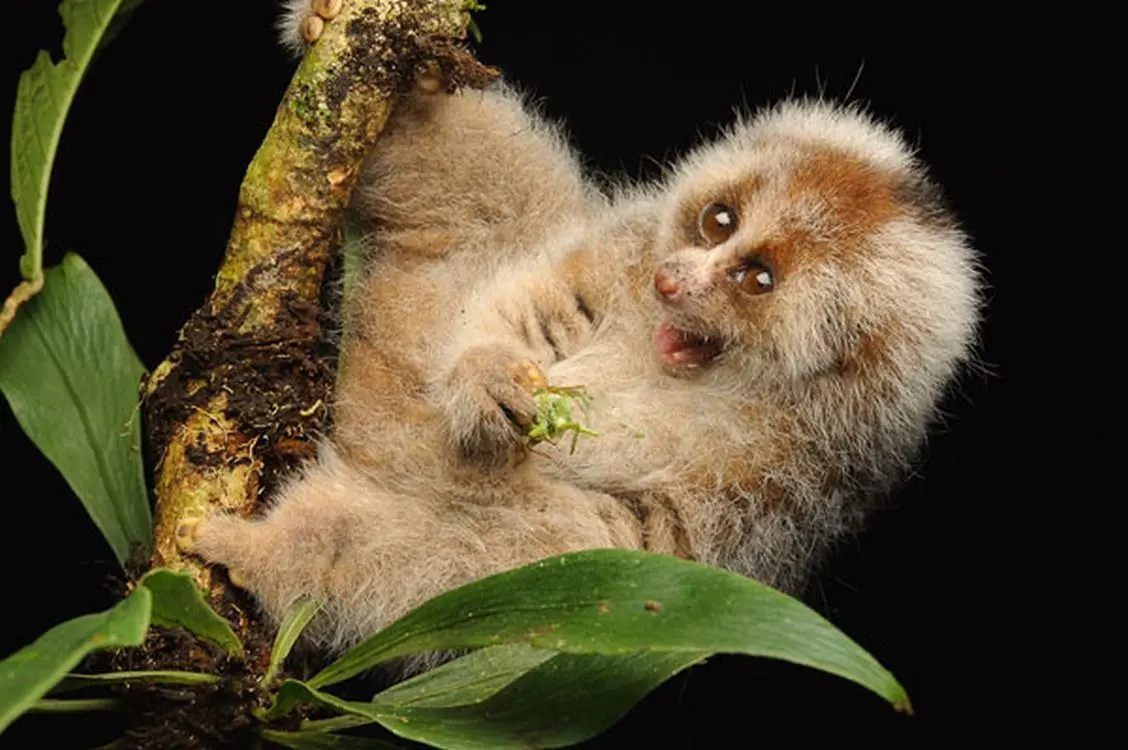
Yet, as a growing body of evidence and recent scientific literature demonstrates, this big-eyed, slow-moving furball is very
much still with us. While academic institutions and international scientists wrote the species off as a ghost of the past, the Bangka slow loris was quietly surviving on its native Indonesian island, shielded from extinction not by elite global research grants or high-tech tracking equipment, but by the dedicated, everyday efforts of a local wildlife rescue organization that had been quietly returning them to the wild for years.
The remarkable reality of the animal’s survival came to light through a newly published scientific paper authored by a team of Austrian scientists working alongside international colleagues. The paper details the fascinating chain of events that led to this long-overdue "rediscovery," proving once and for all that a species can disappear from the rigid confines of the formal scientific record without ever vanishing from the lives of the people who share its island home.
The thread that unraveled the mystery began not in a remote jungle expedition, but within the pages of a 2022 field guide dedicated to the primates of Indonesia. Authored by a researcher named Supriatna, the field guide made specific mention of the Gunung Maras National Park, a small, protected forest situated near the city of Muntok on Bangka Island. Within the text, this specific habitat was highlighted as a known home for the Bangka slow loris, sparking immediate curiosity among researchers who had long accepted the species’ disappearance as a settled biological fact.
Digging deeper, Supriatna’s work cited an unpublished academic thesis written by another scientist, a document that held crucial field data concerning Bangka slow lorises housed and processed at the Alobi Wildlife Rescue Center, a local conservation hub operating directly on the island. Once the international research team turned their attention toward the Alobi Center, the illusion of the animal’s extinction evaporated almost instantly. It became clear through the center’s extensive operational logs that the primate had never actually died out, and that its stubborn persistence had simply gone completely under the radar of the global scientific community.
By carefully examining and presenting the comprehensive data collected by the Alobi Wildlife Rescue Center on Nycticebus bancanus stretching all the way back to 2015, the authors of the new paper demonstrated unequivocally that the Bangka slow loris still exists. Furthermore, the data suggests that the nocturnal primate is likely far more widely distributed across Bangka Island than previously documented in historical literature.
The scope of the rescue center’s work is striking. Between 2015 and 2025, the Alobi Wildlife Rescue Center successfully intercepted and rescued more than 90 individual Bangka slow lorises. Rather than representing a dying population gasping its final breaths, the vast majority of these encounters—86 in total—involved animals that were subsequently rehabilitated and successfully released back into their natural woodland habitats.
In almost every single recorded case, these rescue operations were necessitated by human expansion. As local agriculture, infrastructure, and urban areas encroached further into the island’s natural landscapes, these slow-moving primates inevitably strayed too close to civilization. They frequently ended up displaced in people’s private gardens, agricultural plantations, or stranded dangerously on local roads, prompting concerned residents to alert the wildlife center rather than allowing the animals to perish.
The revelation has prompted broader reflections within the international conservation community regarding how modern science evaluates biodiversity. The study serves as yet another stark reminder that effective conservation efforts are fundamentally dependent on the deep, on-the-ground knowledge of local communities, Indigenous peoples, and regional experts who understand these species and their native landscapes intimately. When formal academic institutions abandon a species on paper, local populations often continue to coexist with them daily. A species can easily vanish from academic journals and museum archives without ever disappearing from the actual homes and backyards of the people who share the land.
Beyond its miraculous survival and the heartwarming efforts of the Alobi Center, the Bangka slow loris commands attention for another extraordinary biological trait: it is one of the very few venomous primates known to science.
While the species maintains an omnivorous diet, foraging quietly through the forest canopy under the cover of night, it possesses a sophisticated and dangerous defense mechanism. The slow loris is capable of secreting a specialized toxin from brachial glands located on its upper arms. When threatened, the animal will deliberately lick these glands, mixing the potent secretion with its saliva. This transforms an ordinary defensive bite into a dangerous, cytotoxic surprise for any predator foolish enough to test it.
The resulting venom rapidly damages and destroys local tissue cells, frequently leading to severe necrosis, excruciating pain, and significantly impaired wound healing in victims. Alongside the closely related pygmy slow loris, this unique evolutionary adaptation makes the Bangka slow loris entirely singular within the primate order. Such a remarkable and specialized animal undoubtedly merits enhanced conservation protection, increased funding, and rigorous regional safeguards to ensure its continued survival.
With its secret finally brought to light on the global stage, the story of the Bangka slow loris stands as a testament to the resilience of nature and the vital importance of grassroots wildlife protection. As researchers and conservationists rally around the findings of the recent study, the future looks considerably brighter for this big-eyed survivor, proving that even after a century in the dark, nature still retains the capacity to surprise us.