Earth Overshoot Day was first launched in 2006 by Andrew Simms, an author, political economist, and campaigner, working in collaboration with the Global Footprint Network. Since that time, the date has been calculated and announced annually. Over the nearly two decades since its inception, the date has consistently crept earlier into the year, serving as a stark indicator of how rapidly human consumption habits are expanding and stripping the planet of its vital resources.
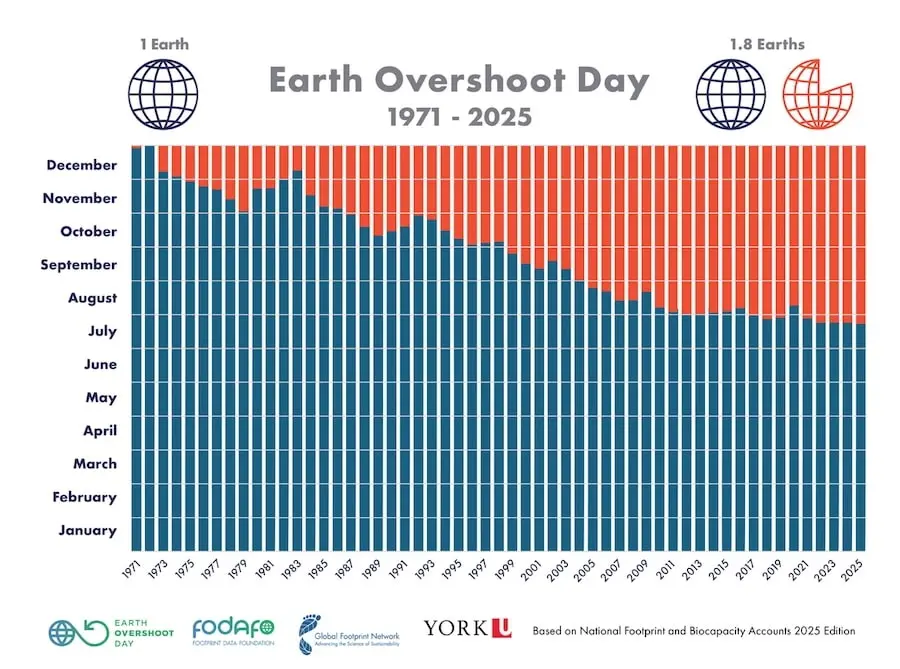
In conjunction with this year’s announcement, the Global Footprint Network undertook a comprehensive recalculation of historical Earth Overshoot Days, extending their analytical models even prior to 2006 to achieve greater scientific accuracy. These updated historical models reveal a dramatic trajectory of ecological deficit over the past several decades.
According to the latest calculations, Earth Overshoot Day fell as late as December 31 in 1972, meaning humanity lived within the planet’s biocapacity for almost the entire year. By 1979, however, the date had crept up to November 3. During the early 1980s, economic shifts and temporary slowdowns caused the date to recede slightly back into early December, but this reprieve was short-lived. By 1989, the date had advanced to October 12.
The threshold remained stubbornly in October throughout the decade, holding steady until 1999, when increased industrialization and globalization pushed the marker to September 25. When Earth Overshoot Day was first officially formalized and announced to the public in 2006, the revised calculations placed the event on August 22.

The acceleration continued into the 21st century. The marker reached July for the first time in history in 2018, before temporarily retreating back to August in 2020 amid pandemic-related economic slowdowns. Since then, however, the date has remained locked firmly in the month of July. The previous earliest record was set on July 25, a threshold crossed in both 2022 and 2023. By hitting this mark on July 24 in 2025, the global community has set a new record, highlighting the widening gap between human demand and the Earth’s capacity to keep pace.
The implications of this trajectory are profound. Currently, humanity is utilizing nature at a rate 1.8 times faster than the planet’s ecosystems can regenerate. This means the global population is effectively consuming the equivalent of 1.8 Earths to support current lifestyles, industrial processes, and economic models. This deficit is driven by the over-extraction of essential natural assets, including freshwater reserves, timber, and seafood populations, all of which are consumed at rates far exceeding their natural replenishment cycles. Furthermore, human societies continue to pump greenhouse gas emissions into the atmosphere at volumes far beyond what terrestrial and marine ecosystems can sequester.
As the Global Footprint Network emphasized in its annual briefing, the danger of depleting resources at this pace lies in its cumulative effect. Even if the calendar date of Overshoot Day were to stabilize from year to year, the ongoing mismatch between consumption and replenishment creates compounding ecological stress. This escalating pressure has brought humanity perilously close to breaching vital ecological thresholds, having already exceeded seven of the nine scientifically defined planetary boundaries that maintain stability on Earth.
Lewis Akenji, a board member of the Global Footprint Network, addressed the gravity of the situation in a public statement accompanying the 2025 data release. He noted that humanity is testing the absolute boundaries of recoverable ecological damage.
"We are stretching the limits of how much ecological damage we can get away with. It is now a quarter into the 21st century and we owe the planet at least 22 years of ecological regeneration, even if we stop any further damage now," Akenji said. He added that securing a viable future requires an unprecedented level of commitment, stating that if humanity wishes to maintain a habitable planet, the scale of current adaptation and mitigation investments must expand dramatically beyond anything seen in historical precedent.
Despite the grim statistics, researchers and campaigners maintain that it is not too late to alter course and steer humanity back toward ecological balance. Moving Earth Overshoot Day back toward the end of the calendar year is entirely possible, provided governments, industries, and societies implement targeted structural changes. These solutions form the core of a campaign organized by the Global Footprint Network known as the Power of Possibility.

Among the most impactful interventions identified by the network is the reduction of global carbon emissions. Cutting global carbon emissions by 50 percent alone would shift the Earth Overshoot Date farther into the year by a full three months, effectively neutralizing the single largest driver of the global ecological deficit.
Additional systemic adjustments offer substantial cumulative relief. For instance, reducing global food waste by half would push the overshoot date back by 13 days. Transitioning to green economic frameworks on a global scale—such as establishing a Green New Deal internationally—could shift the date by 42 days. Meanwhile, accelerating the global energy transition so that at least 75 percent of all electricity is generated from renewable sources would push the date back by an additional 26 days.
Mathis Wackernagel, co-founder and board member of the Global Footprint Network, emphasized that humanity ultimately faces a stark choice regarding how this era of overshoot will conclude. He pointed out that the laws of physics dictate that ecological overshoot cannot continue indefinitely.
"Because of the nature of physics, overshoot cannot last. It will end either by deliberate design or dumped-on disaster," Wackernagel said in his statement. He concluded that choosing a managed, intentional transition should be the obvious preference for global leaders, particularly given the wide array of viable technological and economic solutions already available.