
For countless homeowners, the thought of relinquishing their long-held role as the central family host is enough to keep them anchored to large properties they no longer need or want to maintain. While they may desperately crave the freedom that comes with shedding excessive square footage, lower utility bills, and simplified housekeeping, they harbor a deeper fear that a smaller footprint will inevitably mean fewer family gatherings. Their house has long served as the gravitational center of the family calendar, the permanent fixture where everyone comes back to roost season after season. Letting go of that physical space can carry the heavy emotional weight of letting go of tradition itself.
This concern is entirely valid and deserves a prominent place in any retirement or relocation planning. Whether individuals are setting their sights on the booming tiny home movement, a compact suburban cottage, or an apartment, experts suggest evaluating how holiday hospitality and daily living will function before signing any moving papers. The challenge lies in bridging the gap between a minimalist lifestyle and the desire for maximum human connection, proving that a reduction in physical square footage does not have to spell the end of cherished family customs.
Get Creative with the Table
Transitioning to a smaller space requires a fundamental shift in how furniture is utilized, particularly when it comes to dining. The everyday dining table in a compact home or tiny house simply cannot be expected to seat a large holiday contingent comfortably on a daily basis. Instead, homeowners are discovering the utility of adaptable furniture designs that transform to meet the demands of specific occasions.
Drop-leaf tables and extendable models offer a practical middle ground, remaining compact for daily use while expanding outward when company arrives. Temporary folding tables also remain a staple of holiday hosting, particularly when hosts take advantage of local rental options or borrowed pieces rather than dedicating valuable storage space to bulky furniture all year round. Beyond traditional setups, breaking away from the concept of one long, unbroken table can open up new possibilities. Two smaller tables placed in proximity often fit an unconventional floor plan far more comfortably than a single oversized unit.
Hosts frequently find success by seating an immediate group at the primary kitchen or dining table while establishing a secondary dining area nearby, such as a well-appointed folding table in the living room. Utilizing cohesive tablecloths, matching dinnerware, and simple seasonal decorations across both dining zones helps unify the disparate areas, ensuring that all guests feel included in the central celebration rather than feeling relegated to the children’s table.
Let Your Rooms Do a Different Job for the Day
In a downsized environment, traditional room designations become fluid, allowing multi-purpose spaces to step up during peak holiday hours. The living room, for instance, can easily be reimagined as an auxiliary dining or social hall for an afternoon, provided hosts are willing to temporarily shift coffee tables or reconfigure seating arrangements to open up floor space.
Table space management also requires strategic thinking when the kitchen counters in a tiny home are limited. Rather than crowding the primary dining surface with heavy serving platters, hosts are increasingly turning to kitchen counters, sideboards, or dedicated buffet stations to hold the main meal. This approach leaves the smaller dining tables entirely free for plates, glasses, and personal dining space, ensuring that guests can eat comfortably without constantly dodging serving bowls. When conventional furniture falls short, creative hosts have even utilized sturdy storage bins topped with appropriate coverings or traditional television trays to provide individual guests with convenient surfaces for their plates and drinks.
Take the Celebration Outside When You Can
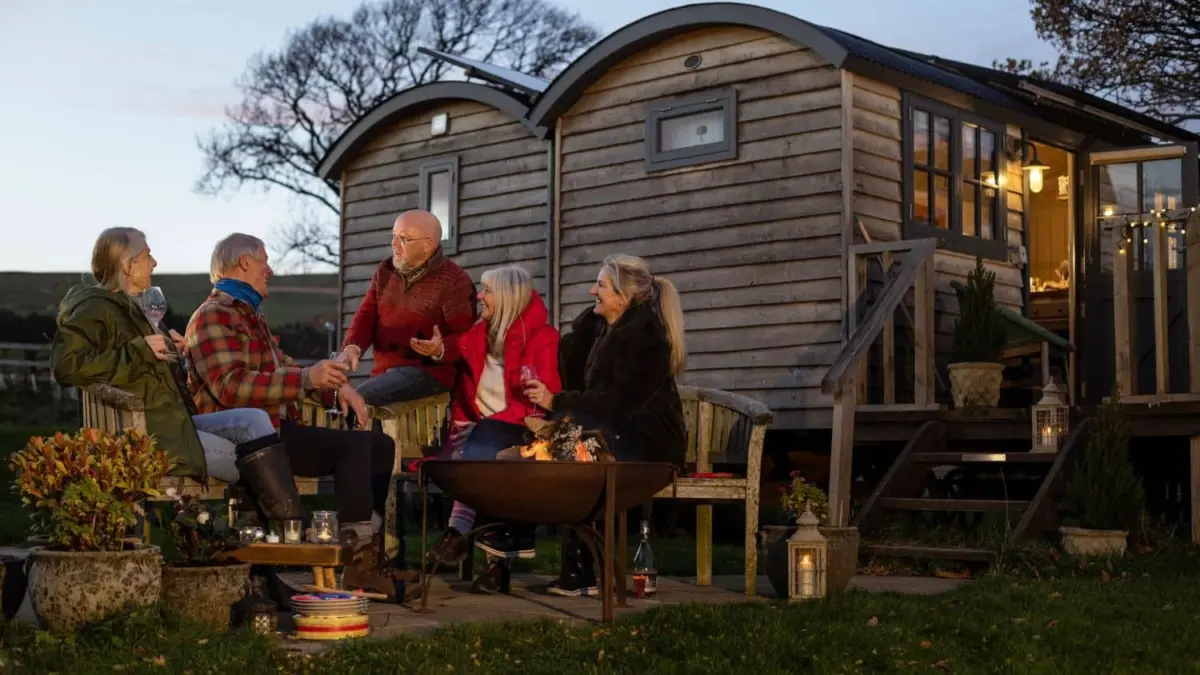
For those who choose a smaller home in regions blessed with mild winter weather, the geographic footprint of the gathering can expand significantly beyond the interior walls. A patio, deck, porch, or even a modest yard can transform into an active extension of a tiny home during a holiday visit.
An outdoor dining setup can comfortably hold the main meal, or the exterior space can be utilized during the initial arrival phase, giving guests a place to enjoy appetizers and catch up outdoors before moving inside for the formal meal. Even in cooler climates, providing a comfortable, weather-proofed seating area for a few people to step outside and visit can drastically alleviate the indoor crowding that often plagues smaller homes.
However, relying on the outdoors requires careful logistical foresight. Seasoned hosts emphasize the necessity of establishing a solid backup plan long before the invitations are sent out. If the success of the gathering relies heavily on favorable weather forecasts, homeowners must determine in advance how they will pivot if rain, wind, or unexpected cold fronts roll in. This might involve setting a strict limit on the number of guests hosted at any single moment, staggering arrival times, or arranging to transition the core activities to an alternative location.
Look Beyond Your Own Front Door
One of the most valuable resources for individuals downsizing into specialized communities is the shared infrastructure right outside their doorstep. For those exploring tiny home communities or cooperative retirement villages, inquiring about shared amenities can completely change the calculus of holiday hosting.
Many modern tiny home communities feature dedicated community rooms, clubhouses, or communal kitchens that residents can reserve for private family gatherings and events. These shared spaces effectively act as an extension of the resident’s private home, providing the square footage, tables, chairs, and kitchen capabilities necessary to host a large family holiday even when the primary residence can comfortably accommodate only one or two occupants.
Before committing to a community, prospective residents are encouraged to ask specific, detailed questions regarding reservation policies, availability during peak holiday seasons, and the exact inventory of tables and kitchen equipment provided. Incorporating these shared community assets into the home search allows downsizers to maintain their hosting ambitions without feeling constrained by the physical walls of their personal dwelling.
Plan Around the Gathering You Love
Ultimately, the decision to downsize should prompt a thoughtful evaluation of what makes holiday traditions truly meaningful. Before calculating square footage requirements, potential movers benefit from auditing their historical gatherings by asking a few fundamental questions about how their family actually celebrates.
Examining typical attendance numbers, the flow of the day—whether guests sit down for a formal, synchronized meal or drift in and out throughout the afternoon—and the division of culinary labor can illuminate what physical space is actually required. For some, the traditional heavy-duty cooking may give way to a collaborative potluck model, while others may find that their scaled-down lifestyle encourages them to focus on intimate, high-quality conversations rather than large, production-heavy dinners.
Downsizing serves as an organic inflection point, offering permission to redesign holiday traditions so they actively fit a new stage of life rather than forcing a new lifestyle to fit an outdated mold. While a holiday gathering may look visually different within a compact or tiny home, the core spirit of hospitality remains unchanged, proving that the person who brings everyone together defines the gathering far more than the size of the house itself.