Published in the journal Nature, a new study details how a team of scientists documented what is now confirmed to be the deepest and most extensive colony of animals ever observed on Earth. Operating the submersible Fendouzhe during an expedition that also explored the Kuril-Kamchatka Trench and the western Aleutian Trench, the research team found that life not only survives in the planet’s most extreme underwater valleys, but flourishes in surprising abundance.
"Hadal trenches, some of the Earth’s least explored and understood environments, have long been proposed to harbour chemosynthesis-based communities. Despite increasing attention, actual documentation of such communities has been exceptionally rare," the authors wrote in their findings. "Here we report the discovery of the deepest and the most extensive chemosynthesis-based communities known to exist on Earth during an expedition to the Kuril–Kamchatka Trench and the western Aleutian Trench using the manned submersible Fendouzhe."
The discovery challenges long-held models of deep-ocean carbon cycling and pushes the boundaries of where scientists believe life can exist. The scientists behind the expedition suggest that given the geological similarities shared among Earth’s hadal trenches, these unique chemosynthesis-based communities may actually be far more widespread than previously anticipated. Lead author Xiatong Peng noted the broader implications of the findings, pointing out that similar hidden ecosystems could exist across other underexplored oceanic abysses.
A Vibrant Oasis in the Deep Sea
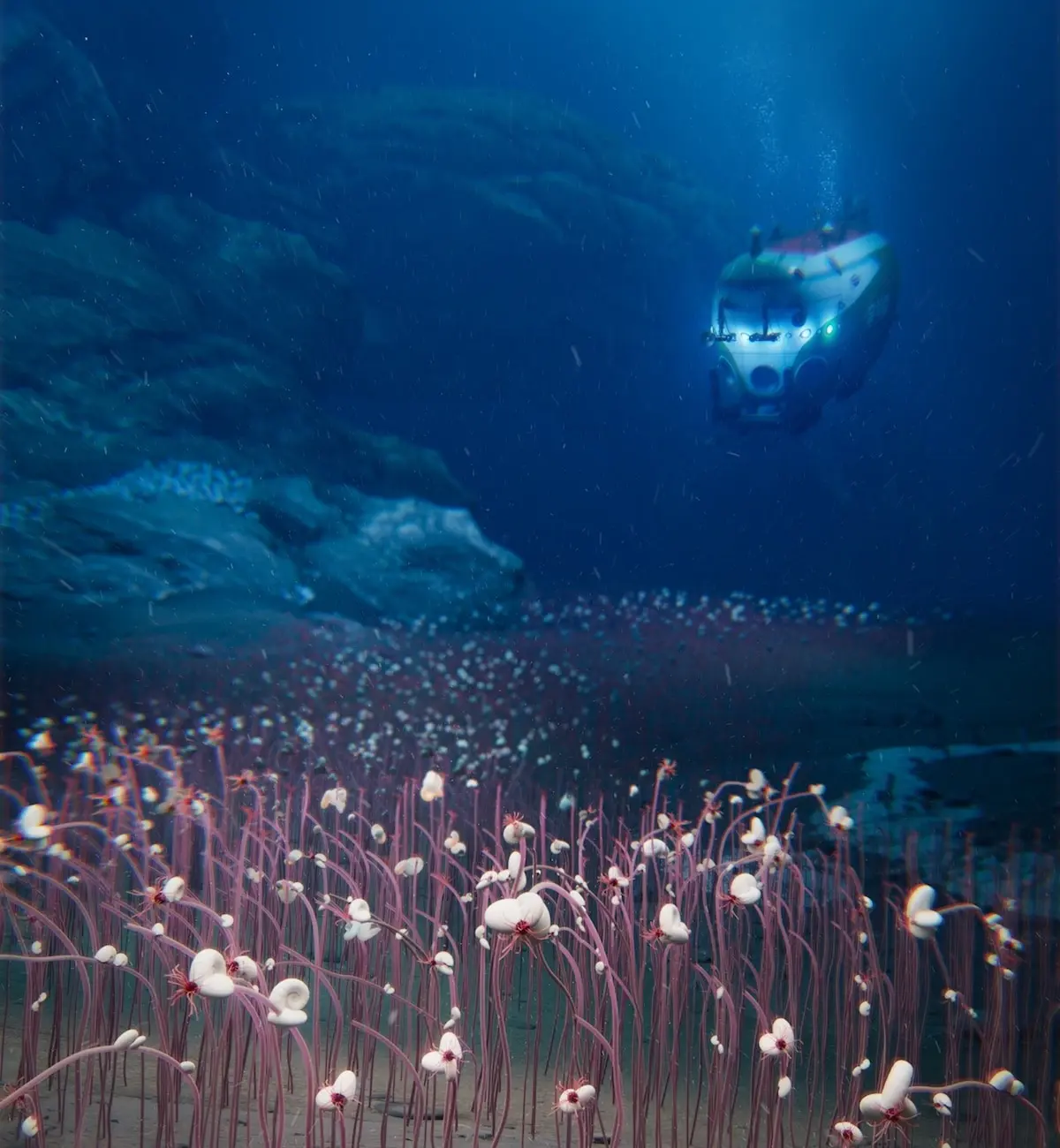
The newly identified communities are composed primarily of siboglinid polychaeta—commonly known as tubeworms—and bivalves spanning a massive distance of 1,553.4 miles at staggering depths ranging from 3.6 to 5.92 miles beneath the ocean’s surface. To put the depth into perspective, the bottom of the Mariana Trench extends even farther down than the height of Mount Everest reaching up into the sky.
At these extreme depths, absolute darkness prevails, meaning no sunlight can possibly penetrate to fuel biological processes. Instead of relying on photosynthesis, the traditional foundation of the marine food web, these creatures subsist entirely on chemicals. They draw vital nutrients from hydrogen sulfide-rich and methane-rich fluids that travel along massive faults traversing deep sediment layers within the trenches. According to isotopic analysis conducted by the researchers, this methane is produced microbially from organic matter that has drifted down from the upper layers of the ocean over vast periods of time.
The Fendouzhe submersible completed 23 dives into the western Pacific’s Mariana Trench last year alone, giving researchers unprecedented visual and physical access to the seafloor. What they captured on camera astonished the scientific community.
"What makes our discovery groundbreaking is not just its greater depth – it’s the astonishing abundance and diversity of chemosynthetic life we observed," said study co-author Mengran Du, a marine geochemist with the Institute of Deep-sea Science and Engineering, part of the Chinese Academy of Sciences. "Unlike isolated pockets of organisms, this community thrives like a vibrant oasis in the vast desert of the deep sea."

Video footage released alongside the study reveals dense fields of tubeworms stretching up to a foot long, accompanied by sprawling mounds of clams and various mollusks. Observers aboard the submersible also recorded free-floating marine worms, spiky crustaceans, delicate sea lilies, sea cucumbers, and a host of other invertebrates navigating the harsh environment. The researchers documented compelling evidence showing that microbes were actively producing methane, with tubeworms showing a distinct tendency to cluster tightly around snow-like microbial mats.
Shifting Paradigms and Conservation Concerns
While previous scientific expeditions had successfully identified communities of single-cell organisms thriving on the abyssal seafloor, finding larger, complex animals in such numbers at these depths has been exceptionally rare. Past discoveries included marine invertebrates like tubeworms living inside hydrothermal vents located 1.24 miles below the floor of the Pacific Ocean within the Earth’s crust, but nothing approaching the scale or depth of the newly mapped hadal communities.
These revelations arrive at a critical global juncture, coinciding with intense international debates over the controversial practice of deep-sea mining. As nations weigh the economic potential of harvesting valuable minerals from the ocean floor, ocean scientists have repeatedly warned that industrializing the seabed could irreversibly devastate fragile marine ecosystems in some of the last truly wild, untouched zones on the planet. Despite ongoing talks, the International Seabed Authority has yet to adopt comprehensive binding rules to govern the emerging industry.
Human exploration of the Mariana Trench remains an elite and rare undertaking. Although the first human explorers briefly visited the bottom of the crescent-shaped trench during a 1960 expedition, only a handful of people have made the harrowing descent in the decades since. Among them was Hollywood director James Cameron, who completed a solo trip to the bottom in 2012, famously describing the alien environment as desolate and otherworldly.
For the researchers who descended in the Fendouzhe, the experience offered a profound connection to an unseen realm.
"Diving in the submersible was an extraordinary experience – like traveling through time. Each descent transported me to a new deep-sea realm, as if unveiling a hidden world and unraveling its mysteries," Mengran Du reflected.
The complete findings of the study, titled "Flourishing chemosynthetic life at the greatest depths of hadal trenches," have been officially published in the journal Nature.