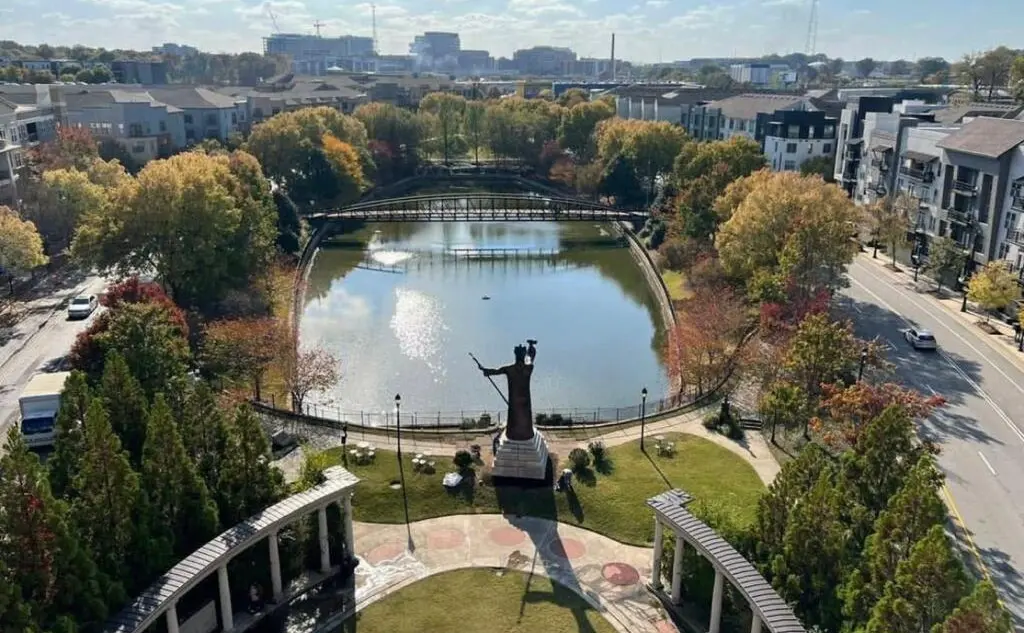
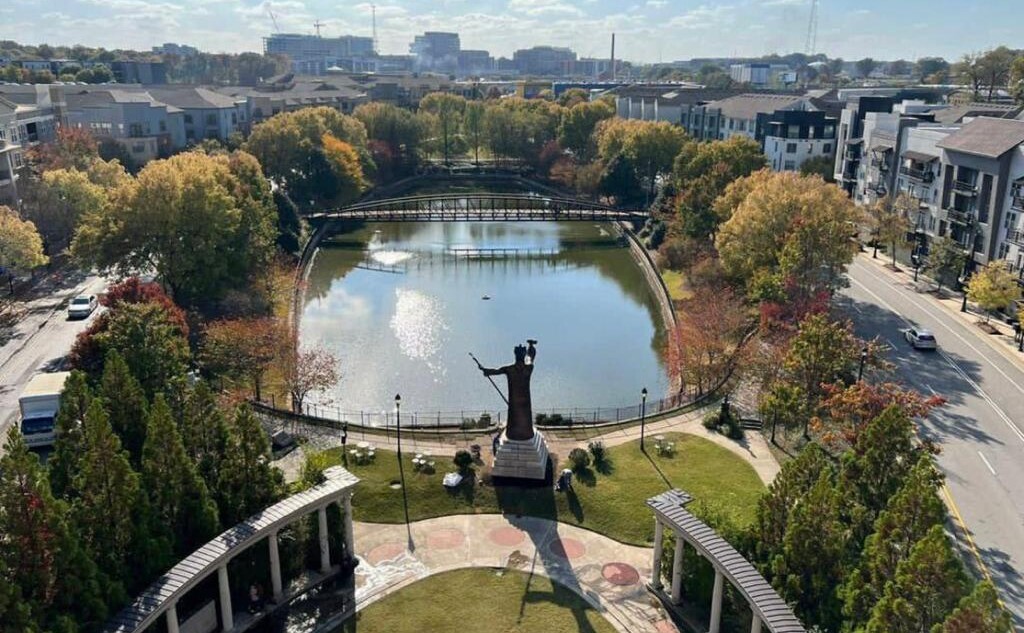
Crews have completed the installation of a striking, 29-foot bronze statue of Cyrus the Great at Pardis Park, cementing its status as one of the largest Iranian monuments outside of Iran. The towering bronze figure alone weighs an impressive 8,000 pounds, a massive scale that does not even account for its elaborate limestone base, which has been meticulously shaped to mirror the architecture of the ancient king’s historic tomb.
This Saturday, the monument will be formally and publicly dedicated during "Iran Unveiled," a free, family-friendly festival designed to celebrate the rich heritage and enduring contributions of Persian culture. The event marks the culmination of a multi-year journey fraught with logistical hurdles, financial strain, and deeply personal motivations, ultimately resulting in a permanent cultural landmark for the city.
Why Atlanta
To understand why a monument to a 2,500-year-old monarch belongs in the capital of Georgia, one must examine the legacy of Cyrus the Great. While he founded the vast Achaemenid Persian Empire roughly two and a half millennia ago, history remembers him far less for his military conquests than for his unprecedented political tolerance and administrative vision.
Central to this legacy is the Cyrus Cylinder, a fragile clay artifact inscribed with Babylonian cuneiform script that is currently housed in the British Museum. Widely heralded by historians and legal scholars as one of the earliest known declarations of human rights, the cylinder outlines a progressive policy of religious freedom, ethnic tolerance, and respect for the dignity of every individual living under imperial rule. Among his most famous humanitarian acts, Cyrus liberated the Jewish population held in captivity in Babylon, permitting them to return to their ancestral homeland and rebuild their sacred temple in Jerusalem.
It was precisely this ethos of justice, pluralism, and civil liberty that inspired Rostam Zafari, co-founder of the nonprofit organization Nimruz and the primary driving force behind the monument project, to site the statue in the city historically intertwined with the legacy of Dr. Martin Luther King Jr.
"It’s so fitting in the home of Martin Luther King," Zafari said in an interview with Atlanta’s 11 Alive. "This is a message for freedom and peace and coexistence between people, and justice as well."
The physical setting of Pardis Park further reinforces this powerful thematic message. Zafari spearheaded the creation of the park specifically to honor global champions of human rights and liberty from diverse backgrounds. Within its grounds, visitors can already find tributes to international figures such as the renowned Cuban poet and national hero José Martí, as well as monuments recognizing Hungary’s historic freedom fighters. Cyrus now stands atop a meticulously crafted replica of his own historical tomb, anchoring the park’s broader mission of global solidarity.
Even the name of the park carries profound historical resonance. "Pardis" translates to "paradise" in Persian, a linguistic root that traces directly back to the walled, tranquil gardens of ancient Persian kings.
Furthermore, historical ties bind the ancient ruler to early American political thought. Founding Father Thomas Jefferson famously owned two personal copies of the Cyropaedia, the ancient biographical account of Cyrus’s life, education, and leadership written by Xenophon. Jefferson frequently encouraged his own grandchildren to study the text to understand the tenets of enlightened governance. Zafari views the Atlanta statue as a tangible bridge connecting these historical ideals, serving as a reminder of the foundational principles shared by both nations across centuries.
"We have to go back to our roots as people and the ideals that both of our nations were founded on," Zafari noted.
Why Now
The realization of the monument was far from simple. Sculpted by accomplished Atlanta-based artist Stan Mullins, the mammoth project required several years of painstaking craftsmanship and the collaborative efforts of more than 40 individuals. Securing adequate financial backing presented a persistent hurdle throughout the process, and an earlier prototype of the statue suffered unexpected complications before the final, durable bronze could be successfully cast. Zafari acknowledged that he took significant personal and financial risks to ensure the project reached completion.
"I believed it was something that would outlast me and my family," Zafari explained.
With the heavy bronze figure now standing securely in Pardis Park, organizers determined that the milestone warranted a major public celebration. The "Iran Unveiled" festival was conceived not only to mark the official dedication of the monument but also to foster cultural exchange and community engagement.
"We wanted to celebrate this," Zafari said. "It’s a big deal."
For Zafari, the project carries a profound personal significance, serving as a dedicated tribute to his grandparents. "They taught me what it means to be a human being and to be an Iranian," he reflected, describing the completed statue as a multi-layered gift: presented to the city of Atlanta, dedicated to his grandparents’ hometown in Iran, and offered in their memory.
Beyond honoring his family and the legacy of Cyrus, Zafari harbors a broader aspiration that the towering monument will help reframe how modern Iran and its people are perceived by the international community, offering a narrative that transcends the often narrow or conflict-driven depictions frequently found in contemporary news media.
"I want [Americans] to know that [Iranians are] very similar to American people," he said. "In freedom, in plurality, in music, in joy. That is what it means to be Iranian."
This inclusive vision forms the operational core of Nimruz, the cultural organization Zafari co-founded alongside his cousin, Sepanta Mohseni. The nonprofit is dedicated to bringing together individuals of Iranian descent from every background, faith tradition, and political viewpoint, providing a unified platform to celebrate shared cultural heritage and introduce its depth to their local American neighbors.