Earth Overshoot Day designates the exact point in the year when humanity’s demand for ecological resources and services—such as food, timber, fibers, and carbon absorption—exceeds what the Earth’s ecosystems can naturally regenerate and absorb over the course of an entire year. The arrival of this date on July 24 underscores the accelerating speed at which human consumption habits are stripping the planet of its vital resources, leaving future generations facing an escalating ecological deficit.
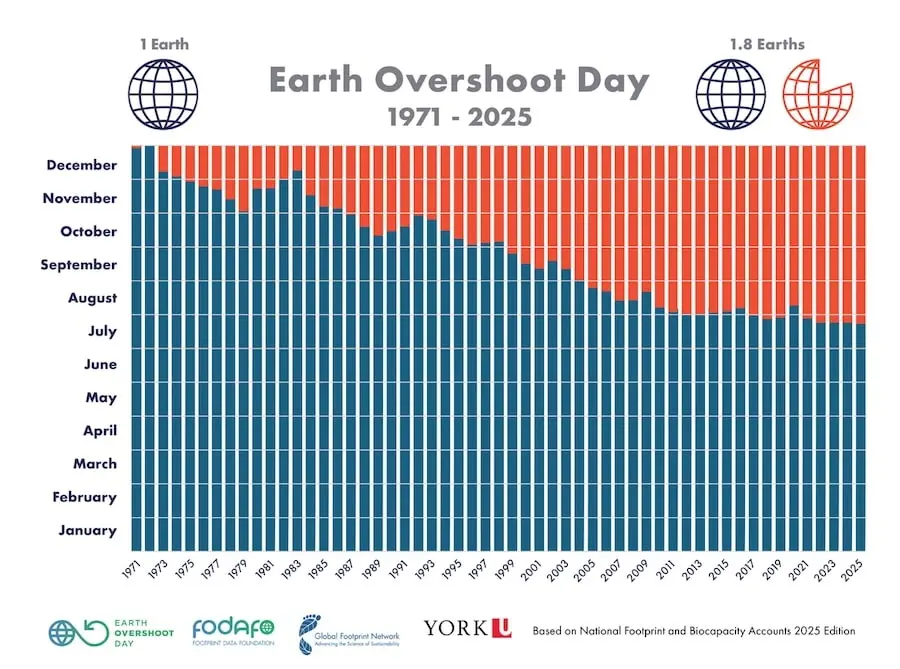
The concept of Earth Overshoot Day was first launched in 2006 by Andrew Simms, an author, political economist, and campaigner, working in collaboration with the Global Footprint Network. Since its inception, the date has been calculated and announced annually to track the global footprint of human activity. Over nearly two decades, the trajectory has been remarkably consistent and alarming: the date has steadily crept earlier into the calendar year, illustrating how rapidly consumption has outpaced the Earth’s biological capacity.
To provide greater scientific accuracy and historical context, the Global Footprint Network recalculated previous Earth Overshoot Days this year, extending their analytical models even prior to 2006. These updated historical calculations reveal a dramatic long-term acceleration in resource depletion. In 1972, Earth Overshoot Day fell as late as December 31, meaning humanity lived roughly within the sustainable capacity of the planet. By 1979, however, consumption had accelerated enough to pull the date forward to November 3.
Although the date experienced minor fluctuations in the early 1980s—temporarily retreating into early December—the momentum quickly reversed as industrialization and global consumption surged. By 1989, Earth Overshoot Day had reached October 12. It remained hovering in the month of October throughout the 1990s, crossing into September on September 25, 1999. By the time the metric was officially formalized and announced in 2006, the revised calculations placed the date on August 22.

The relentless pace of consumption eventually pushed the milestone into the summer months. The date reached July for the first time in history in 2018. Although global lockdowns and economic slowdowns temporarily nudged the date back to August in 2020 due to the COVID-19 pandemic, the rebound was swift. Since then, the date has remained firmly entrenched in July. The previous earliest record was set on July 25, a threshold crossed in both 2022 and 2023. By hitting July 24 in 2025, the world has set a new grim benchmark, highlighting that nature simply cannot continue to keep up with the demands placed upon it.
According to the Global Footprint Network, humanity is currently consuming nature 1.8 times faster than Earth’s ecosystems can regenerate. This means that to sustain our current global lifestyle, we would need the biological capacity of 1.8 Earths. Key drivers of this deficit include the over-extraction of freshwater, the widespread depletion of global forests, and the relentless overfishing of marine seafood populations. Furthermore, humanity continues to pump carbon dioxide emissions into the atmosphere at a volume far exceeding what natural ecosystems can sequester, driving the climate crisis to dangerous new heights.
Experts emphasize that depleting resources at this rapid and sustained pace has a profound cumulative effect, even during years when the date might appear to stabilize. With consumption chronically outpacing replenishment, ecological pressure builds up across the globe. This systemic strain is already visible in how close humanity has come to breaching seven of the nine scientifically defined planetary boundaries, which outline the safe operating space for human civilization on Earth.
"We are stretching the limits of how much ecological damage we can get away with. It is now a quarter into the 21st century and we owe the planet at least 22 years of ecological regeneration, even if we stop any further damage now," said Lewis Akenji, a board member of the Global Footprint Network, in a public statement addressing the 2025 findings. "If we still want to call this planet home, this level of overshoot calls for a scale of ambition in adaptation and mitigation that should dwarf any previous historical investments we have made, for the sake of our common future."
Despite the sobering nature of the report, researchers and campaigners stress that it is not too late to reverse course and alter the trajectory of human development. Moving Earth Overshoot Day backward into the calendar year is entirely possible through coordinated, systemic interventions. These solutions have been compiled and detailed by the Global Footprint Network under an initiative known as the Power of Possibility campaign.

Among the most impactful measures outlined by the campaign is the aggressive reduction of global carbon emissions. Cutting global carbon emissions by 50 percent alone would push the Earth Overshoot Date farther into the year by three months, single-handedly neutralizing a massive portion of the current ecological deficit.
Other targeted interventions offer significant, measurable improvements. Reducing global food waste by half would push the date back by 13 days. Transitioning to a global-scale Green New Deal framework could shift the date by 42 days. Meanwhile, ramping up renewable energy infrastructure so that at least 75 percent of global electricity is generated from clean sources would push the date forward by 26 days.
These solutions point to a clear path forward, but scientists warn that time is running out for voluntary, incremental change. The sheer mathematical reality of ecological limits means that overshoot is a temporary condition that must eventually resolve itself, whether through deliberate human planning or catastrophic systemic collapse.
"Because of the nature of physics, overshoot cannot last. It will end either by deliberate design or dumped-on disaster," said Mathis Wackernagel, co-founder and board member of the Global Footprint Network. "It should not be too hard to choose which one is preferable, particularly in light of so many possible choices."