In the realm of modern publishing and content creation, the single biggest factor driving this distinction is practicality. Because most contemporary writing does not exist purely for entertainment, it commands a much narrower audience unless its immediate utility is obvious to the reader.
The rationale behind this preference is entirely understandable. Modern life moves at a relentless pace, leaving people constantly seeking ideas and actionable advice that promise immediate, life-changing results. In such a high-pressure environment, spending valuable time learning about abstract concepts that lack an immediate practical application can feel like an unnecessary luxury. Why invest hours in theoretical exploration when there are pressing problems to solve right now?
Yet, seasoned observers argue that this widespread preference for immediate utility is fundamentally mistaken. For individuals who genuinely care about long-term effectiveness and true mastery, spending the vast majority of time consuming quick "advice" or superficial "tips" is profoundly counterproductive. Instead, a much more reliable path to success involves dedicating most of one’s learning efforts to understanding deep, fundamental principles.
Why Impractical Knowledge is More Efficient
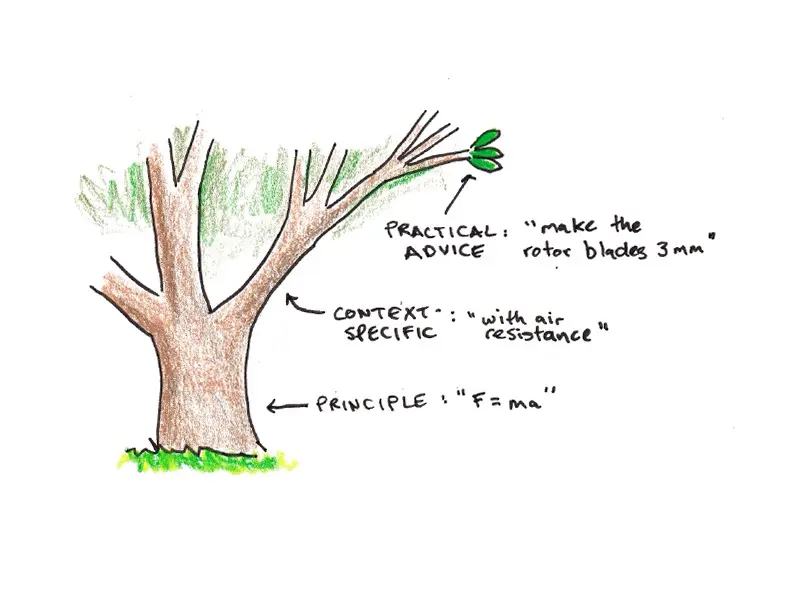
To understand why abstract knowledge ultimately delivers greater utility, it helps to visualize the structure of knowledge as a robust tree.
At the very foundation of this tree lie the fundamental principles. These are the core truths that are least contingent on specific, shifting states of the world and hold the highest degree of general validity. Familiar examples from the physical sciences include foundational equations like Newton’s second law of motion ($F = ma$), or the principles governing the conservation of momentum and energy.
While these core principles are remarkably general, they are also insufficient on their own to resolve many of the complex, specific situations that people care about in daily life. Designing a reliable bridge or engineering a modern rocket ship requires far more than simply knowing that force equals mass times acceleration. Consequently, as one travels upward along the trunk of the knowledge tree, the structure encounters branching points. These represent significant splits and variations in the state of the real world.
Consider the behavior of falling objects. While it remains a universal truth that heavy and light objects accelerate at the same rate under gravity, distinct domains emerge depending on external factors. There are operational domains where air resistance is practically irrelevant, such as dropping a dense lead ball alongside a solid gold ball. Conversely, there are domains where atmospheric drag becomes a massive, noticeable factor, such as comparing the descent of a feather against a solid rock.
As learners delve deeper into specific, concrete situations, the branches multiply into finer and finer subdivisions until they finally reach the outermost leaves of the tree. These leaves represent practical advice in its purest form. They are the specific "tips" handed down to novices who may understand very little about the foundational mechanics of a domain and simply want a straightforward instruction on what actions to take. A typical example of a leaf would be a precise technical instruction, such as shaping propeller blades in a specific geometric configuration to minimize localized air resistance.
This botanical model yields a crucial structural observation: the leaves of the tree vastly outnumber the major trunks and primary branches. Each individual leaf covers an incredibly narrow, highly specific subset of all possible states of the world. To adequately cover a significant portion of possible scenarios using only leaves, a person would need to memorize an overwhelming multitude of distinct, highly contextual pieces of advice for every conceivable contingency.
This stark structural imbalance suggests a clear strategic advantage. For anyone looking to maximize their breadth of usefulness—defined as the total number of concrete situations in which their knowledge can successfully apply—the most efficient approach is to learn lower down on the tree of knowledge. By focusing on ideas and frameworks that are less dependent on specific circumstances, a learner acquires tools that travel much further across different domains.
Real-World Examples Across Different Fields
To see how this conceptual framework operates in practice, it is helpful to examine several diverse areas of human endeavor, ranging from physical fitness to business and effective learning.
Consider first the universal goal of getting into shape and maintaining physical health. In the architecture of the knowledge tree, the outermost leaves correspond to specific, highly rigid workout routines—such as a proprietary multi-day split designed by a fitness influencer. Moving slightly inward along the branches reveals foundational training principles like progressive overload, muscular adaptation, and adequate recovery cycles. Deeper still, toward the trunk, lie the bedrock sciences of energy metabolism, muscle physiology, and cardiac mechanics.
Following a specific workout plan can be entirely effective, provided that an individual’s personal physical condition conforms closely to the demographic and physiological profile assumed by the plan’s creator. However, serious complications arise when the target audience does not match the model. For instance, a high-intensity routine engineered for a resilient, twenty-year-old competitive athlete will be wholly inappropriate, and potentially injurious, for a fifty-five-year-old adult recovering from joint surgery. In that scenario, rigid practical advice fails completely.
In sharp contrast, a firm grasp of basic physiological principles remains applicable across vastly different contexts. Understanding how the body responds to stress, adaptation, and recovery empowers an individual to navigate away from an unsuitable regimen and successfully identify or construct an alternative routine situated on an entirely different branch of the knowledge tree.
A parallel dynamic is evident in the challenging endeavor of starting a new business. Here, the leaves of the tree manifest as tactical maneuvers, such as purchasing targeted advertisements on a specific social media platform or cold-calling purchasing managers at mid-sized regional firms. If an entrepreneur is operating within the exact niche and market conditions presupposed by that specific advice—perhaps having received it directly from a mentor running a nearly identical operation—those tactics may provide immediate value.
Yet, if market conditions diverge even slightly, chasing rigid tactics can rapidly become counterproductive. Entrepreneurs facing novel challenges are better served by retreating down the trunk of the knowledge tree to fundamental concepts of commerce, such as achieving product-market fit, developing a minimum viable product, or conducting rigorous market research. At the deepest base of the tree lie even more universal economic concepts, such as the fundamental laws of supply and demand.
The same principle applies directly to the domain of effective learning, which forms the core of much educational writing. Students studying for a high-stakes academic examination often seek out narrow advice tailored specifically for passing that exact test—representing the leaves of the educational tree. Moving slightly further down the branches reveals moderately general strategies for tackling multiple-choice formats or organizing physical study materials. Reaching the deepest bedrock of the tree uncovers universal cognitive principles such as the spacing effect and the power of retrieval practice. These foundational insights remain universally applicable across virtually every academic discipline, even if they leave learners with the creative freedom to determine how best to apply them to their unique circumstances.
Dealing with Common Objections
Despite the clear efficiency of focusing on foundational principles, skeptics frequently raise several common objections against prioritizing deep concepts over immediate practicalities.
The first major objection argues that fundamental principles simply do not constrain decision-making tightly enough. Critics point out that rarely does learning a deep, abstract principle provide all the specific information required to determine the single best course of action in a messy, concrete situation. In real-world scenarios, an overwhelming number of competing considerations are usually at play.
This critique contains a kernel of truth. Principles alone rarely provide a turnkey solution. However, learning from principles remains fundamentally more efficient; it simply means that foundational knowledge occasionally requires supplementation with localized details to arrive at the correct operational answer.
To extend the botanical analogy, imagine searching for a squirrel hidden within a large tree. Being told that the animal is located "on the third major branch from the right" does not pinpoint its exact millimeter coordinates, but it successfully narrows the search space and provides an immediate, highly efficient starting point. In contrast, relying solely on highly specific advice—knowing only whether the squirrel is resting on one particular leaf—is only helpful if the animal happens to inhabit that exact leaf. In almost all other cases, such narrow information fails to limit the search efficiently. Directly applicable advice is only useful when it precisely mirrors the exact reality of the situation at hand.
A second common objection challenges the validity of the principles themselves, arguing that theoretical concepts often fail to accurately describe the complex realities of the world. Critics contend that theoreticians frequently devise elegant-sounding academic models that offer little to no utility in domains of practical, urgent concern.
This problem certainly exists, but it typically stems from a different underlying issue: either the true fundamental principles remain largely undiscovered in that domain, or our current understanding is too incomplete to adequately constrain the problem. This resembles a partial map of knowledge where observers can clearly see numerous leaves on the outer canopy, but remain largely ignorant of the major branches supporting them underneath, forcing them to guess at the underlying structure.
In domains where foundational principles strongly dictate practical outcomes—such as classical physics and structural engineering—the rationale for mastering fundamental theory is unassailable. In domains where principles only weakly determine practical execution, such as entrepreneurial ventures or second language acquisition, fundamental concepts remain valuable, but they must be heavily supplemented with extensive situation-specific tactics.
This limitation does not negate the superior efficiency of principles. Rather, it highlights the reality that in certain domains, our collective knowledge remains incomplete, forcing us to rely on practical heuristics simply because the deeper architecture is yet to be fully mapped.
Finally, critics suggest that deriving practical solutions directly from fundamental principles is often mentally intractable, making reliance on pre-packaged practical advice an operational necessity. Following the tree analogy closer to the trunk requires significantly more cognitive heavy lifting to trace how branching points connect to specific leaves.
This is a fair critique and explains why intellectual and professional domains are organized hierarchically rather than reducing every human problem to quantum mechanics. However, this complexity merely indicates that for highly intricate domains, learners occasionally need to integrate intermediate knowledge from higher up the tree to make fundamental principles actionable. Because the explanatory span of core principles remains remarkably broad, they consistently offer a more efficient vehicle for long-term learning than isolated tips.
Applications for Real Life
Reflecting this analytical framework back onto itself reveals a deeper principle: the assertion that learning fundamental principles is more efficient than gathering isolated practical advice is, itself, a foundational concept. This realization carries direct, practical consequences for how individuals consume information and structure their personal education.
Consider the vast publishing market dedicated to practical advice books covering productivity, dietary health, and personal finance. A massive proportion of these titles function merely as leaves on the knowledge tree. Readers encounter newly marketed diet plans promising rapid weight loss, detailed descriptions of specific writing rituals utilized by famous novelists, or rigid retirement savings blueprints designed for specific economic brackets.
If an individual intends to read only a single book on a subject, opting for a strictly practical guide might occasionally prove effective. Because fundamental principles alone do not tightly constrain immediate tactical choices, they may not provide an instant, step-by-step action plan. By purchasing a specific practical guide, a reader might coincidentally find themselves in the exact life situation described by the author, reaping immediate benefits.
However, for individuals committed to continuous reading and lifelong learning, starting at the level of isolated tips is a strategic misstep. When exploring a topic deeply rooted in an academic discipline—such as human nutrition or behavioral psychology—the most effective starting point is a standard textbook. When investigating a professional practice, the wisest approach is to consult unbiased introductory literature that prioritizes foundational mechanics over personal anecdotes or trendy hacks.
More broadly, individuals can adopt a personal maxim to prioritize exploring the intellectual "trunks" across diverse domains of knowledge. When specific, highly practical problems inevitably arise that demand detailed knowledge of the outer leaves, the necessary groundwork will already be in place, transforming what could have been an arduous struggle into a manageable application of enduring principles.