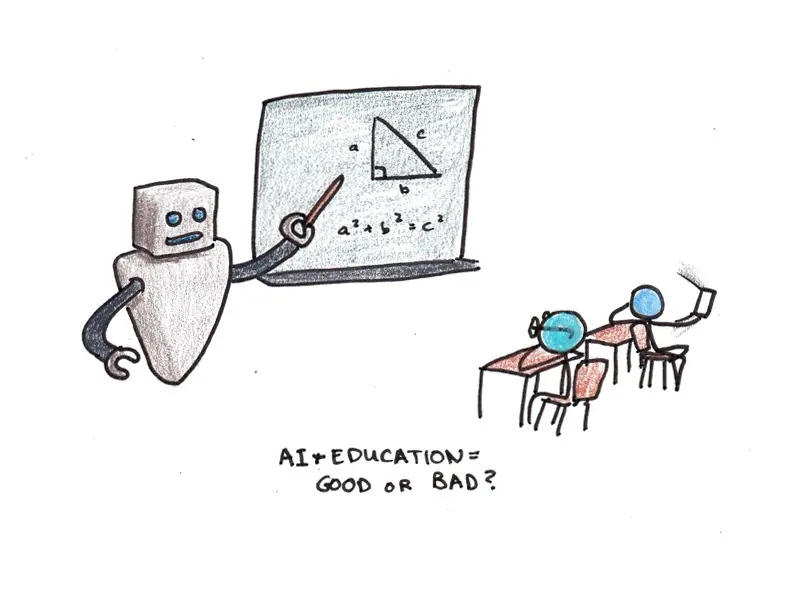
Conversely, the opportunities presented by artificial intelligence are vast and transformative. Alongside its potential pitfalls, AI introduces the possibility of accessible, patient tutoring available at any hour, on-demand explanations of complex concepts, limitless extra practice problems, and invaluable research assistance. Adapting a classic phrase to the current educational landscape, the arrival of AI in learning represents both the best of times and the worst of times.
This tension is central to a recent essay by educational commentator Carl Hendrick, who examined the growing body of findings regarding AI’s impact on cognitive development. To illustrate the psychological trap facing modern students, Hendrick draws a compelling analogy to the aviation industry and the introduction of automated flight systems. Specifically, he looks at the degradation of pilot skills following the widespread adoption of the autopilot.
Reflecting on the implications of aviation automation for modern learning, Hendrick notes that the automated functions in commercial aircraft actually save far more lives than they endanger, much like the expected safety benefits of self-driving cars. Rejecting simplistic narratives that pit benevolent humans against malevolent machines, he points out that the true danger lies not in automation itself, but in over-dependency. When flight crews face sudden emergencies, they have sometimes instinctively reached for more automation rather than dropping down a level to take manual control. Hendrick argues that this dangerous over-reliance is precisely what occurs when novice learners are given unfettered, uncritical access to advanced chatbots.
Significantly, Hendrick does not place the blame for this alarming trend on the students themselves. Instead, he directs his critique toward educational institutions. Schools have frequently vacillated between adopting a prematurely pro-AI stance—encouraging students to use chatbots in their assignments provided they properly cite the algorithmic output—and retreating into strict appeals for academic honesty in a futile attempt to maintain the traditional status quo.
This current approach is entirely untenable, signaling that education must undergo a structural evolution to account for the presence of AI. The appropriate institutional response does not involve embracing vague, tech-forward policies that blindly accept AI-generated output as a legitimate substitute for authentic student effort. Rather, educators and learners must recognize that artificial intelligence, much like historical technological leaps such as the calculator or Wikipedia, functions simultaneously as an extraordinary analytical tool and a potentially debilitating crutch.
Exploring the Optimal Balance of AI Use in Education
The reality that having AI complete one’s homework undermines genuine learning applies across multiple disciplines. Similar concerns surround the rise of coding agents and automated software generation techniques. While the rapid advancement of coding agents unlocks exciting new possibilities for workflow efficiency, relying entirely on automated code generation actively impairs an individual’s ability to learn how to write code independently.
Whether this technological trade-off is acceptable within the realm of professional productivity remains a more complex question. The degree to which automated coding enhances or undermines productivity likely depends heavily on the stage of knowledge acquisition a worker has achieved. Beginners who have not yet constructed a robust mental model of how programming logic operates miss crucial opportunities to practice foundational syntax and problem-solving skills. In contrast, experienced experts who already possess deep domain knowledge can effectively steer the automated process and genuinely benefit from the reduction in routine effort.
Nevertheless, if the primary objective is to learn how to write code from scratch, relying on an AI assistant to complete the work inevitably diminishes the depth of learning. This raises a deeper question regarding whether there is an optimal amount, or specific timing, for AI intervention during the learning process. While excessive reliance on AI is demonstrably harmful, could learning also be hindered by maintaining a strict policy of zero AI assistance?
Prior to publishing research on intense skill acquisition, the prevailing view strongly favored rigorous, unassisted problem-solving and the associated mental strain as the primary driver of skill mastery. However, subsequent investigations into cognitive load theory suggest that this view requires nuance. While deliberate practice remains an essential component of mastering any discipline, the cognitive load involved can frequently overwhelm a learner. Seeking targeted assistance, whether through a worked example, a completion problem, or a simple hint to overcome an impasse, can often prove significantly more efficient for learning than prolonged, unproductive floundering.
Developing Tentative Guidelines for Artificial Intelligence in Classrooms
Because academic research into pedagogical approaches typically spans decades, the rapid emergence of generative AI leaves the scientific literature playing catch-up. A mature, empirically validated consensus regarding AI best practices will likely take years to develop. In the absence of exhaustive, long-term studies, educators and learners must rely on pragmatic guidelines derived from existing cognitive science.
The foundational principle is that authentic learning cannot occur from work that an individual does not perform themselves. While AI assistance can either support or hinder educational outcomes depending on how it is applied, utilizing a chatbot to execute an entire assignment from start to finish bypasses the cognitive processes required to master the underlying skill.
A second consideration involves the timing of AI engagement during initial attempts at a problem. In many creative and analytical domains, attempting a solution independently before consulting external resources is vital. Asking an AI for assistance at the very beginning of an essay or project inevitably skews the direction of the work, depriving the learner of the crucial experience of building independent judgment, formulating arguments, and mapping out a personal research path.
Conversely, targeted assistance becomes valuable when initial, unassisted efforts lead to a persistent roadblock. When a learner struggles unsuccessfully despite their best efforts, educational research indicates that reviewing a worked example, explanation, or direct instruction yields better results than continuing to struggle blindly. Seeking AI-guided explanations after an initial failure is therefore prudent, provided the learner subsequently applies those insights by attempting another problem of the same category entirely without AI support.
Furthermore, artificial intelligence excels when utilized to suggest alternative perspectives, methodologies, and source materials. While starting a project with AI can encourage learners to skip necessary critical thinking, the expansive breadth of knowledge possessed by large language models makes them exceptionally useful for surfacing overlooked research papers, books, alternative theories, and creative approaches that might not emerge during a preliminary human search.
Finally, AI proves highly effective when deployed to diagnose confusion and correct mistakes. After a learner completes an independent attempt at solving a problem, reviewing expert solutions provides essential feedback. In many academic and technical fields, AI models are fully capable of generating expert-level solutions while simultaneously pinpointing the exact origins of a student’s misconceptions or arithmetic errors.
Integrating Artificial Intelligence into the Practice Loop
Effective skill acquisition frequently operates within a continuous practice loop consisting of seeing, doing, and receiving feedback. The seeing phase encompasses receiving direct instruction, observing worked examples, or internalizing conceptual knowledge to guide the search for a correct solution. The doing phase requires independent practice, while the feedback loop provides relevant signals from the environment regarding the effectiveness of that practice.
Within this established pedagogical framework, artificial intelligence possesses immense potential to enhance both the initial instructional phase and the final feedback phase. By providing customized explanations, alternative viewpoints, and detailed error analyses, AI acts as a powerful educational multiplier. However, what artificial intelligence cannot and should not replace is the central pillar of the learning loop: the rigorous, independent effort of doing the work for oneself.