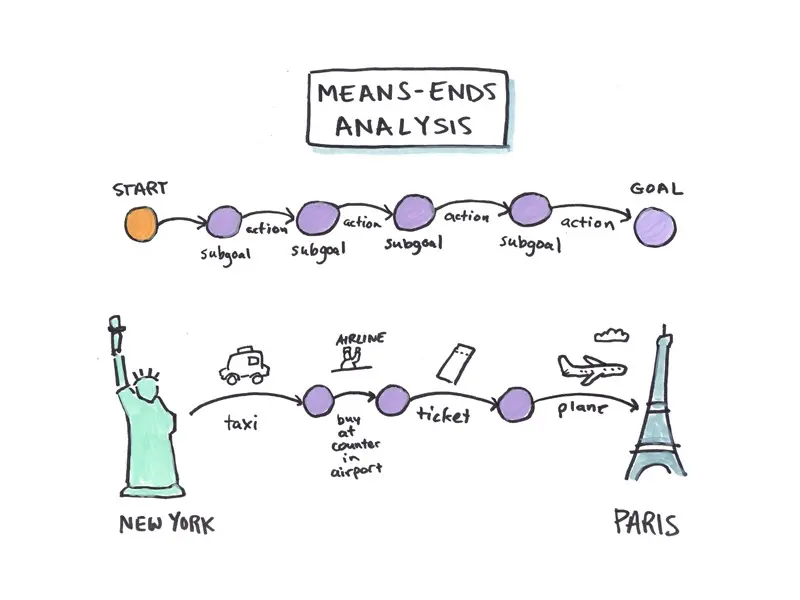
However, educational research paints a surprisingly different picture. In many cases, studying the solution directly results in broader, more general learning, enabling students to perform better on entirely new types of problems. This remains true even when learners are fully capable of solving the problems on their own through sheer determination.
The Puzzle
The counterintuitive nature of problem-solving and learning began to draw serious scientific scrutiny decades ago. In 1982, psychologist John Sweller was conducting an experiment on problem-solving with undergraduate students using a set of relatively simple puzzles. In these tasks, students were given a starting number and a goal number, with the objective of navigating from the start to the goal using only two possible moves: multiplying the current number by three or subtracting twenty-nine.
For instance, starting with the number 15 and aiming for 16, a student could multiply by 3 to reach 45, and then subtract 29 to arrive at 16. Every problem Sweller assigned possessed a hidden structural trick: they could all be solved by repeatedly alternating between multiplying by three and subtracting twenty-nine a specific number of times.
Despite the straightforward nature of the rule, Sweller made a startling observation. While the undergraduates found the problems relatively easy to solve and experienced very few failures, almost none of them discovered the underlying rule. Whatever cognitive mechanisms the students were utilizing to successfully reach the answers, learning the alternating solution sequence did not play a role. They were able to solve the problems without actually learning the underlying method.
How We Solve Problems
This phenomenon ties directly into foundational research on human cognition. Just a decade before Sweller’s experiment, future Nobel laureate Herbert Simon and Allen Newell published their landmark book, Human Problem Solving, detailing the mental processes people use when tackling unfamiliar challenges.
Simon and Newell discovered that when individuals confront a problem they do not immediately know how to answer, they engage in a systematic search process through what they termed a "problem space." This mental navigation resembles moving through a maze, except instead of physical walls and dead ends, the individual is navigating through the possible logical states of the problem itself.
While simple tasks like Sweller’s math puzzle featured only two moves, complex real-world tasks present vastly larger problem spaces. A Rubik’s cube, for example, features eighteen different moves, leading to a staggering total of forty-three quintillion configurations. Randomly twisting the cube yields little progress because the sheer volume of possibilities is too large.
To manage this complexity, humans rely on heuristics—innate, general-purpose procedures for solving problems. People apply these heuristics spontaneously without necessarily being consciously aware of them. Among these, Simon and Newell identified a particularly dominant strategy known as means-ends analysis.
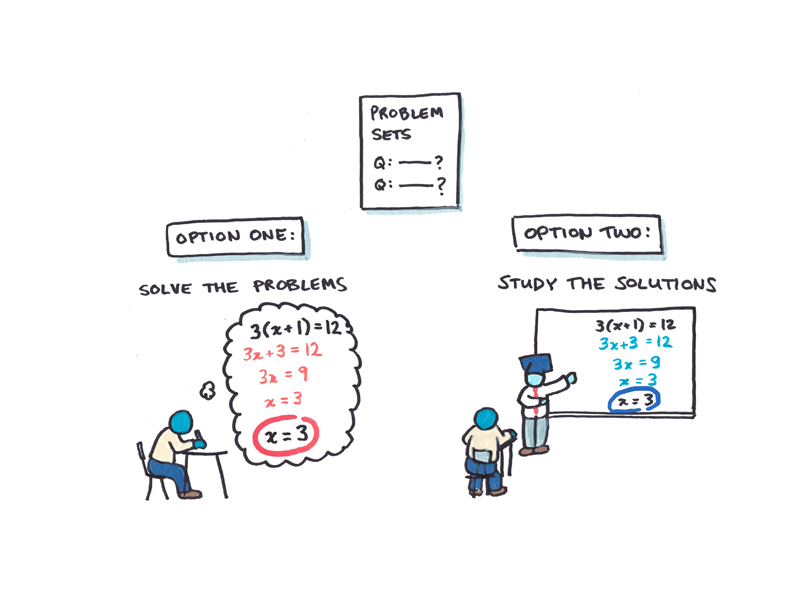
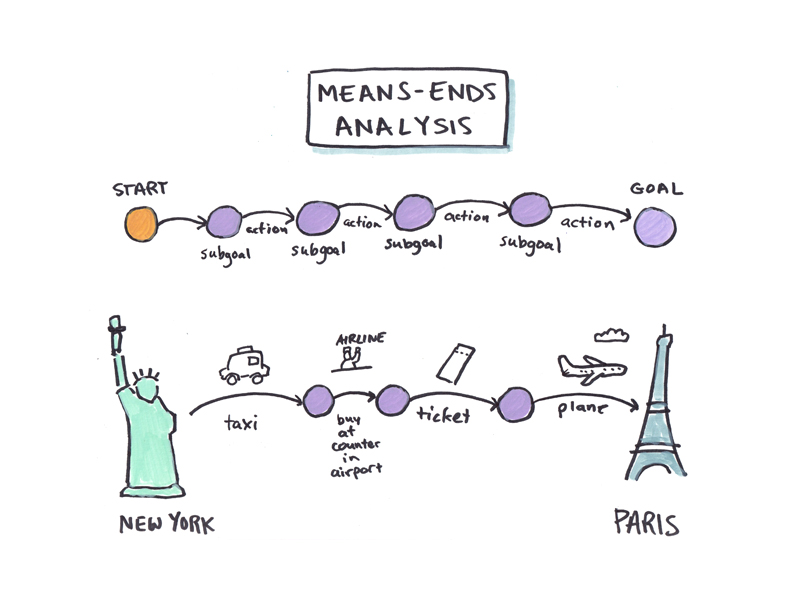
Means-ends analysis begins by identifying the ultimate goal and then searching backward for actions that could make that goal attainable. If the primary action cannot be performed directly, the problem solver establishes a sub-goal to reach a state where the action becomes possible. Repeating this process eventually leads to a solution.
Consider the logistical challenge of traveling from New York to Paris. An individual might reason backward: reaching Paris requires taking a plane, taking a plane requires buying a ticket, buying a ticket requires visiting the airline’s desk at the airport, and getting to the airport requires taking a taxi.
While means-ends analysis is a robust strategy for navigating unfamiliar territory, it carries a severe cognitive drawback. Generating and tracking multiple goals and sub-goals simultaneously consumes a massive amount of mental bandwidth within working memory. When working memory is overloaded with the mechanics of searching for a solution, the brain lacks the spare capacity required to notice broader patterns or absorb underlying principles. Recognizing this bottleneck, Sweller hypothesized that suppressing means-ends analysis might actually improve learning outcomes.
Problems without Goals?
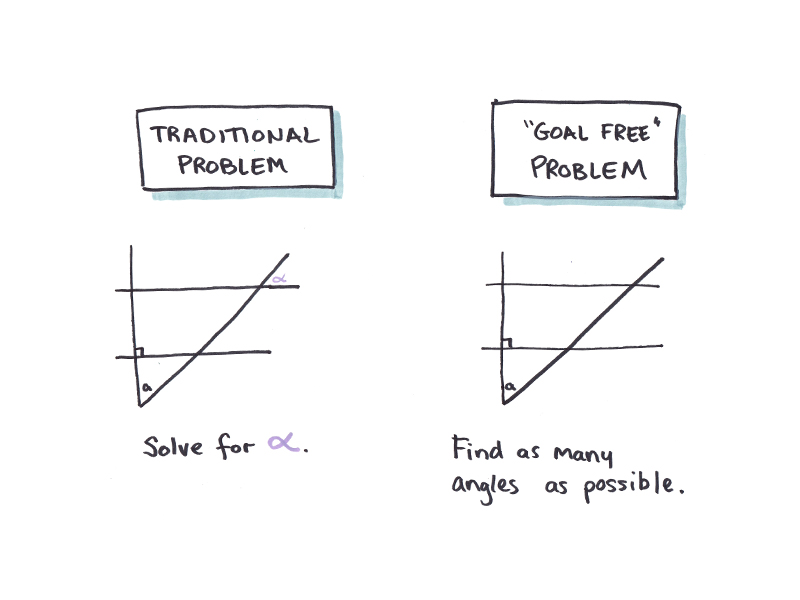
To test this hypothesis, Sweller turned to trigonometry puzzles, examining how students learned to solve for missing angles and side lengths in geometric shapes. In traditional settings, students are given a specific target angle or side to find, forcing them to rely heavily on means-ends analysis by working backward to determine what values are necessary for the calculation.
To eliminate this burden, Sweller designed "goal-free" problems. Students were presented with the same geometric shapes and equations, but instead of being instructed to find a single specific angle, they were asked to calculate as many unknown angles and side lengths as they could uncover.
In subsequent evaluations conducted by Sweller and his colleague Elizabeth Owen, students who practiced with goal-free problems demonstrated a vastly superior understanding of the material when tested on entirely new types of trigonometry puzzles they had never encountered before. The goal-free group answered eight out of ten test questions correctly, whereas the traditional problem-solving group managed an average of only three.
The Worked Example Effect
Despite the success of goal-free problems, their utility remains limited because the problem spaces of most real-world disciplines are simply too vast for the approach to scale effectively. To address this limitation, researchers began examining the power of worked examples—fully written-out solutions paired with subsequent practice attempts on structurally similar problems.
In experiments involving algebra instruction, Sweller and his colleagues divided students into two groups. Half the students received worked examples, while the other half received raw problems to solve independently. To ensure a fair comparison, any student in the problem-solving group who failed to reach a solution within five minutes was automatically given the answer, eliminating the possibility that the problem-solvers underperformed merely because they failed to reach the correct destination.
When both groups were tested on similar problems, their performance levels were comparable. However, when researchers introduced a novel problem type, three-quarters of the worked-example group successfully solved it, compared to zero percent of the traditional problem-solving group. Studying worked examples fostered deeper structural understanding and better generalization of the technique than independent problem-solving did.
Cognitive Load Theory
These cumulative experimental findings led Sweller and his colleagues to formulate cognitive load theory, which posits that learning places distinct demands on the brain’s limited cognitive architecture. The first component, intrinsic load, represents the working memory strictly required to process and understand the core material. Without this specific mental effort, learning cannot occur.
In contrast, extrinsic load encompasses mental effort that is not intrinsically necessary for learning but is instead imposed by the design of the task or the method of instruction. Means-ends analysis is a prime example of extrinsic load, forcing the brain to juggle numerous goals and sub-goals while trying to grasp a concept. Extrinsic load can also arise from poor instructional design, such as forcing a student to visually cross-reference disparate parts of a diagram or sift through irrelevant information.
When the total cognitive load exceeds an individual’s working memory capacity, the brain begins dropping information. If the dropped information is essential to the learning process, comprehension suffers. Optimizing cognitive load by maximizing mental effort spent on genuine learning while minimizing unnecessary procedural friction is the foundation of effective instruction.
Novices Use Heuristics, Experts Retrieve Knowledge
Skeptics of cognitive load theory often argue that difficult skills in mathematics, physics, and programming cannot be mastered simply by reviewing answers provided by an instructor; students must think deeply and work through problems independently. Recent research into retrieval practice—which demonstrates that actively recalling information strengthens memory far more effectively than passive review—seems to support this intuition.
Yet, these ideas do not actually contradict one another. The value of goal-free problems, worked examples, and direct instruction shifts dramatically as a learner acquires experience. While novices rely heavily on heuristics like means-ends analysis because they lack prior reference points, experts operate entirely differently.
Instead of working backward through heuristic searches, experts utilize forward reasoning. When confronted with a familiar problem, experts instantly recognize its underlying structure by drawing upon organized clusters of stored knowledge known as schemas. Recognizing a problem type and retrieving an established schema imposes virtually none of the heavy extrinsic load associated with means-ends analysis.
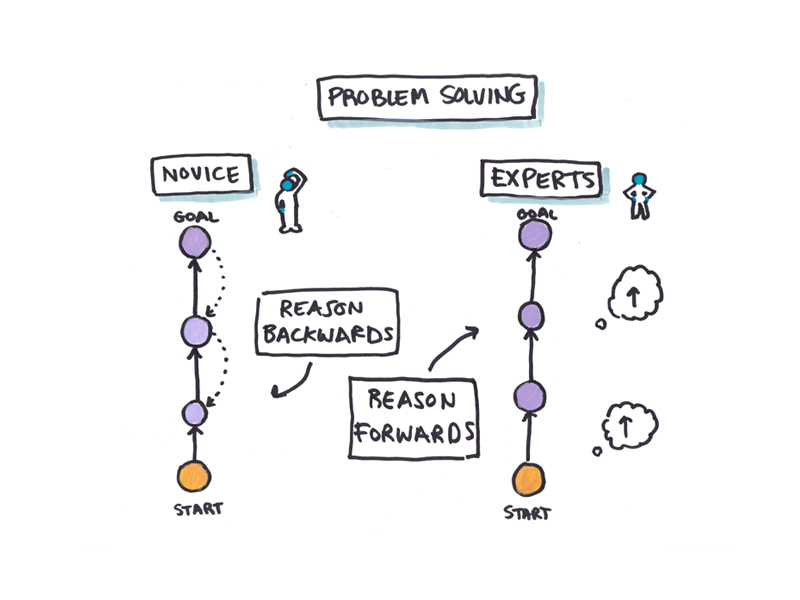
As learners transition from novice to expert status, the cognitive landscape shifts. Through a process known as chunking, the brain’s effective working memory capacity expands within a specific domain. Consequently, while beginners benefit immensely from worked examples that protect their limited working memory, advanced learners benefit progressively more from independent problem-solving and rigorous practice.
This phenomenon, known as the expertise-reversal effect, demonstrates that the utility of worked examples steadily decreases as competence grows, eventually making independent problem-solving the superior strategy for mastery. Optimal education requires a dynamic balance: clear explanations and worked examples at the beginning of an instructional sequence, followed by a gradual fading of support to encourage independent problem-solving as competence increases.
The Application
Applying these insights to everyday study habits requires recognizing that both instructional examples and active practice are essential, but their proportions must shift over time. Early in the learning process, studying clear examples is paramount. Later on, independent problem-solving should occupy the majority of study time.
Researchers have also explored instructional strategies that bridge the gap between studying examples and independent practice. One method involves self-explanation prompts, where learners review a worked example while writing out brief explanations for each individual step, a practice that has been shown to deepen comprehension significantly.
Another strategy is instructional fading, which involves smoothly transitioning from worked examples to independent problem-solving by gradually omitting the final steps of an example and requiring the student to complete them. Stepwise retrieval problems, where solutions are revealed incrementally, offer a similar middle ground, prompting knowledge retrieval without overwhelming working memory with a complete blank slate.
While cognitive load theory has faced skepticism from traditional educators attached to trial-and-error methodologies, its foundational principles are firmly established by empirical data. Effective learning is undeniably effortful, but the nature of that effort dictates success. Mastering complex subjects requires a thoughtful combination of following expert guidance and embracing independent practice at the right stage of the journey.