In this line of work, the single greatest factor driving that distinction is practicality. Because the content offered here is rarely categorized as pure entertainment, it commands a significantly narrower audience whenever its immediate utility is not immediately obvious.
The rationale behind this consumer behavior is entirely understandable. Everyone lives under the heavy demands of a packed schedule. When people arrive looking for ideas and advice, they are typically searching for solutions capable of changing their circumstances. Spending precious time learning about a subject that lacks immediate practical application can easily feel like a waste of resources.
Yet, looking at knowledge through this narrow lens alone represents a fundamental strategic mistake.
If overall usefulness is the ultimate objective, dedicating the vast majority of time to consuming quick advice or fleeting tips is profoundly counterproductive. A far more effective approach—one that yields vastly superior long-term results—involves dedicating that same time and energy to mastering fundamental principles. Even though discussions centered on deep, underlying ideas traditionally attract smaller audiences than quick-fix tips, the long-term dividend for the reader is immeasurably higher.
Why Impractical Knowledge is More Efficient
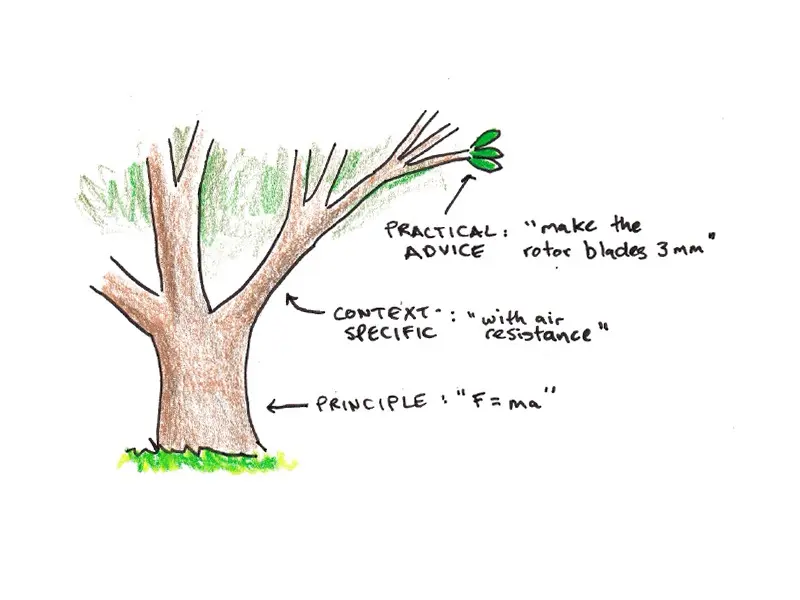
To understand why foundational concepts ultimately outperform quick fixes, it helps to visualize human knowledge as a living, branching tree.
At the very base of the tree lie the fundamental principles. These are the concepts least dependent on the specific, ever-changing states of the world, making them the most universally true. This bedrock category includes foundational laws such as F = ma in physics, or the conservation of momentum and energy.
While these principles possess universal truth, they are frequently insufficient on their own to solve many of the complex situations people care about in daily life. Knowing F = ma is not enough, by itself, to design a secure bridge or engineer a modern rocket ship. As we travel upward from the roots along the trunk, we encounter branching points. These represent major structural splits in the state of the world.
For instance, physics dictates that heavy and light objects fall at the exact same speed in a vacuum. Yet there are real-world domains where air resistance is practically irrelevant—such as dropping a lead ball versus a solid gold ball—and other domains where air resistance becomes an immensely noticeable factor, such as comparing a feather to a rock.
As an individual learns more about a specific, concrete situation, the pathways branch outward repeatedly until they finally terminate at the leaves of the tree. The leaves represent practical advice. They are the kinds of quick tips handed to novices who know little about a particular domain and simply want a direct instruction on what action to take. An example of a leaf would be a specific directive: "Make your propeller blades precisely this shape to minimize air resistance."
Crucially, the tree features far more leaves than it does trunks. Furthermore, each individual leaf covers only an incredibly narrow subset of all possible states of the world. To reasonably cover a meaningful space of real-world possibilities using leaves alone, a person must memorize thousands of different practical tips for thousands of distinct scenarios.
Consequently, anyone aiming to maximize the breadth of their useful knowledge—defined as the total number of concrete situations a piece of information successfully applies to—is far better off learning lower down the tree of knowledge. By focusing on core ideas that depend less on granular specifics, learners acquire tools that adapt to vastly more environments.
Real-World Applications Across Disciplines
This arboreal analogy becomes even clearer when applied to common human endeavors, whether striving for physical fitness, launching a commercial enterprise, or mastering a complex academic subject.
Consider the universal goal of getting into shape. In this domain, the leaves represent a specific workout plan adopted from a fitness magazine or online influencer. Moving further down the major branches reveals underlying physiological principles such as progressive overload and adequate recovery. Deepest toward the trunk are the core scientific fundamentals, including energy metabolism and muscle and cardiac physiology.
Following a specific workout plan works adequately as long as an individual’s personal circumstances closely mirror the exact profile of the person for whom the plan was originally designed. But complications arise when a routine built for a serious athlete in their twenties is handed to a fifty-five-year-old recovering from a joint injury. Under those circumstances, the hyper-specific plan not only fails to work; it can easily become counterproductive.
In stark contrast, a solid grasp of basic physiological principles continues to apply regardless of age or injury history. That foundational understanding steers the individual toward more applicable advice located on an entirely different branch of the knowledge tree.
A parallel dynamic unfolds when starting a business. The leaves in the commercial world consist of hyper-specific tactical maneuvers, such as purchasing targeted advertisements on a specific social media platform or cold-calling purchasing managers at mid-sized firms. If a founder operates in an identical market to the person dispensing that advice, those tactics might hit the mark.
If the business model differs even slightly, however, those exact tactics can backfire. Founders are better served by focusing on concepts situated closer to the trunk. Moving slightly down the tree reveals foundational entrepreneurship ideas like product-market fit, the minimum viable product, and systematic market research. At the base lie bedrock economic concepts such as supply and demand.
The same rule applies to the study of effective learning—a topic frequently explored by educators and researchers. When a student studies for a standardized test, exam-specific advice functions as the leaves. Moving down the branches uncovers moderately broader strategies for tackling multiple-choice questions or organizing study materials. Finally, reaching the trunk exposes bedrock cognitive science principles like the spacing effect and active retrieval practice.
While these fundamental principles can sometimes leave ambiguity regarding how to handle one specific, idiosyncratic test, they remain universally applicable across virtually every academic discipline.
Dealing with Common Objections
Skeptics frequently raise valid objections when evaluating the wisdom of prioritizing foundational principles over immediate practicalities.
The first major objection argues that principles alone are rarely sufficient to constrain decision-making in the real world. This critique is entirely accurate. Rarely does learning a deep, abstract principle hand an individual all the information needed to immediately execute the best course of action in a high-stakes, real-world scenario. Too many concurrent variables demand attention.
Even so, learning principles remains vastly more efficient. Principles simply require supplementation with specific contextual knowledge to bridge the gap toward a correct answer.
Returning to the arboreal analogy, imagine attempting to locate a small bird hiding somewhere in a large tree. If someone offers the clue that the bird is resting on the third branch from the right, that direction does not pinpoint the exact leaf, but it provides an exceptionally productive place to begin the search. Conversely, being told whether or not the bird occupies a single, isolated leaf is only useful if the bird happens to be sitting directly on that exact leaf. In almost all other cases, that hyper-specific piece of information fails to guide the search effectively. Specific advice is only helpful when it matches the exact parameters of the current situation.
A second objection challenges whether theoretical principles accurately describe the real world at all. Critics point out that academic theoreticians frequently devise elegant-sounding principles that fail to translate directly into useful, actionable advice.
While this does happen, the root cause is usually that the underlying principles remain undiscovered or insufficiently developed to fully constrain the problem. Under the tree analogy, this resembles viewing a dense canopy of leaves while remaining entirely blind to the network of branches hidden beneath. Observers can guess at the branch structure, but those educated guesses are occasionally wrong.
Human knowledge is often correct as far as it goes, but it may not extend as far as practitioners need it to. In domains where principles strongly dictate practical outcomes—such as physics and engineering—the rationale for mastering fundamentals is undeniable. In domains where principles only weakly dictate practical advice, such as entrepreneurship or second-language acquisition, foundational concepts remain vital, but they must be paired with extensive situation-specific guidance.
A third objection suggests that figuring out complex solutions from first principles is simply too intractable, forcing practitioners to rely exclusively on practical advice.
The closer one travels toward the trunk of the knowledge tree, the heavier the mental lifting required to map out branching points and trace where leaves eventually emerge. This critique is fair, and it explains why hierarchical domains exist in the first place. For extraordinarily complex domains, practitioners occasionally require specialized knowledge from higher up the tree to make fundamental principles operational. Yet, because the explanatory span of a single principle is so broad, mastering fundamentals remains the most efficient route to overall competence.
Applications for Real Life
Applying these realizations reflexively leads to a deeper principle: the understanding that learning principles is inherently more efficient than collecting practical advice. Recognizing this truth carries significant real-world consequences for how individuals consume information.
Consider the vast market of practical advice books flooding shelves on topics ranging from productivity and diet to personal finance. How many of these publications represent little more than isolated leaves? Consider the latest fat-busting diet promising dramatic weight loss in record time, the specific daily habits utilized by a favorite novelist, or the hyper-specific budget plan designed for early retirement.
If an individual plans to read only a single book on a subject, a practical guide might be the optimal choice. Because fundamental principles lack the granular detail needed to dictate immediate actions, they will not automatically hand the reader a concrete checklist. If a reader happens to inhabit the exact, narrow situation described by an author, they can certainly benefit from that tailored advice.
However, anyone planning to read broadly across a subject should avoid starting with the leaves of practical advice. If the trunk of a knowledge tree resides within an academic discipline—such as nutrition or psychology—reading a standard textbook yields a superior return on investment. If the trunk falls within the scope of a professional practice, seeking out unbiased, foundational overviews provides a sturdier base.
More broadly, individuals can adopt a personal maxim to absorb as much of the trunk-level knowledge across various domains as possible. When complex, practical problems eventually arise that demand detailed attention to the leaves, some localized problem-solving will still be required, but the heaviest and most important learning will already be complete.