This classic parable points to a profound and enduring truth about human psychology: people rarely notice what is closest to them. The traits, habits, and environments that are most obvious to outside observers are frequently invisible to the individuals living within them. This lack of awareness does not stem from these elements being inherently difficult to spot; rather, it is because human beings are entirely immersed in them at all times.
Gaining genuine insight into one’s own existence remains a persistent challenge. Individuals frequently fail to recognize recurring behavioral patterns in their daily lives. Instead of pausing to reflect, they react automatically to external events, staying stuck for far too long in professional trajectories, personal relationships, and even rigid identities that no longer serve their best interests or personal growth.
Yet, every once in a while, individuals manage to gain critical perspective. They find a way to step back, see the metaphorical water they are swimming in, and seize an opportunity to alter their course. Unfortunately, those moments of clarity are typically rare, occurring only a handful of times in an ordinary lifetime while people remain overwhelmingly busy navigating the daily currents of existence.
Reflecting on this constant state of immersion, writer and educator Scott Young designed a twelve-month curriculum called Foundations. Within this comprehensive program, he deliberately chose "Reflection" as a dedicated, month-long focus. The primary objective of this module was to actively cultivate the exact type of perspective that helps individuals identify and examine the underlying environments shaping their choices.
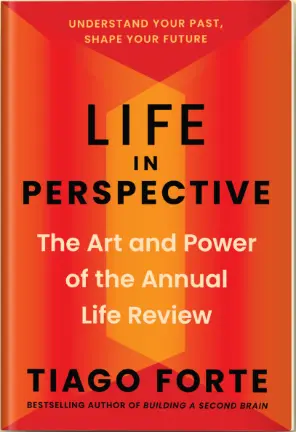
Reflecting on the structure of that project recently, Young noted that if he were developing the initiative completely from scratch today, one essential addition would be Tiago Forte’s latest book, Life in Perspective. The inclusion of Forte’s work highlights a growing conversation among productivity and personal development thinkers about how to bridge the gap between busy routine and meaningful self-awareness.
Annual Reviews: Less Analysis, More Feeling
When Tiago Forte first mentioned that he was writing a book dedicated to the subject of annual reviews, initial reactions from peers were mixed. A book focused entirely on conducting annual reviews can easily sound about as thrilling as a manual on filing taxes. Many readers might naturally imagine a text loaded with dense, analytical steps for sorting through digital notes, categorizing past achievements, and summarizing rigid goals—essentially functioning as a high-level planning seminar tailored for the most left-brained, hyper-organized individuals imaginable.
However, readers approaching the book with these expectations are often pleasantly surprised. Rather than serving as a dry ledger of past productivity, the volume is deeply directed toward solving the foundational problem of generating genuine personal insights. It addresses a fundamental question: Is there a practical way to make this sort of deep reflection a regular, sustainable practice rather than a haphazard occurrence that happens only by accident?
The methodology that Forte advocates relies heavily on granting oneself the mental and emotional space to genuinely connect with how one feels about life—encompassing the past, the current reality, and the aspirations for the future. This approach consciously departs from the tedious habit of simply crunching numbers or tracking metrics in a spreadsheet, favoring a more resonant, human-centered evaluation of personal well-being and life direction.
My Takeaways from the Book
Scott Young admits that he has not traditionally maintained a strict habit of conducting annual reviews in the precise manner that Forte outlines. Nevertheless, he brings a unique perspective to the practice, having published public reviews of his life and career on his personal blog for the past two decades. Over that same twenty-year span, he has also accumulated thousands of pages of personal journal entries, recording the incremental shifts of his thoughts, projects, and ambitions.
Despite this extensive background in self-documentation, Young found that a number of Forte’s core arguments struck a deep chord. The book successfully brought fresh attention to several subtle ways that individual reflective practices often flounder or drift off course over time, even among those who already consider themselves dedicated to journaling and self-analysis.
Forte’s previous major work, Building a Second Brain, established itself as a modern classic within the specialized field of personal knowledge management, transforming how millions of knowledge workers organize their digital notes and ideas. Given the strong reception of his previous principles, observers and critics fully expect that Life in Perspective will similarly emerge as an enduring reference for individuals seeking to better understand and navigate the hidden waters in which they spend their lives.