The single most influential factor driving this distinction is practicality. Because modern writing rarely functions purely as entertainment, it naturally commands a much narrower audience when its utility is not immediately obvious.
The rationale behind this preference is easily understood. In an era defined by fast-paced lifestyles and constant demands on attention, people turn to content in search of ideas and advice capable of shifting their circumstances. Spending precious time learning about subjects that lack immediate, tangible utility can feel counterintuitive.
Yet, looking at knowledge acquisition through this narrow lens alone presents a fundamental misconception. For those who genuinely prioritize usefulness and long-term capability, spending the majority of time consuming surface-level "advice" or quick "tips" can ultimately prove counterproductive. A far more effective approach is to dedicate that same time and energy to mastering fundamental principles.
Why Impractical Knowledge is More Efficient
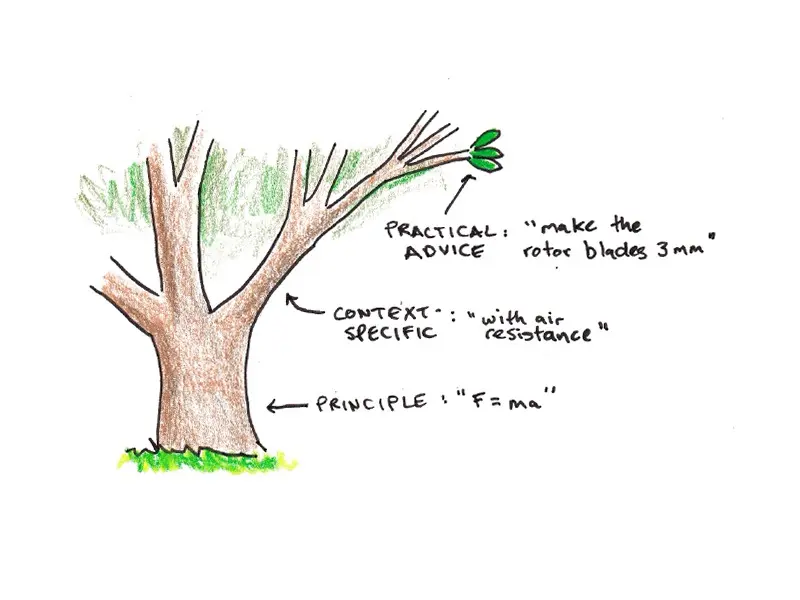
To understand why foundational ideas outperform quick fixes, it helps to visualize the architecture of knowledge as a living tree.
At the very base of the tree lie core principles. These represent the concepts least dependent on specific, shifting states of the world and most universally true. Classic examples include foundational physical laws like F = ma, or the conservation of momentum and energy.
While these principles are broadly applicable, they are frequently insufficient on their own to navigate specific real-world scenarios. Designing an advanced bridge or a modern rocket ship requires far more than just recalling the basic equation for force and mass. Moving upward along the trunk, the structure encounters branching points, which symbolize the various ways real-world conditions can diverge.
Consider the classic physics phenomenon regarding objects falling under gravity. While it remains true that heavier and lighter objects fall at identical speeds in a vacuum, distinct operational domains emerge when environmental factors are introduced. In scenarios where air resistance is practically negligible, such as comparing a dense lead ball to a solid gold ball, the distinction does not matter. In other domains, such as dropping a feather versus a rock, air resistance becomes a defining, noticeable factor.
As learners delve deeper into concrete, specific situations, the paths branch outward repeatedly until they finally reach the outermost leaves of the tree. These leaves represent practical advice. They embody the type of specific tips typically handed to beginners who know little about a particular domain and simply want an immediate action plan, such as instructions to shape propeller blades in a precise geometry to minimize drag.
The structural reality of this metaphor reveals a vital mathematical truth about information: there are vastly more leaves than there are trunks. Furthermore, each individual leaf covers an incredibly narrow subset of possible real-world conditions. To adequately cover the vast expanse of potential circumstances through leaves alone, a person would need to memorize countless different tips for countless distinct scenarios.
Consequently, maximizing the breadth of truly useful knowledge—defined as the number of concrete situations a concept can successfully inform—is best achieved by studying lower down the tree. Focusing on ideas that are insulated from hyper-specific details offers far greater long-term efficiency.
Real-World Applications Across Disciplines
This arboreal analogy becomes even clearer when applied to common human endeavors, starting with physical fitness and health.
In the context of getting in shape, the leaves of the tree represent specific workout routines chosen from a fitness magazine or online forum. Moving down the primary branches leads to deeper physiological principles, such as progressive overload and systemic recovery. Closer still to the trunk are foundational concepts governing energy metabolism, muscle physiology, and cardiac health.
Following a rigid, pre-packaged workout plan can yield results, provided the individual’s personal situation closely mirrors the exact demographic the plan was designed for. However, complications arise when a routine built for a twenty-year-old competitive athlete is given to a fifty-five-year-old recovering from a joint injury. In such cases, the specific plan is not only likely to fail, but it may actively cause harm.
Conversely, a solid grasp of basic physiological principles remains applicable across vastly different contexts. This foundational understanding can guide an individual toward far more appropriate advice located on an entirely different branch of the knowledge tree.
A parallel dynamic appears when launching a commercial enterprise. The leaves in this domain consist of tactical tactics, such as purchasing targeted advertisements on social media or cold-calling purchasing managers at mid-sized corporations. For entrepreneurs operating in the exact same niche as the source of the advice, these tactics may prove effective.
Yet, applying those same narrow tactics outside their intended domain can quickly backrule an initiative. Entrepreneurs are far better served by focusing on ideas residing closer to the trunk. Moving slightly down the tree reveals fundamental concepts of business creation, including product-market fit, minimum viable products, and structured market research. Nearer to the base lie bedrock economic principles like supply and demand.
The same principle applies directly to effective learning, a subject that frequently forms the core of cognitive research. Students preparing for an exam might seek out specific advice for passing that exact test, representing the leaves of the tree. Moving down the branches uncovers general strategies for tackling multiple-choice formats or organizing study schedules. At the trunk lie deep, cognitive principles of learning, such as the spacing effect and retrieval practice.
While these bedrock principles can sometimes leave room for ambiguity regarding how to handle a single, highly specific exam, they remain universally applicable across virtually all educational pursuits.
Dealing with Common Objections
Despite the efficiency of fundamental principles, critics frequently raise valid objections to prioritizing them over immediate practicalities.
The first major objection is that principles alone are rarely sufficient to constrain real-world decision-making. This argument holds merit; rarely does learning a deep scientific or economic principle provide a complete blueprint for the best course of action in a messy, multifaceted human situation. Too many competing variables are usually at play.
Even so, learning principles remains fundamentally more efficient. Principles simply require supplementation with specific contextual knowledge to arrive at a correct operational answer. Returning to the tree analogy, imagine searching for a small bird hidden within the canopy. Being told that the bird is located on the third branch from the right does not pinpoint its exact feather-by-feather coordinates, but it dramatically narrows the search area. In contrast, relying solely on whether the bird occupies a single, isolated leaf is only useful if the searcher happens to check that exact leaf first. Specific advice only has value when it happens to match the exact conditions of the current environment.
A second objection suggests that abstract principles frequently fail to accurately describe the complex reality of the world. In these instances, a theoretician has devised an elegant-sounding concept that refuses to translate into actionable insight.
While this does happen, it is more commonly a symptom of underdeveloped fields where foundational principles remain undiscovered or insufficiently mapped. In the tree metaphor, this resembles observing a canopy of leaves while remaining entirely blind to the hidden branches underneath. Guesses can be made, but those guesses carry a high margin of error.
Existing knowledge is often correct as far as it goes, but it simply does not extend far enough down toward the practical level. In heavily matured domains where principles strongly dictate practice, such as physics and engineering, the rationale for mastering fundamentals is undeniable. In domains where principles only weakly constrain practice, such as entrepreneurship or language acquisition, foundational concepts remain vital, but they must be paired with extensive situation-specific guidance.
A final critique argues that deriving solutions from first principles is frequently too mentally taxing or intractable, forcing individuals to rely entirely on practical shortcuts.
While climbing down the mental hierarchy from the trunk to the leaves requires significant cognitive effort, this complexity is precisely why specialized, hierarchical domains exist. In deeply complicated fields, individuals occasionally need to draw upon knowledge higher up the tree to make fundamental principles operational. Nevertheless, because the explanatory power of principles is so expansive, they continue to offer a more efficient learning curve overall.
Implications for Lifelong Learning
Applying this overarching idea recursively yields a deeper principle of its own: learning fundamental principles is inherently more efficient than collecting scattered practical advice. Recognizing this dynamic changes how people approach education, reading, and personal development.
Consider the sheer volume of published material dedicated to productivity, dieting, and personal finance. How many of these volumes consist merely of leaves? The latest rapid weight-loss regimen promising dramatic transformations in a fortnight, the hyper-specific daily routines of a bestselling novelist, or a rigid budget designed for early retirement all fit this category.
For someone intending to read only a single book in their lifetime, a purely practical guide might offer the highest immediate utility. Because fundamental principles lack the granular constraints needed to dictate direct action, they rarely provide a turnkey checklist. A practical book might happen to align with an author’s exact circumstances, yielding immediate benefit.
However, for those committed to continuous reading and lifelong learning, starting at the leaves is a flawed strategy. When exploring a domain deeply rooted in an academic discipline, such as nutrition or cognitive psychology, beginning with a textbook yields far better results. When studying a professional practice, seeking out unbiased overviews that outline basic structural frameworks provides a sturdier foundation.
Ultimately, cultivating a personal maxim to absorb the trunks of various domains transforms the learning process. When real-world problems eventually demand detailed, leaf-level knowledge, the necessary intellectual groundwork will already be firmly in place.