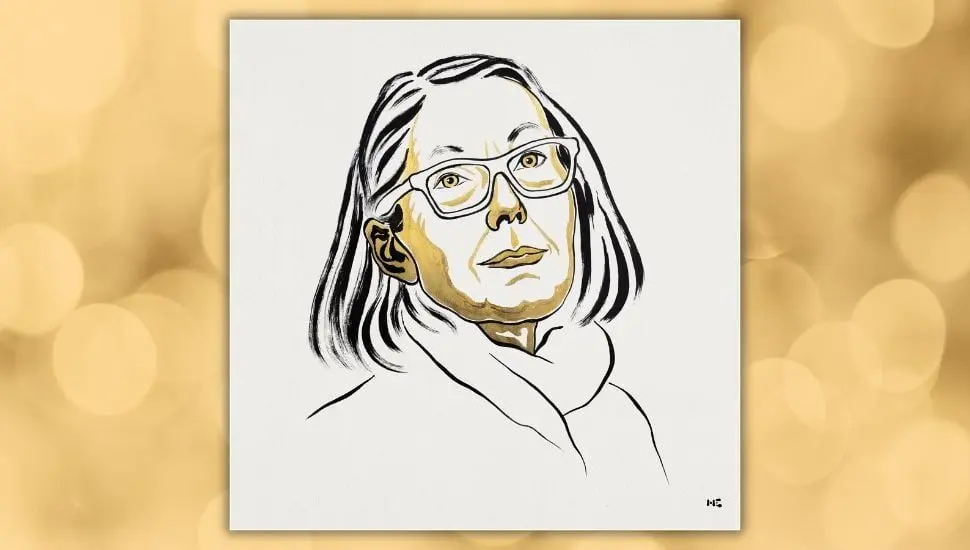
The news of the award quickly reverberated across the global literary community, drawing reactions from readers, critics, and fellow writers who have long championed her unique contributions to poetry, essay, and translation. True to her distinctively candid and understated persona, Carson offered a characteristically succinct and memorable reaction when reached during an Icelandic broadcast. Upon learning that she had been awarded the Nobel Prize, she responded simply, "Crazy, I think they’re all crazy."
For readers who may not yet be familiar with Carson or the breadth of her genre-defying career, the honor serves as an invitation to explore a vast and multifaceted body of work. Over the decades, Carson has consistently refused to conform to rigid literary categories, blending poetry, prose, classical scholarship, visual art, and translation into something entirely her own. Her writing often engages directly with ancient Greek and Roman literature, yet it remains fiercely contemporary, plumbing the depths of human emotion, love, desire, grief, and intellectual curiosity.
Born in Toronto, Canada, in 1950, Carson established herself early on as a formidable scholar of classical antiquity, earning her doctorate from the University of Toronto and teaching classics at various universities in Canada and the United States. This deep-rooted familiarity with ancient languages and texts has served as the bedrock for much of her creative output. Rather than treating the classical past as a dusty museum artifact, Carson approaches antiquity with a sense of vibrant immediacy and playfulness, using it as a lens through which to examine modern anxieties and relationships.
Her breakthrough work, Eros the Bittersweet, published in 1986, set the tone for much of what was to follow. Part essay, part lyrical meditation, the book explores the nature of desire in classical Greek thought and literature, establishing Carson’s signature style: intellectually rigorous, emotionally raw, and formally inventive. She followed this with works that continually pushed the envelope of what literature could do and look like.
Among her most celebrated achievements is Autobiography of Red, published in 1998, which she sub-titled a "novel in verse." The book reimagines the ancient Greek fragment of the lyric poet Stesichoros about the monster Geryon and his encounter with Herakles, transforming the mythological tale into a deeply moving, modern coming-of-age story about art, identity, and heartbreak. The work was widely acclaimed by critics and introduced Carson to a much broader readership, cementing her reputation as one of the most original voices in contemporary poetry.
Carson’s subsequent publications have continued to defy easy classification. Works like Men in the Off Hours, Nox—an elegiac, accordion-fold book created as a memorial to her late brother—and Float have consistently demonstrated her willingness to experiment with the physical and structural possibilities of the book as an artistic medium. Whether she is translating the plays of Euripides and Sophocles with a fierce, modern linguistic energy or constructing intricate poetic collages that incorporate visual art, footnotes, and fragments, Carson has continually expanded the vocabulary of modern literature.
The Nobel Prize in Literature, established by the will of Alfred Nobel in 1895, has a long and storied history of recognizing writers whose work has conferred the greatest benefit on humankind. In selecting Carson, the Nobel Committee has highlighted an author who has not only mastered her craft but has fundamentally reshaped the forms available to writers working today. Her dialogue with the classical tradition has proven that ancient texts remain endlessly adaptable, capable of speaking directly to the complexities of the twenty-first century.
As news of the 2026 prize continues to spread, bookstores, libraries, and literary societies around the world are seeing a renewed surge of interest in Carson’s extensive catalog. From her scholarly essays to her groundbreaking verse novels, her writing invites readers into a space where intellect and emotion are inextricably linked, and where the boundaries between the ancient past and the present day dissolve entirely.