
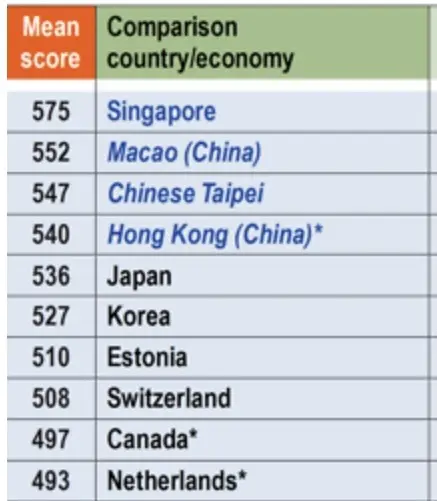
When examining the global rankings for mathematics, an observer has to look far down the list before reaching a Western nation. Furthermore, these standings do not even fully capture the scope of regional performance. While China as a whole was not included in that specific dataset, its major metropolitan areas—specifically Beijing, Shanghai, Jiangsu, and Zhejiang (often abbreviated as BSJZ)—actually ranked higher than Singapore during the 2018 assessment cycle.
The scholastic prowess extends beyond numbers. East Asian countries also dominate reading assessments, claiming four of the top five spots globally. This achievement becomes even more impressive when accounting for the linguistic complexity involved. Writing systems based on logographic characters, such as those utilized in Japan and China, are vastly more intricate and demanding to learn than the alphabetic systems foundational to most European languages.
The most immediate and obvious answer to the question of East Asian scholastic performance is a deeply ingrained cultural and structural emphasis on studying. Of the six East Asian countries that top the PISA rankings in mathematics, all but Japan exceed the Organization for Economic Co-operation and Development (OECD) average for weekly hours spent in classwork. When including the combined Chinese cities of BSJZ, three regions ranked in the top seven worldwide for total hours spent studying. Furthermore, many students in these high-performing countries attend evening "cram" schools—known locally by various terms—long after their regular school day has officially concluded.
Whether this intense focus on academic rigor is an unmitigated good remains a complicated question. On one hand, a hyper-competitive, academic-first culture can systematically remove opportunities for children to play, socialize, and explore other developmental avenues. To the extent that specialized academic knowledge is ultimately unnecessary or unused in many modern jobs, this exhaustive approach may represent a net-negative that places a societal drag on innovation and personal well-being.
Conversely, it is difficult to ignore the incredible economic performance of East Asian economies, such as the Four Asian Tigers—Hong Kong, Singapore, South Korea, and Taiwan. Their phenomenal rise, particularly in high-technology manufacturing and advanced services, suggests that an intense focus on mathematics and the sciences yields profound practical payoffs.
While debating the relative merits of different educational cultures offers fertile ground for discussion—including intriguing regional nuances, such as Japan’s outlier status of achieving high grades with comparatively fewer hours of studying—the deeper historical origins of these cultures deserve equal attention. Why did such a uniquely strong, enduring emphasis on educational attainment take root in East Asian societies in the first place?
The Keju: 1,300 Years of Studying
One primary historical explanation for the cultural emphasis on education involves the long-lasting, transformative influence of the Chinese civil service examinations, known historically as the keju. While medieval Europe was just beginning to establish the decentralized social structures of feudalism, the Chinese imperial state was already being staffed by a sophisticated meritocratic bureaucracy. This bureaucracy was entirely drawn from graduates of some of the most competitive, grueling exams the world has ever known.
To understand the mechanics and societal ramifications of this framework, historians often look to foundational works such as Ichisada Miyazaki’s comprehensive study, China’s Examination Hell: The Civil Service Examinations of Imperial China, which details the immense benefits alongside the severe human costs generated by the system.
Initiated during the Sui dynasty in the year 605 CE, the civil service examinations were originally designed as a political mechanism to bypass the powerful aristocratic families that wielded overwhelming control over the imperial government. In theory, the examinations were open to virtually all men. Any male citizen, ranging from the son of a noble family down to a peasant commoner, could theoretically attend and compete. In practice, however, the immense financial burdens required to sustain years of uninterrupted study meant that very few individuals outside of the already well-off could realistically pursue the path to a degree.
Despite these socio-economic barriers, the system allowed for a remarkable degree of upward social mobility, helped legitimize imperial rule across changing dynasties, and served as a powerful tool for centralizing state power. For these reasons, despite dynastic upheavals, economic shifts, and even foreign conquests, the system persisted for an astonishing thirteen centuries before finally being abolished in the waning days of the Qing dynasty.
The psychological and cultural weight of the system was difficult to escape. Even historical figures like Hong Xiuquan, who suffered a nervous breakdown after failing multiple times to become a licentiate, came to believe he was the younger brother of Jesus Christ, and launched a devastating civil war that cost tens of millions of lives, nonetheless set up his own variant of the examination system within the territories he controlled. Even for those who personally suffered under its crushing weight, the exams were viewed as an absolute essential pillar of governance and order.
What Was It Like Taking the Exams?
Historical accounts of the examinations are striking not only for their description of the multilayered testing process centered on the rigorous memorization of the Chinese classics, but also for their vivid depictions of the grueling physical and psychological toll placed on the candidates.
At the height of their institutional complexity during the late Qing dynasty, the examinations were divided into three major tiers: provincial, metropolitan, and palace examinations.
The provincial examinations, held nominally every three years, required exam-takers to be locked inside tiny, isolated cells within large, labyrinthine examination halls for three consecutive days. Candidates were provided with only three wooden boards: one serving as a makeshift bed, one as a bench, and one as a writing surface. Because these massive halls were used so infrequently, they were often dilapidated, forcing students to desperately shelter their precious answer sheets from leaking rainwater.
Those taking the provincial exams faced not only harsh physical confinement, but also profound psychological terrors rooted in superstition. It was widely believed that supernatural forces—specifically ghosts—would actively punish those guilty of unseen moral transgressions during this critical stage. Seducers and swindlers expected to be haunted, and historical anecdotes record that various guilty consciences led directly to suicide or complete nervous breakdowns during the three days of isolation.
In other instances, perceived cosmic justice or karma manifested in strange ways. A past moral transgression might result in lamp oil accidentally spilling across an answer sheet, a procedural violation that led invariably to immediate failure. It was widely accepted among the populace that any apparent unfairness in the exam results was not an unlucky accident, but rather the manifestation of concealed crimes being judged directly by heaven.
The few candidates who successfully navigated the provincial rounds then made the long, expensive journey to the capital for the metropolitan examinations. In the early years of the keju, these metropolitan tests represented the final stage of a scholar’s journey, after which he was practically guaranteed a prestigious and lucrative place in the imperial bureaucracy.
However, the fierce loyalty that test-takers naturally owed to their individual examiners created dangerous factions within the government apparatus. Much like modern academics often owe the trajectory of their careers to eminent doctoral advisors, historical scholars felt deep allegiance to the officials who passed them. To prevent this factionalism from undermining the ultimate authority of the throne, palace examinations judged directly by the emperor were eventually instituted. Through this final layer, successful graduates theoretically owed their gratitude not to a bureaucratic examiner, but to the emperor himself.
Given the enormous incentives for corruption within a system that guaranteed elite status, the administrative measures taken to combat cheating and favoritism were remarkably sophisticated. Candidates were thoroughly searched for hidden smuggling materials before entering the cells. Examiners were granted access only to a student’s assigned seat number rather than their name, and during higher-level examinations, answer sheets were meticulously hand-copied by independent scribes to ensure that a candidate’s identity could not be guessed through distinctive handwriting.
When scandals did occasionally emerge, they triggered massive public backlash, creating a strong institutional motivation to maintain at least the rigorous facade of integrity. Examiners discovered participating in schemes to undermine the testing process faced severe punishments, including exile or execution.
The overall process was defined by punishing levels of competitiveness. A candidate had to pass an initial local exam just to gain entry into the official system, a gateway that typically featured a pass rate of only one to two percent. Provincial exams featured a pass rate of roughly five percent, while metropolitan exams hovered between fifteen and twenty percent. Although very few candidates actually failed the final palace exams—which tended to serve more as a ceremonial ranking mechanism than a substantive test—the specific rank achieved there heavily influenced an individual’s subsequent career trajectory. Out of more than a hundred thousand initial applicants, perhaps only a dozen would ultimately see their lifelong ambitions realized as top-tier graduates of the palace exams.
Unlike modern university systems where key educational bottlenecks occur during early adulthood, the process of studying for and taking the imperial exams could consume a lifetime. It was not uncommon for newly minted graduates to be elderly men with gray hair. In some cases, aging, persistent test-takers were granted honorary passes, allowing them to finally earn their highest status despite having long passed the standard age of official retirement.
Legacy of the Imperial Examination System
It remains challenging to quantify the exact, direct impact that China’s historical examination system continues to exert on academic achievement in contemporary East Asian societies. One creative economic and sociological study utilized natural variations in the historical intensity of exam attendance across different regions of China—measured by the density of elite graduates per capita—and found a strong positive correlation between historical testing density and modern educational attainment levels.
Some researchers remain skeptical that such direct cultural lines can be drawn across centuries. For ages, China exerted immense cultural gravitational pull on its neighbors; even countries like Japan, which never formally adopted an indigenous version of the imperial examination system, nevertheless embraced broad aspects of Chinese civilization, ranging from written characters to philosophical traditions. It is difficult to imagine that societal attitudes toward learning did not diffuse across borders, even in the absence of a formal bureaucratic testing apparatus.
Yet, even if the precise causal mechanisms linking the ancient keju to modern study habits are debated, the question of its legacy remains vital. For more than a millennium, the examination system fostered a cultural obsession with formal education that had no historical parallel in Europe until much later periods.
Despite its obvious flaws and societal costs, the system was remarkably progressive for its era. Allocating critical government positions based on merit rather than hereditary birthright was virtually unknown in Western political structures until the nineteenth century. The fact that an institutionalized meritocracy emerged during the early medieval period and endured until the threshold of the modern era stands as a monumental historical milestone.
The cultural fallout of the keju extended far beyond the classroom. One notable downstream effect was the deliberate suppression of the military class. While military examinations did proceed in parallel with civilian ones, success in military fields rarely translated into high societal respect or supreme governmental office. Battlefield generals found their political advancement strictly limited, which ensured robust civilian control over armed forces throughout much of imperial history.
At the same time, while this civilian dominance and political centralization fostered centuries of internal peace and stability compared to the fractured polities of medieval Europe, some historians have argued that absolute state centralization may have inadvertently hindered the kind of decentralized, disruptive innovations that ultimately spurred the Industrial Revolution in the West.
Furthermore, questions remain regarding the content of the exams themselves. While mastering the classical texts was intended to instill wise judgment and upright moral conduct, its practical success in creating effective administrators is debated. From a modern economic perspective, dedicating generations of bright minds to the memorization of texts far removed from technical governance appears strikingly inefficient.
This historical reality invites contemporary reflection. As modern societies grapple with credential inflation, rising tuition costs, and an intense cultural fixation on standardized testing, future generations may look back at modern academic pressures with similar skepticism. Whether observers ultimately judge the historical keju as an essential forerunner to a modern, knowledge-based meritocracy, or view it as an exorbitantly wasteful scholastic competition, the institution continues to serve as an indispensable lens for understanding the profound role education plays in shaping societies past and present.