
Even famously reliable navigators like Christopher Columbus claimed in their historical journals to have encountered mesmerizing mermaids—creatures that modern history suggests were almost certainly half-ton, gray-skinned manatees. Yet the myth stretches back much further into maritime lore. Seductive aquatic entities luring weary sailors to a watery, passionate death is a narrative trope that practically originated alongside the invention of the sail itself. Isolate human beings on a vessel, send them voyaging into a vast and vacant sea, and they are bound to project their internal states onto the environment. Anyone watching from the outside would recognize the pattern immediately: some things are bound to happen.
This frustrated, misdirected desire is not a phenomenon unique to historical sailors, nor is it something that vanished with the advent of modern navigation or improved vision care. Being bored and restless is fundamentally woven into the human condition—an existential baseline that is dramatically exacerbated by physical isolation, immense distances, and the removal of the everyday distractions and social communities we assemble around ourselves just to forget this very vulnerability for as long as we can.
Given this reality, it remains remarkably strange that in speculative literature, when human civilization imagines its most extreme voyages—departing our home planet entirely and heading out into the cold, silent stars—sexual desire and romantic longing too often get left behind on Earth. In many mainstream science fiction narratives, the human characters themselves wind up becoming the most alien things to be found aboard the ship. Within these futuristic frameworks, authors frequently ask an implicit question: Why would characters possibly touch each other when there is so much complex navigation, calculus, and engineering to do?
In a vast array of science fiction novels, human desire is treated as a technology far too primitive for future worlds dominated by warp drives, interstellar travel, and laser blasters. It is often framed as a base impulse that humanity must evolve beyond—or at least strictly learn to control—in order to reach our highest destiny as galaxy-conquering space lords or cosmic pioneers.
That perspective is perhaps somewhat understandable when viewed through a real-world lens. As far as space agencies like NASA are publicly willing to admit, no human being has ever engaged in sexual intercourse in actual space. The physical logistics of what such an encounter would even look like in microgravity represent an entire field of niche study, involving a fair amount of complex technological problem-solving. However, in fictional worlds equipped with artificial gravity and advanced life support, there is no legitimate reason to treat human affection and physical intimacy as a volatile variable that needs a few more rounds of laboratory testing before it can be certified as launch-ready.
Even among canonical science fiction writers who do choose to feature sex in their works, the approach frequently mirrors this clinical distancing. Characters are rarely permitted to experience straightforward physical intimacy; instead, they are subjected to elaborate, high-concept variations often categorized as "FutureSex." Consider the work of Iain M. Banks and his gender-shifting, technologically altered animal hybrids in Consider Phlebas, or the time-hopping, Shrike-grappling soldiers found in Dan Simmons’ sprawling epic Hyperion. Reading these passages, a reader can easily imagine hypothetical starship engineers hiding in a supply closet, frantically taking notes on what the next software release patch might need to fix.
Consequently, the sex that does manage to manifest in traditional science fiction is frequently portrayed as slightly unsettling, deeply eccentric, and laden with the idiosyncratic psychological kinks of the author. While there is nothing inherently wrong with creative exploration, the historically male-dominated landscape of science fiction literature likely goes a long way toward explaining why intimacy in space has so often been depicted through a lens of alienation rather than simple human connection.
Science fiction operates fundamentally as a genre of not only exploration, but of systematic explanation. It leans heavily into wish fulfillment, but it operates as if those wishes came bundled with a comprehensive instruction manual. Authors effectively tell their readers: Here is all this fantastic, impossible machinery and cosmic wonder, but first, let me give you the precise terms and conditions. These are stories of great speed told remarkably slowly. This creates an inherent narrative tension with sexual desire, which is by its very nature irrational and inexplicable. Science fiction writers are not entirely incorrect in recognizing sex as an older, stranger technology—one that is deeply primal and irrational, yet simultaneously inevitable and fixed as a core part of the human experience.

Yet, despite its permanence, desire does not fit neatly into speculative stories that prioritize hard science over human fiction. Writing about love, lust, and sex also involves a form of wish fulfillment, but it typically arrives only after a significant amount of wish denial. Romance narratives can be understood as slow stories told very fast. This dynamic helps explain why the booming "romantasy" genre feels inevitable in contemporary publishing, operating on the premise that sexual desire functions more like magic than mathematical logic.
However, that does not mean an equivalent exploration of lust is impossible within the confines of hard science fiction. There is a completely natural narrative lane available for understanding what human desire looks like against the backdrop of a cold space vacuum. To find it, readers and writers alike simply need to look backward—returning to those historical sailors trapped aboard wooden vessels while exploring their own era’s ultimate frontier.
The sea was empty, so they projected sex onto it. They did so simply because they were bored, and because they were human.
That fundamental psychological reality is just as natural at the speed of light as it was when navigating around the Mediterranean. No amount of interstellar distance will ever completely separate human beings from their core biology. We will not suddenly reject our physical desires simply because no amount of cosmic data can—or should—fully explain them. Human beings were bored and restless when they first stepped out of prehistoric caves, and we will remain bored and restless when we finally leave this planet, regardless of what strange phenomena we encounter in the cosmos. Because while readers may stand in absolute awe of sprawling sci-fi world-building, to the actual characters inhabiting those universes, their environments are often as unremarkable as a Tuesday evening at a local restaurant—just another mundane reality to be endured before they get another chance to experience genuine physical release.
It remains a foundational part of human nature then, now, and always.
The argument is certainly not that spacefaring heroes should gaze out the reinforced glass windows of their starships and suddenly mistake floating debris for space mermaids. But they should, at the very least, be able to recognize a flawed, recognizable human face reflected back at them in the glass. They should be permitted to take a brief moment, even when desperately outrunning hostile galactic empires or navigating complex interstellar conflicts, to remember that they still inhabit physical bodies. And possessing one of those fragile, mortal forms is arguably as strange and terrifying as anything else to be found in the wider universe.
Once writers begin their craft from that foundational understanding, the synthesis of science and visceral human friction will take care of itself. In the deep vacuum of space, where vast stretches of territory are entirely devoid of life, there is ultimately only one reliable way for human beings to assure themselves that they are still alive. And it certainly is not through mathematics.
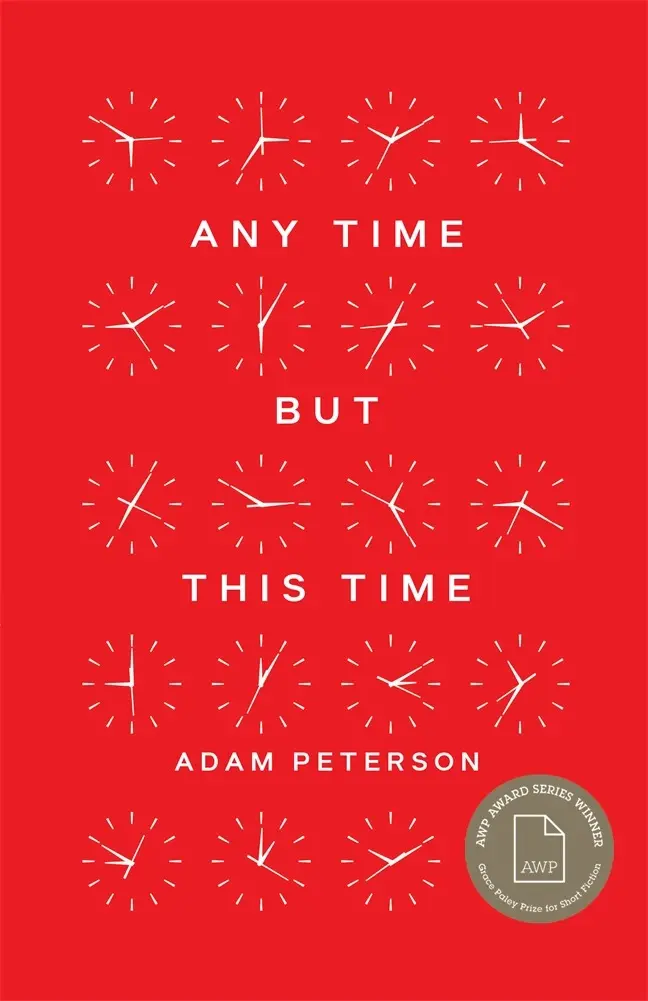
Any Time but This Time by Adam Peterson is available now via Mad Creek Books.