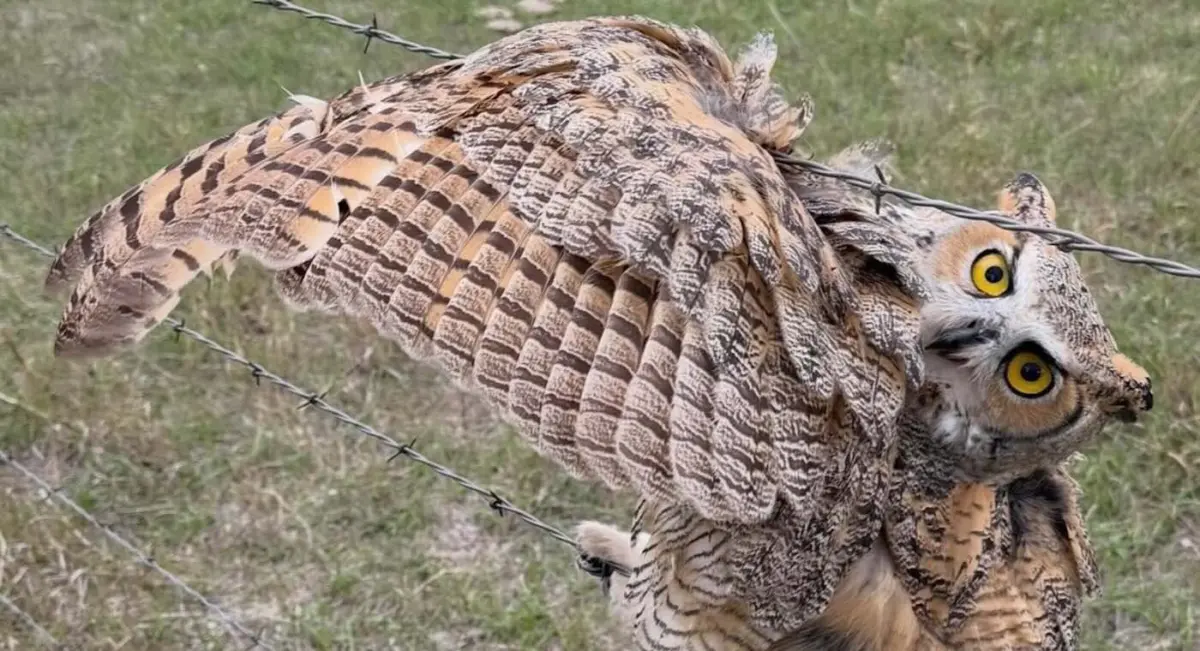
The remarkable series of events was originally detailed by the Cowboy State Daily, capturing how a rural community can seamlessly stitch itself together when a vulnerable creature is in desperate need of help.
The story unfolded when local residents Sharon and Scott Jacobs were driving past a stretch of private land in Spearfish. Scott glanced out at the fence line and caught sight of a still, dark shape. Initially, he assumed the lump of feathers draped over the wire was a deceased hawk, a tragic but not entirely uncommon sight along rural roadways where wildlife frequently encounters fencing infrastructure.
However, Sharon, a devoted animal lover with a deep-seated compassion for wildlife, felt a lingering uncertainty. Unwilling to simply drive past without confirming, she asked her husband to put the vehicle in reverse and back up so she could get a closer look at the mysterious silhouette resting against the sharp metal strands.
Stepping out of the vehicle, Sharon walked cautiously toward the fence line. As she drew nearer, the lump of what appeared to be dead feathers suddenly shifted. To her astonishment, Scott’s presumed "dead hawk" was actually a living, breathing great horned owl. The magnificent raptor was trapped, its body tangled tightly within the unforgiving coils of barbed wire.
What followed over the next hour resembled an improvised, high-stakes game of hot potato, drawing in half a village of ordinary citizens who happened to cross paths with the emergency.
Knowing that wild raptors can become immensely stressed and potentially injure themselves or their rescuers further when cornered, Sharon immediately went to work. She called back to her husband that they were dealing with an owl, and then approached as close as she dared. Maintaining a calm, steady demeanor—much like the reassuring voice she often used with her own rescued horses back home—she began speaking softly to the distressed bird, working to keep it as calm as humanly possible under the circumstances.
The rescue team quickly realized they were under-equipped for the task at hand. To safely handle a raptor of that size and disposition, they needed two essential items: a dark bag to place gently over the owl’s head, which acts as a reliable technique to keep captive or injured birds calm by eliminating visual stimuli, and a pair of heavy-duty gloves to protect human hands from razor-sharp talons.
Scott searched their vehicle and managed to locate a suitable dark bag, but they were entirely lacking gloves. At that exact moment, another motorist happened to drive by, noticing the commotion on the roadside. The driver, a local resident named Brandon, pulled over to see if anyone needed assistance. Scott quickly explained the unfolding emergency and asked if Brandon happened to have any gloves in his possession. Fortunately, he did.
Armed with the bag and the newly acquired hand protection, Brandon joined Sharon and Scott at the fence line. Together, they carefully slipped the bag over the owl’s head to subdue its panic. With a fragile semblance of protection shielding them from the bird’s formidable talons, the improvised trio began the delicate, painstaking process of trying to untwist the raptor’s feathers and body from the barbed wire.
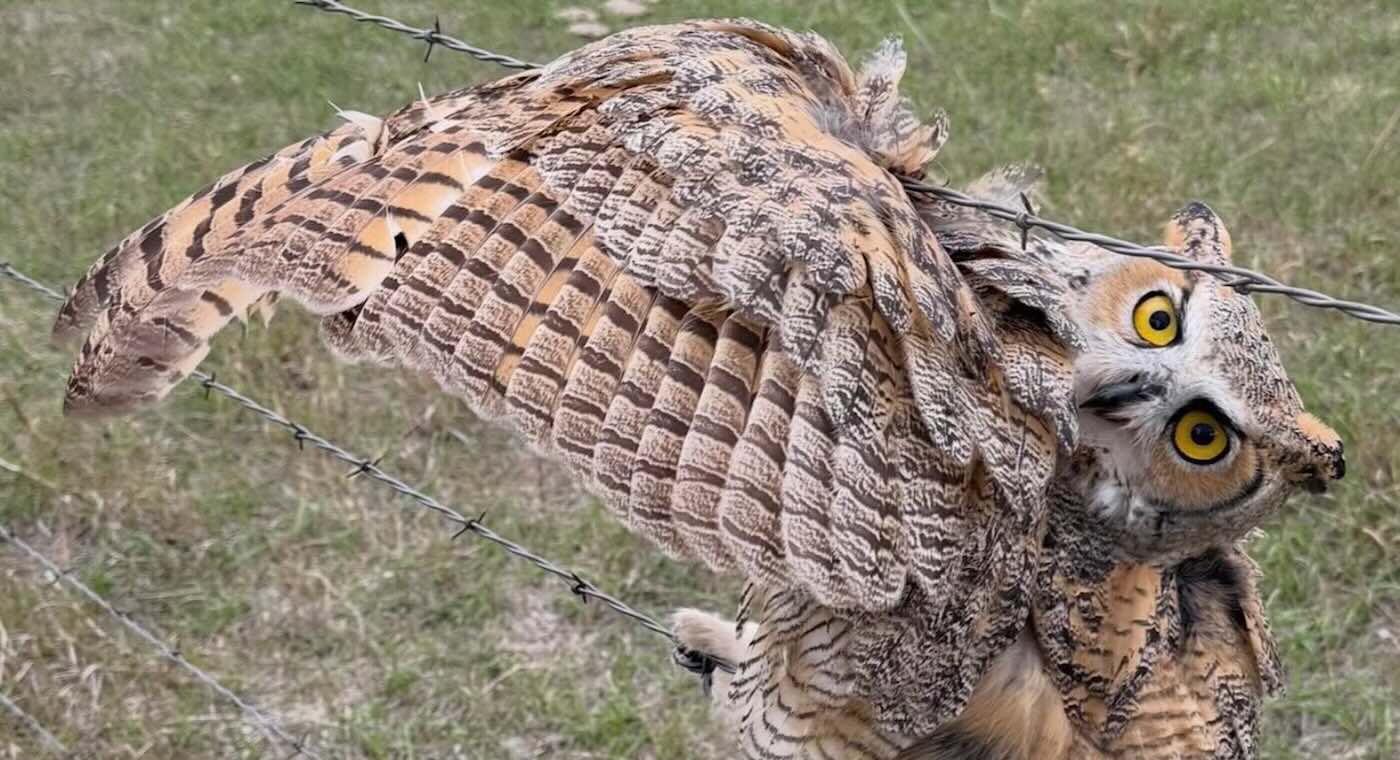
Just as they were assessing the tight grip the wire had on the animal, another key player arrived on the scene: the daughter of the property owner.
Sensing the urgency, Sharon jogged over to the burgeoning roadside parking lot to brief the newcomer. She explained the dire situation clearly, emphasizing that the absolute best and safest way to free the trapped bird without causing further trauma to its wings or skin was simply to cut the wire. The landowner’s daughter immediately placed a phone call to her father to explain the situation and ask for his permission to damage the fence. Her father did not hesitate, responding immediately with an affirmative that they ought to cut the bird free right away.
There was just one remaining obstacle standing between the owl and its freedom: wire cutters.
As fortune would have it, the community resourcefulness that had materialized on the roadside held once again. Brandon, who had already provided the crucial gloves, revealed that he also had wire cutters in his possession.
With the tools secured, the team of three individuals on-site—backed by the landowner’s daughter on the telephone granting authorization—went to work. They carefully snipped the barbed wire, finally releasing the heavy raptor from its metallic prison.
The moment the bird was free, Sharon did not waste a single second. She immediately loaded the injured owl into her vehicle and rushed it toward a local veterinarian who had already agreed to meet them at his office to conduct an emergency examination. What had started as two people on a drive had now seamlessly expanded into a five-person rescue network.
Upon arrival at the clinic, the veterinarian went to work assessing the damage. He successfully dislodged two embedded steel barbs from the animal’s body and thoroughly cleaned the wounds. To the immense relief of everyone involved, the veterinarian delivered an encouraging prognosis, confirming that the injuries were treatable and that the bird would eventually be able to fly again.
With the immediate medical crisis stabilized, Sharon took the next logical step to ensure the bird’s long-term recovery. She began calling every wildlife rehabilitation center in the surrounding region to determine which facility was best equipped to handle the specialized, intensive care required by a wounded great horned owl. After careful consideration, the Black Hills Raptor Center was identified as the ideal sanctuary for the bird’s rehabilitation journey.
Reflecting on the whirlwind sequence of events that brought strangers together from all walks of life, Sharon later shared her thoughts with the Cowboy State Daily.
"Everybody’s goal was to get this beautiful creature taken care of," Sharon said, marveling at how effortlessly the community mobilized to ensure the raptor’s survival.
Staff at the Black Hills Raptor Center have since indicated that once the owl completes its rehabilitation and regains its full strength, the most ecologically sound approach will be to release the magnificent bird right back into the exact same area where it was found. Hearing this plan, Sharon noted that she has every intention of being present for the momentous occasion—adding with a heartfelt laugh that she knows she will undoubtedly shed tears of joy when the bird finally takes flight.