
For weeks, Mia has been living out of her compact Prius, traveling nineteen hours away from home to embark on an unconventional health experiment. Suspecting that her permanent residence might be the underlying cause of long-standing, pervasive health issues, she decided to temporarily relocate for three months to test her theory before making any permanent life-altering decisions.
Settling into a sparsely furnished rental apartment with minimal stock furniture, she brought only daily essentials, work equipment, and a few personal items. This stripped-down environment quickly transformed into an impromptu masterclass in minimalism, shedding light on consumption habits, the psychological weight of physical belongings, and the unexpected benefits of solitude.
The experiment has already yielded significant developments. According to Mia, this temporary relocation is providing the first genuine improvement in her health that she has experienced in years. While the realization that her primary home may be linked to her medical struggles introduces complex challenges ahead, the immediate physical relief has validated the drastic lifestyle shift.
The Psychology of Using It Up
Among the earliest lessons learned in the sparse apartment was the psychological shift surrounding everyday consumables. Furnished short-term rentals typically provide hotel-sized portions of basic items. Having brought her own toiletries and cleaning supplies, Mia found herself surrounded by duplicate, travel-sized essentials.
Rather than succumbing to a conventional hoarding mentality—the instinct to save tiny items for a hypothetical future need—she made a conscious choice to use them immediately. Because these products were often subpar versions of everyday items, saving them offered no genuine enrichment to her daily routine. By rapidly consuming these products, discarding the empty containers, and clearing them from her physical space, she noticed a corresponding reduction in mental clutter. This hands-on realization reinforced her support for intentional decluttering strategies focused on completely exhausting current inventory before acquiring replacements.
The Power of Functional Decor
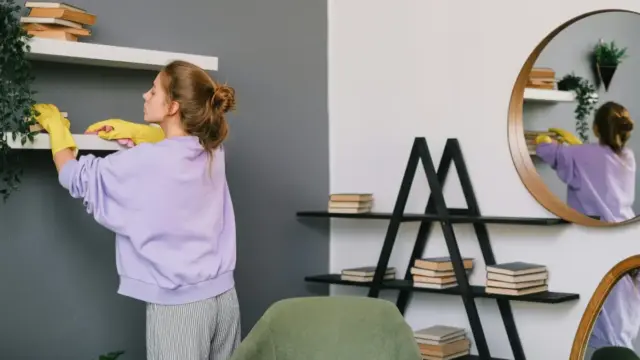
Being a self-described homebody, adapting to an unfamiliar living space presented a psychological hurdle. To combat the sterile feel of bare stock furniture, Mia integrated the few personal items she brought from home directly into her daily environment rather than hiding them away in drawers or closets.
Colorful throw blankets were draped across the couch rather than neatly folded and stored. Books were propped up on surfaces throughout the apartment rather than stacked quietly on a bedside table. While an excessive accumulation of items styled this way might easily transition into visual clutter, limiting the approach to a handful of meaningful mementos successfully warmed up the space. The strategy allowed everyday functional items to serve a dual purpose, making the temporary apartment feel like home without generating useless waste or unnecessary accumulation.
Navigating Personal Needs Through Intentional Objects
Living away from home also highlighted the importance of intentional utility, particularly for individuals managing sensory sensitivities. For Mia, the sound of clinking metal silverware triggers nausea, a daily challenge when confronting standard apartment kitchenware. Rather than enduring the standard cutlery or accumulating single-use plastic items, she relied on a combination of a newly gifted wooden spoon and a pair of chopsticks.

The wooden spoon, given to her by a close friend during a recent birthday visit, immediately replaced the standard utensil drawer, rendering the rest of the kitchen’s metal cutlery obsolete. The experience underscored a broader philosophy of material selection: possessing a single item that serves its purpose perfectly, while also bringing personal joy, holds far greater value than maintaining a collection of redundant or uninspiring alternatives.
The Unexpected Benefits of Solitude
The relocation also brought an abrupt shift in social dynamics. With only a few acquaintances nearby, her social calendar shrank dramatically compared to her life back home. While deeply valuing her friendships, Mia discovered that the reduction in social obligations provided a profound surge of energy and productivity.
Managing a simplified living space freed up substantial time and mental bandwidth. Daily routines, such as walking to the gym for workouts and preparing healthy meals, became effortless. Furthermore, having recently acquired a business, the newly found quiet allowed her to get significantly ahead on professional responsibilities while carving out the mental space required to write and reflect on her blog.
Despite the benefits of solitude, she plans to gradually reintroduce social activities and structured hobbies—such as game nights with old friends and returning to fight training—now that her energy levels have rebounded. The temporary isolation, however, proved vital in restoring her physical and mental stamina.
The Rapid Accumulation of Clutter
Despite conscious efforts to maintain a minimalist lifestyle, the experiment demonstrated just how quickly physical objects infiltrate a living space. Within three weeks of arrival, the impending threat of clutter became tangible. Following her recent birthday, new gifts began occupying visible space, including a trampoline positioned nearby. Additionally, despite driving cross-country with almost nothing, her kitchen cabinets quickly filled with saved plastic food storage containers.
This rapid accumulation illustrated a broader systemic flow of goods within modern domestic environments, where items naturally migrate into the home on a daily basis. Without an intentional, counteracting flow of goods moving back out, possessions inevitably pile up over time. To combat this phenomenon, she quickly returned to established passive decluttering practices to maintain control over her environment.
Assessing the Experiment
As the three-month experiment continues, the preliminary results offer a mixture of encouragement and complexity. The noticeable improvement in her health represents a major breakthrough after years of unyielding symptoms. At the same time, acknowledging that her primary residence may be the root cause presents logistical and emotional hurdles that will require careful navigation.
With the newfound mental clarity and reduced domestic friction provided by her minimalist surroundings, she intends to address these underlying environmental concerns. In the meantime, daily routines continue uninterrupted, and preparations are underway for upcoming community initiatives, including a planned holiday decluttering challenge for her readers.