
For investors who have tuned out the daily financial drama, the baseline narrative of the AI boom is straightforward: rapid technological breakthroughs, staggering corporate investments, and an intense public focus on how automated intelligence will reshape the global workforce. Yet, this rapid ascent has sparked widespread anxiety. Market participants worry that the current mania is moving too fast and reaching too high, setting the stage for a repeat of the early 2000s dot-com crash. That particular historical boom launched the early career of prominent financial commentators before the ensuing bust threatened employment status and financial stability.

Addressing these cyclical anxieties has become a regular fixture for long-term financial educators. Recently, discussions centered on the AI investment cycle have taken center stage at gatherings such as Camp FI Midwest, with further presentations scheduled for upcoming financial conferences like the Bogleheads gathering. While financial media outlets frequently spin alarming narratives about impending doom, a closer look at historical market cycles reveals a broader perspective on how booms, busts, and human psychology interact over decades.
Will the AI Bubble Ruin Our Retirement?
Achieving long-term financial independence and reaching more than two decades of retirement brings a certain level of comfort with market volatility. However, questions from peers about how retirees manage to sleep at night amidst global uncertainty highlight a persistent cultural unease. When news watchers list their primary concerns, the roster typically includes aggressive geopolitical actors, persistent inflation, towering national debts, international conflicts, and the looming threat of the AI bubble.

Interestingly, these specific worries echo anxieties from previous decades, though the particulars shift over time. Exactly twenty years prior, during the economic environment of 2006, observers were similarly preoccupied with dangerous geopolitical leaders, conflicts in the Middle East, national debt, and inflation. Back then, the overvalued stock market was attributed to a roaring housing bubble rather than an AI boom, and the dominant fear regarding employment was the outsourcing of jobs overseas rather than automation. There were even fierce debates over peak oil and whether fossil fuel depletion would doom global industrial civilization—an outcome that ultimately reversed course as technology advanced.
Despite the heavy cloud of anxiety in 2006, the subsequent two decades witnessed both severe economic trauma and remarkable overall growth. The Great Financial Crisis materialized shortly thereafter, driven by irrational exuberance over escalating home values combined with complex, over-leveraged financial instruments. It stands as the largest market crash since the Great Depression. Yet, when viewed through a long-term historical lens, even that monumental crisis appears as a temporary dip. A hypothetical investment of one hundred thousand dollars made prior to that era would have nonetheless grown substantially over the subsequent twenty years, weathering both the financial collapse and the subsequent economic shock of the 2020 pandemic.

Simultaneously, global living standards improved dramatically across multiple metrics. The proportion of the global population living in extreme poverty dropped significantly over a twenty-year span, while infant mortality rates were cut in half. Clean energy expanded exponentially as solar panel costs plummeted, making solar generation a dominant source of new electrical capacity worldwide. Pure electric vehicle sales transitioned from a negligible market share to a substantial fraction of global automotive sales. These developments suggest that focusing energy on an uncertain future yields less value than maintaining a constructive, long-term outlook.
Prosperity Comes From Productivity
The persistent question remains whether the current economic environment is fundamentally different. Skeptics point to the soaring United States national debt, the unprecedented scale of the AI valuation bubble, or speculative scenarios involving superintelligent systems outgrowing human utility. Financial media outlets capitalize on these fears, yet they frequently overlook a fundamental economic principle: true prosperity does not originate within the financial system or the stock market, which ultimately rely on numerical abstractions tracked by computers.

Instead, real prosperity is derived entirely from productivity. Long-standing financial philosophy emphasizes that while the capitalist system remains inherently volatile and prone to wild sentiment swings, beneath the surface turbulence lie real people performing tangible work and generating genuine technological inventions. The concept of an economy is simply another human construct. If a financial system experiences a severe correction because market participants dislike prevailing numerical valuations, society simply recalibrates the metrics and resumes productive labor—a mechanism demonstrated repeatedly following past panics, including the severe downturn of 2008.
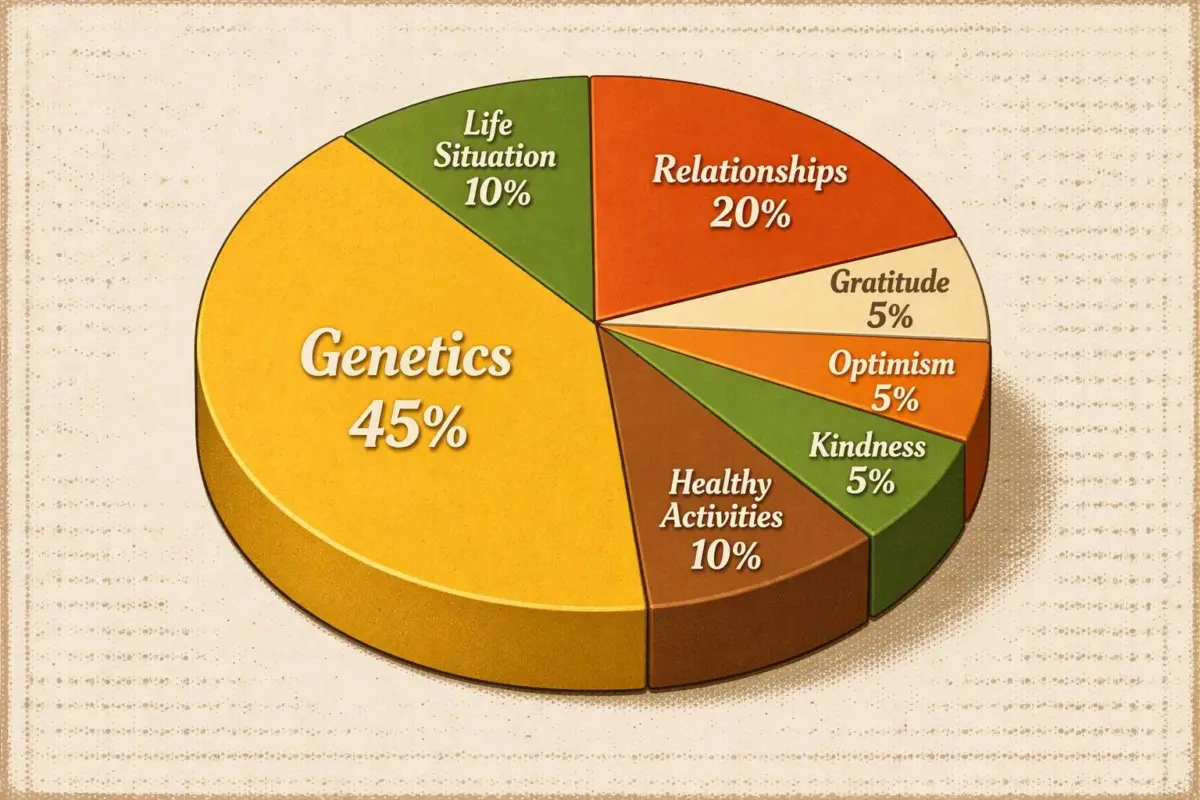
Humanity retains every foundational tool ever invented to enhance productivity. Standard of living, economic growth, and the viability of early retirement are all direct byproducts of high productivity rather than speculative market indices. Once societies achieve a baseline standard of living—a threshold surpassed decades ago in the developed world—further wealth accumulation yields diminishing returns in terms of fundamental human happiness. Psychological well-being depends much more heavily on non-financial factors, including stable personal relationships, optimism, gratitude, and regular engagement in physical and outdoor activities.

Confronting Fear and Viewing Everything as an Experiment
A major impediment to rational financial planning is fear itself. Human beings evolved as sophisticated danger-detection mechanisms, utilizing background anxiety to protect against physical threats and scarcity. However, once immediate physical dangers and material scarcity are successfully mitigated, this psychological machinery often continues running, shifting its focus toward abstract worries, social status comparisons, tax strategies, or regulatory complexities.
Combatting this innate tendency requires self-awareness and an understanding of personal history. Fear of scarcity is frequently passed down through generations, originating from childhood experiences or ancestral survival through historical economic depressions. Identifying the root causes of financial anxiety and systematically analyzing worst-case scenarios helps strip irrational fears of their power. Taking concrete action remains one of the most effective antidotes to anxiety, as proactive behavior transforms the unfamiliar into the manageable and builds genuine personal resilience.

Furthermore, curating a healthy mental diet by reducing consumption of sensationalized daily news helps eliminate unnecessary psychological distress. Human beings are biologically wired to solve problems through physical and mental engagement rather than passive observation of alarming headlines. Shifting focus toward continuous learning, active problem-solving, and building positive social connections with optimistic, productive peers creates an environment where fear naturally recedes.
Adopting a mindset that treats major life transitions and technological shifts as experiments can fundamentally alter one’s perspective. Whether applied to minor household changes or major life decisions like early retirement, viewing outcomes through an experimental lens removes the emotional terror associated with uncertainty.

This perspective applies directly to the current artificial intelligence landscape. Rather than succumbing to doom-scrolling and generalized panic over technological displacement, viewing AI as a sophisticated cognitive tool helps reframe the discussion. Much like the introduction of the internet or automated manufacturing equipment, AI functions as a powerful mechanism to boost efficiency, productivity, and overall economic prosperity. While technological displacement is an inevitable byproduct of automation that requires ongoing economic adaptation, it simultaneously lowers service costs and catalyzes the creation of entirely new industries.
Artificial intelligence ultimately presents society with a choice: to view new developments through a lens of paralyzing fear or to utilize them as a catalyst for continuous learning, positive adaptation, and a more engaged approach to life. By recognizing that fear is often a symptom of evolutionary wiring rather than an accurate reflection of present reality, individuals can better navigate financial markets, retirement planning, and technological revolutions with clarity and confidence.