

The existence of the deduction often comes as a surprise to retirees comparing notes with friends or neighbors. Conversations over smaller-than-expected tax refunds frequently reveal that peers have successfully claimed the senior tax break while others overlooked it entirely. Because some tax preparation software and accountants failed to proactively highlight the change during the initial rollout, many older Americans filed their previous returns without applying the credit, leaving thousands of dollars unclaimed. For a single retiree, a $6,000 deduction can represent a substantial sum—equivalent to a vacation, a year of property taxes, or a major home repair—while married couples filing jointly can secure double that amount.

What Is the New Senior Tax Break?
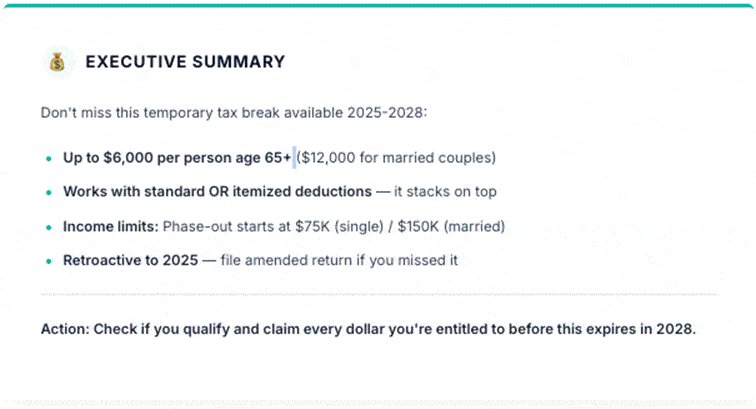
The legislative origin of the deduction traces back to the passage of the One Big Beautiful Bill Act, which was signed into law on July 4, 2025. Buried within the sweeping legislation alongside various other tax adjustments was a dedicated 65 and older tax deduction designed to ease the financial pressure on aging populations facing inflation and rising costs of living.
Crucially, this provision functions independently from existing standard deductions and senior exemptions. Rather than replacing traditional write-offs, it operates as an additional layer of tax relief. Taxpayers are permitted to utilize the benefit regardless of whether they choose to take the standard deduction or itemize their returns, making it a flexible tool for comprehensive retirement tax planning.
Financial Impact and Income Thresholds
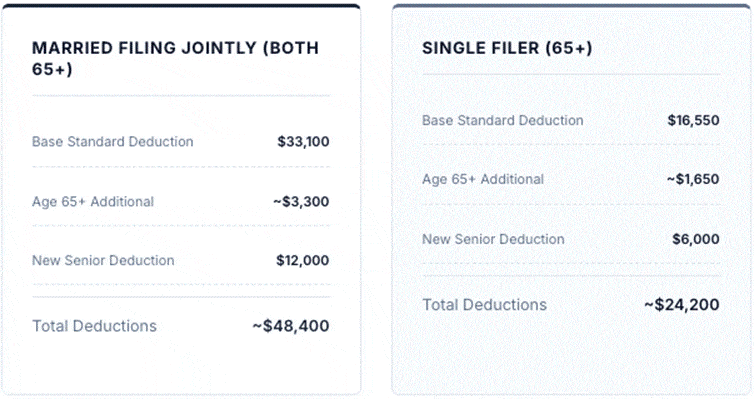
For qualifying retirees, the cumulative effect of standard deductions combined with the new senior tax break creates a substantial shield against federal income liability. When factoring in standard inflation-adjusted deductions for older adults, qualifying married couples may see total baseline deductions approaching $48,400 before any itemization is even considered. For millions of retirees whose primary income sources consist of Social Security benefits and modest retirement accounts, this significant reduction in taxable income can bring their federal tax bill remarkably close to zero, effectively acting as a powerful Social Security tax offset.
However, access to the full deduction is subject to specific income limitations based on Modified Adjusted Gross Income, commonly referred to as MAGI. The policy includes a phase-out structure designed to target relief toward low- and middle-income seniors. For single filers, the phase-out threshold begins at $75,000, while married couples filing jointly face a threshold of $150,000.

The reduction follows a clear mathematical formula: taxpayers lose six cents of the deduction for every dollar their income exceeds the established threshold. For example, a single filer earning $100,000 sits $25,000 above the single limit, resulting in a $1,500 reduction to the deduction and leaving them with a $4,500 benefit instead of the maximum $6,000. Similarly, a married couple with a joint income of $200,000 experiences a $3,000 reduction, retaining a substantial $9,000 deduction.
Clarifying Misconceptions Around Social Security Taxation
The introduction of the deduction has reignited public discussions regarding the taxation of Social Security benefits, a topic that frequently generates confusion. During earlier political campaigns, widespread proposals circulated regarding the complete elimination of federal income taxes on Social Security benefits—a policy change estimated to cost approximately $1.4 trillion over a decade.
The legislation that ultimately passed represented a more modest compromise, carrying an estimated price tag of $93 billion over the same timeframe. Consequently, the new policy does not legally alter the underlying formula governing how Social Security benefits are taxed. Instead, by lowering overall taxable income, the deduction produces a practical offset effect that achieves a similar financial outcome for lower-income retirees. Higher-earning seniors, conversely, will find that the deduction provides tax relief on their broader financial portfolio rather than eliminating benefit taxation entirely.
Strategic Considerations and Filing Requirements
Navigating the new deduction requires careful attention from retirees and their financial advisors. Because the provision is retroactive to the 2025 tax year, individuals who realize they missed the deduction on their previous filings are not permanently barred from receiving the funds. Taxpayers can file an amended return using IRS Form 1040-X to claim the retroactive benefit, potentially recovering hundreds or thousands of dollars depending on their tax bracket.

Furthermore, because the deduction is temporary and scheduled to sunset after four tax years—spanning from 2025 through 2028—financial planners recommend incorporating this finite window into broader retirement strategies. Seniors evaluating major financial decisions, such as executing Roth IRA conversions, drawing down large sums from tax-deferred accounts, or managing capital gains, must account for this temporary tax shield. Managing income to remain below or near the phase-out thresholds can maximize the long-term value of the relief before the statutory expiration date arrives.