
While market observers happily tune out the daily drama to enjoy their lives, the financial narrative surrounding AI dominates headlines. The core fear gripping investors is that while AI is undeniably a major technological advancement, the speculative mania driving it is moving too fast and reaching too high. Many fear we are setting the stage for an amplified replay of the dot-com crash of the early 2000s—a historical parallel that hits close to home for seasoned market participants who lived through the era. That previous internet boom launched early careers and paved the way for early retirement, even as the ensuing bust nearly derailed personal milestones like employment and citizenship applications.

Addressing these cyclical anxieties has become a frequent endeavor for long-time financial commentators. Recently, these thoughts were formalized into a presentation delivered at Camp FI Midwest, with an expanded version slated for the upcoming Bogleheads conference in November. The central question underlying these discussions remains constant across generations: Will the latest technological bubble ruin retirement, or is the fear itself the greater hazard?
Will the AI Bubble Ruin our Retirement?
Reflecting on decades of retirement brings a certain comfort, yet it often highlights the stark contrast between calm experience and external panic. Friends and peers frequently ask how anyone can remain retired, comfortable, and able to sleep at night given the state of the world. A typical catalog of modern worries includes corrupt or dangerous political figures menacing global stability, persistent inflation eroding purchasing power, towering national debts, and geopolitical conflicts threatening widespread destruction.

Yet, these anxieties are remarkably persistent across time. Looking back two decades to 2006, the worries of the day felt just as pressing and apocalyptic. Back then, the world fixated on different leaders, conflicts in the Middle East, escalating national debt, and a severely overvalued housing market that ultimately triggered the Great Financial Crisis. Discussions at the time warned of job outsourcing to India and China, alongside fierce debates over "Peak Oil" and the imminent exhaustion of fossil fuels.
Despite the profound anxieties of 2006, the ensuing twenty years revealed a different reality. Even the Great Financial Crisis—the deepest economic downturn since the Great Depression, fueled by irrational exuberance in real estate and complex financial leverage—looks surprisingly modest in the rearview mirror of a multi-decade stock chart. A $100,000 investment made during those turbulent years would have grown significantly by modern standards, weathering subsequent downturns like the 2020 pandemic crash along the way.

Simultaneously, the broader world experienced substantial improvements. Global extreme poverty rates dropped dramatically over a twenty-year span, and infant mortality rates were cut in half. Clean energy expanded rapidly as solar panels became exponentially cheaper, allowing solar generation to dominate new energy additions globally. Pure electric vehicle sales surged from near-zero to claim a significant share of worldwide automotive sales.
Examining this trajectory highlights a fundamental truth about economic panics: prosperity does not originate from the financial system or the stock market, which are ultimately human constructs built on computer data and numerical values. True prosperity stems directly from productivity.

The Root of Prosperity and the Trap of Fear
The underlying mechanics of capitalism are inherently choppy, prone to wild swings and periodic corrections. However, beneath the surface volatility, real people engage in real work, developing tangible inventions and driving economic output. If an economic system suffers a severe contraction due to shifting numbers, society possesses the capacity to reset the metrics and return to work—a mechanism successfully employed during 2008 and numerous historical precedents.
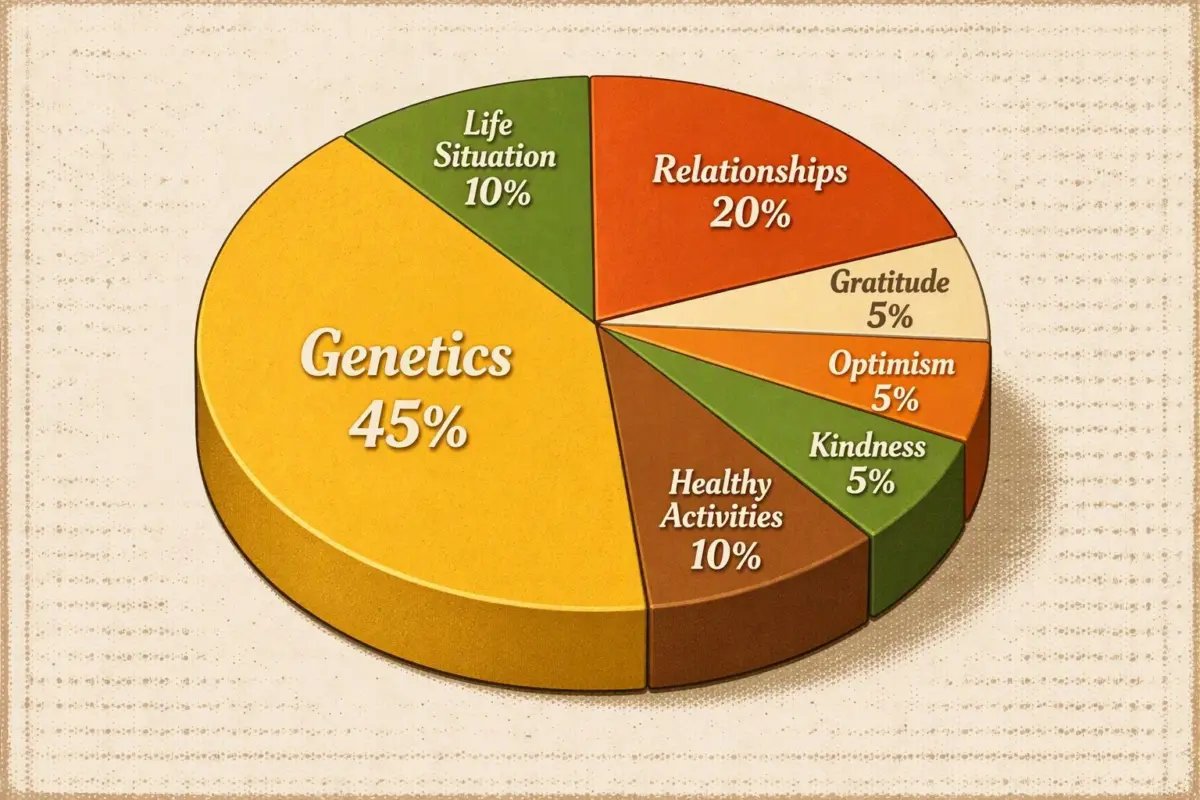
Standard of living, economic growth, and the viability of early retirement are fundamentally anchored in high productivity. Yet, once a society achieves a baseline standard of living, human happiness levels off within the material dimension. Advanced nations crossed those basic requirements decades ago, shifting the focus of human satisfaction toward non-material factors. While genetics play a substantial role in baseline happiness, controllable choices—such as cultivating close relationships, practicing gratitude, maintaining an optimistic philosophy, and incorporating regular outdoor physical activity into daily life—exert a far more meaningful influence on personal well-being.

Despite these reassuring historical patterns, fear remains a persistent obstacle. Human beings evolved as sophisticated danger detection machinery, a biological trait designed to protect against immediate threats. However, when genuine dangers recede, this psychological machinery frequently continues searching for new targets. Once physical survival and food security are established, anxiety shifts toward social belonging, financial status, and abstract economic concerns, eventually reaching trivial heights such as worrying about tax strategies or Required Minimum Distributions during retirement.
Combating this pervasive background fear requires self-awareness and rational evaluation. Examining personal history—such as growing up in households influenced by a scarcity mindset stemming from the Great Depression—often uncovers the true origins of modern financial anxieties. Recognizing that these feelings frequently reflect past trauma or inherited psychological patterns rather than objective present realities allows individuals to confront worst-case scenarios rationally. Action consistently cures fear by transforming the unfamiliar into the familiar, fostering resilience and adaptability.

Filtering out the daily barrage of sensationalized news media further supports mental clarity. News cycles naturally prioritize alarming stories, whereas meaningful progress relies on positive behaviors, continuous learning, and direct problem-solving. Aligning daily routines with human biology—spending time outdoors, moving regularly, and engaging with optimistic, productive communities—helps dismantle the cycle of chronic worry.
Everything is an Experiment
Approaching major life transitions with an experimental mindset offers an effective framework for managing uncertainty. Whether making minor domestic changes or navigating significant milestones like career shifts, new relationships, or early retirement, treating life’s variables as tests reduces emotional friction.

This experimental perspective applies directly to the modern rise of Artificial Intelligence. Rather than succumbing to doom-scrolling and ominous media narratives, understanding the underlying mechanics of AI reveals its potential as a sophisticated form of cognitive leverage. Much like a cognitive nail gun, AI enhances human efficiency, boosting productivity and ultimately driving broader prosperity by making advanced problem-solving tools widely accessible.
Naturally, technological revolutions also introduce workforce disruptions, displacing traditional entry-level administrative and technical roles while simultaneously lowering service costs and catalyzing entirely new industries. Similar to the introduction of the internet and mobile computing, these shifts concentrate immediate rewards among asset owners and shareholders, while challenging the broader workforce to adapt.

Ultimately, technological advancements and economic fluctuations serve as opportunities for deliberate choice. Recognizing fear as an internal psychological response rather than an external threat allows individuals to navigate change through education, resilience, and purposeful action.