
The stock market has a persistent habit of surprising observers. As years pass, major indices fluctuate, crashing to stoke fears of a shrinking retirement stash, then rebounding to record-shattering valuations that prompt an entirely different kind of panic. After all, soaring valuations inevitably breed fears of an impending, catastrophic correction—particularly when current market enthusiasm is fueled by the frenzied expansion of Artificial Intelligence.

For those who manage to tune out financial media drama, blissful ignorance remains an option. However, for investors tracking the current landscape, the AI boom evokes haunting parallels to the dot-com bubble of the early 2000s. That historical market cycle notably turbocharged the early career of prominent financial blogger and early-retirement advocate Mr. Money Mustache, before the subsequent crash nearly derailed his employment and citizenship application.
Addressing widespread questions regarding the current investment cycle, the veteran financial commentator recently debuted a new presentation at Camp FI Midwest, with an updated version slated for the upcoming Bogleheads conference in November. By examining historical market anxiety, the psychology of fear, and the true drivers of economic prosperity, financial observers are taking a closer look at whether the artificial intelligence wave poses a genuine threat to modern retirement plans.

Will the AI Bubble Ruin Our Retirement?
Having achieved over two decades of retirement, the author notes a persistent curiosity from anxious acquaintances. Friends frequently pose variations of a deeply unsettled question: how anyone can remain retired and sleep soundly at night given the state of the world.
A laundry list of modern anxieties typically fills the news cycle: geopolitical volatility involving leaders like Vladimir Putin, persistent inflation eroding purchasing power, the towering United States national debt, and multiple international conflicts threatening global stability. Yet, historical perspective reveals that these worries are merely updated versions of anxieties from decades past.

Reflecting on the year 2006, the worries haunting investors looked remarkably similar, albeit with different actors. Society fixated on geopolitical tensions in the Middle East centered around Iraq, alongside leaders like George W. Bush and Saddam Hussein. Concerns over national debt, inflation, and overvalued asset classes dominated financial discussions, though the housing bubble eclipsed artificial intelligence as the primary real estate and stock market boogeyman. At the time, anxiety centered on job outsourcing to India and China, alongside fierce debates over "peak oil" and the impending exhaustion of fossil fuel supplies.
Despite the anxieties of 2006, the subsequent decades brought profound economic growth. Even the Great Financial Crisis—triggered by irrational exuberance over housing prices and over-leveraged mortgage financial instruments—ultimately registered as a minor dip on a multi-decade stock chart. Over a twenty-year horizon, a $100,000 investment grew substantially, easily absorbing subsequent shocks like the 2020 pandemic crash.

Globally, standard-of-living metrics improved dramatically. The proportion of the global population living in extreme poverty dropped from 20% in 2005 to 8% over the following two decades, while global infant mortality was cut in half. Clean energy expanded exponentially as solar panel costs plummeted, allowing solar generation to dominate new energy additions worldwide. Simultaneously, electric vehicle adoption surged from near-zero to significant global market share.
This historical trajectory raises a fundamental question: whether current anxieties regarding the US national debt, systemic AI disruption, or a potential superintelligence are genuinely different this time. While financial media capitalizes on fear-mongering narratives, economic history suggests that core prosperity stems not from computer-generated figures in the stock market, but from tangible productivity.

Prosperity, Productivity, and the Psychology of Fear
At its foundational level, economic prosperity is driven by productivity rather than financial market fluctuations. The capitalist system is inherently volatile, characterized by choppy waters and wild swings. Beneath those surface waves, however, real people perform real labor and develop tangible inventions.
Financial systems and stock markets are fundamentally human constructs. If a financial system collapses due to shifting market sentiment, society can restructure numerical valuations and resume productivity, exactly as occurred following the 2008 financial crisis and prior historical downturns. Human ingenuity retains every tool ever invented to boost productivity, which remains the true engine of economic growth, higher standards of living, and financial independence.

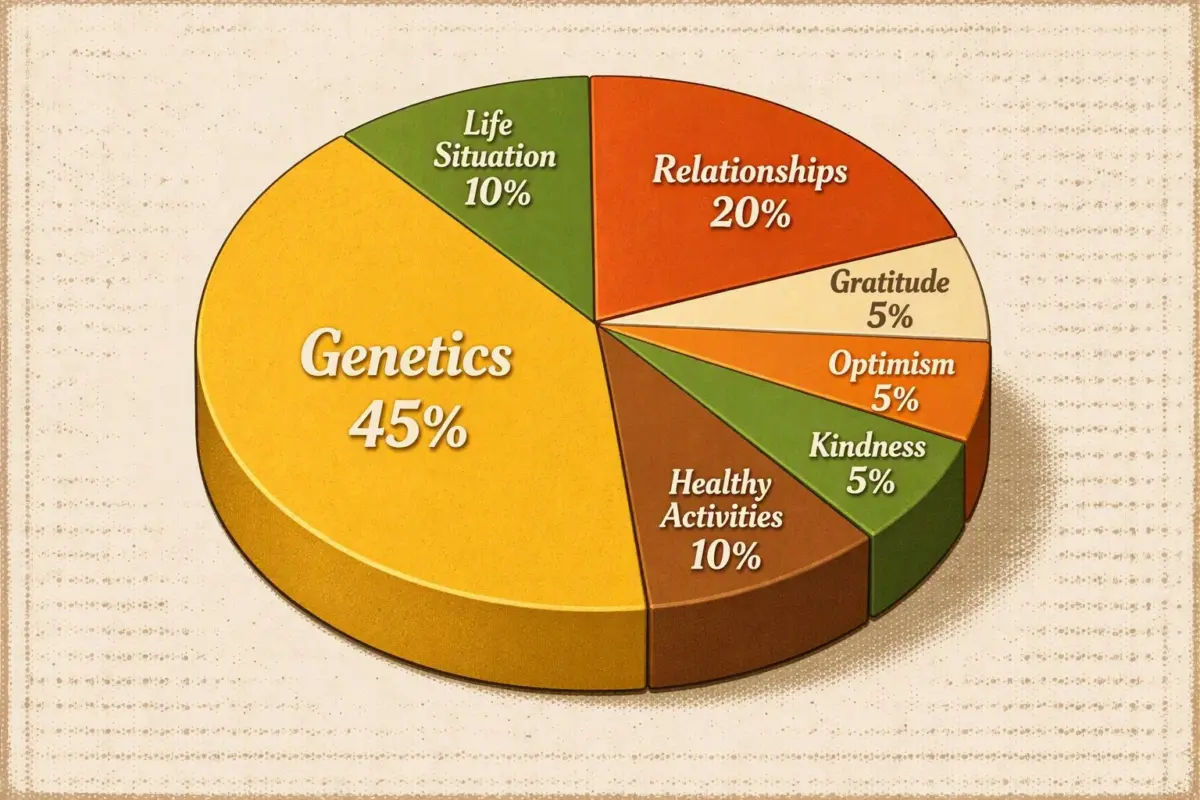
Once a society achieves a baseline standard of living, human happiness largely plateaus along that economic dimension. Wealth ultimately functions as a single component of an individual’s broader life situation. According to behavioral research, happiness is influenced heavily by non-monetary factors, including genetics, close interpersonal relationships, lifelong optimism, and regular engagement in healthy physical activity.
Despite these established principles, pervasive fear continues to plague modern investors. The root cause lies in human evolutionary biology: humans function fundamentally as danger-detection machines. This background anxiety evolved as an adaptive trait to protect against environmental threats. However, when immediate physical dangers are resolved, human psychology continually shifts the goalposts, seeking new sources of worry.

Once scarcity and physical survival threats are conquered, anxiety migrates toward social acceptance, tribal belonging, and financial status. Eventually, individuals reaching comfortable upper-middle-class lifestyles find entirely new outlets for anxiety, ranging from homeowners’ association disputes to complex tax strategies, estate planning, and managing government-mandated Required Minimum Distributions (RMDs) for surplus wealth.
Combating this pervasive fear requires deliberate self-awareness and rational evaluation. Understanding one’s personal history—such as childhood scarcity mentalities or past trauma—sheds light on irrational financial anxieties rooted in the past rather than the objective reality of the present. Identifying worst-case scenarios through structured analysis often reveals that potential financial outcomes are rarely as catastrophic as anticipated.

Action Cures Fear and Redefines the AI Era
Taking decisive action serves as an effective antidote to fear, transforming the unfamiliar into the familiar and building resilience. When individuals develop mental, physical, and emotional adaptability, systemic uncertainties lose their paralyzing grip. Furthermore, reducing exposure to sensationalized daily news diets helps eliminate the psychological toll of curated fear-mongering.
Human beings are biologically wired to solve problems actively using both body and mind, ideally in dynamic outdoor environments. Modern sedentary lifestyles centered around indoor offices and digital screens frequently exacerbate mental health challenges. Realigning daily routines toward active learning, physical movement, and constructive problem-solving naturally diminishes existential dread.

Viewing life transitions through the lens of experimentation—treating career shifts, housing changes, early retirement, and technological disruptions as controlled experiments—alters how individuals process uncertainty. This experimental mindset applies directly to the current artificial intelligence revolution, which has sparked widespread apprehension among workers and investors.
Rather than succumbing to doom-scrolling and ominous media coverage, understanding the underlying mechanics of artificial intelligence reframes the technology. AI functions effectively as a sophisticated form of cognitive leverage—a cognitive nail gun designed to enhance efficiency and productivity. While technological revolutions invariably displace certain administrative and entry-level roles in sectors like finance and software development, they simultaneously lower service costs and catalyze entirely new industries, mirroring the historical trajectory of the internet and mobile computing.

The economic rewards of such technological leaps tend to concentrate among capital owners and shareholders, aligning with broader market performance that has bolstered investor portfolios in recent years. Ultimately, artificial intelligence represents another major technological shift that offers choices rather than mandatory peril.
Approaching the future with curiosity rather than trepidation allows individuals to harness technological progress as a catalyst for continuous learning and personal growth. As financial philosophers frequently observe, the experiences and achievements individuals seek in life invariably lie just beyond the boundary of fear, waiting for those willing to confront uncertainty head-on.