For the prestigious Kips Bay Decorator Show House in New York City, acclaimed interior designer Peter Dunham decided to chart an entirely different course. Rather than chasing fleeting trends or designing for a hypothetical occupant, Dunham chose to build the space he personally desired.
“It was a very selfish room,” Dunham reflects on his striking installation. “It’s the pied-à-terre that I would like to have in that very location for me in New York. It was very personal.”
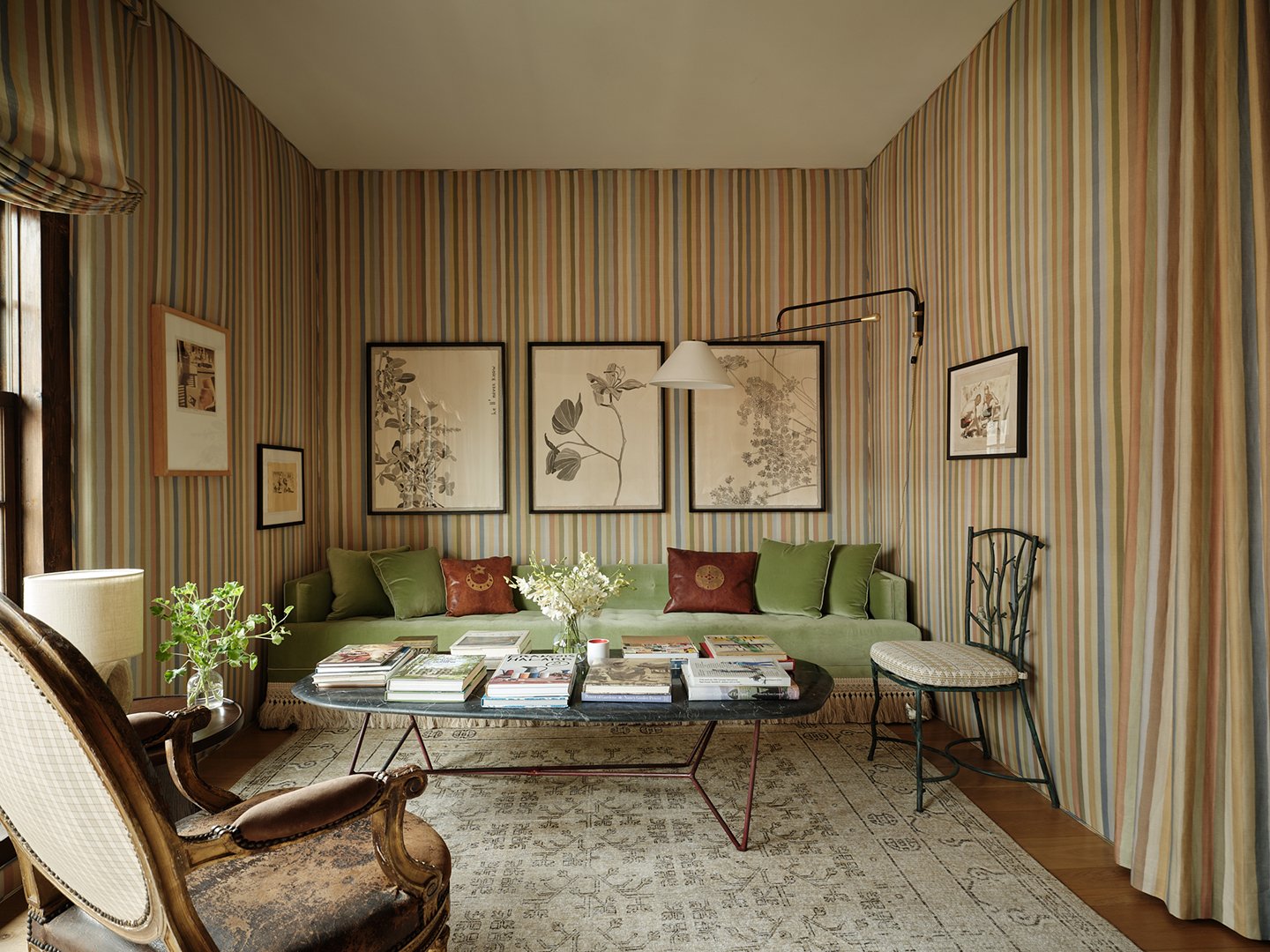
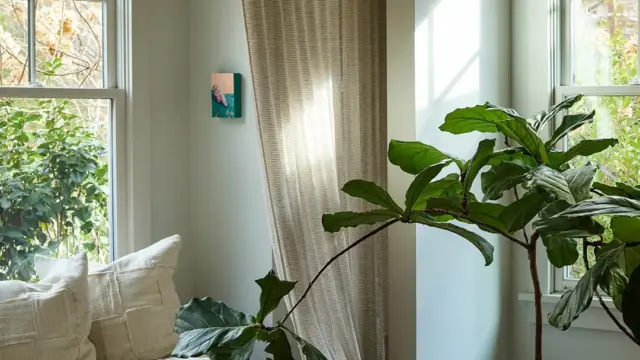
Beyond crafting a space tailored to his own tastes, Dunham sought to establish a profound dialogue with the historic building’s architecture and the surrounding Greenwich Village neighborhood. His color palette and material choices were directly inspired by the natural urban landscape just outside the windows, capturing the rich greens of the neighborhood trees and the warm, rusty hues of classic New York brickwork. The resulting room achieves a deeply atmospheric and airy ambiance, layered with art, textiles, materials, and furnishings spanning multiple eras. The space is so cohesive and lived-in that it feels as though it had evolved organically over decades rather than being assembled in a matter of days.
To understand what makes the space so inviting and how such sophisticated layering was achieved under a notoriously tight deadline, Dunham breaks down the core principles and design strategies that brought his vision to life.
Employ the 75/25 Rule
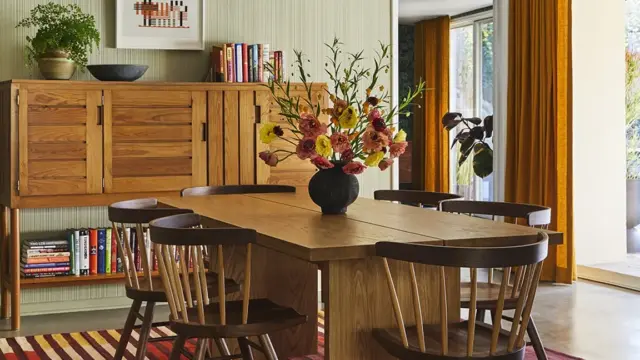
A foundational philosophy in Dunham’s design methodology is the 75/25 rule, which dictates that a maximum of 75 percent of the items in a room should be newly manufactured, while a minimum of 25 percent should consist of found objects, antiques, or vintage pieces. In his Kips Bay space, Dunham met and comfortably exceeded that vintage minimum.
The room features a carefully curated collection of historical and vintage pieces, anchored by a vintage sofa that was meticulously reupholstered in a rich green velvet from Kravet and finished with custom fringe trim by Samuel & Sons. Additional vintage elements include a classic Louis XVI armchair and a modern French black marble tabletop.
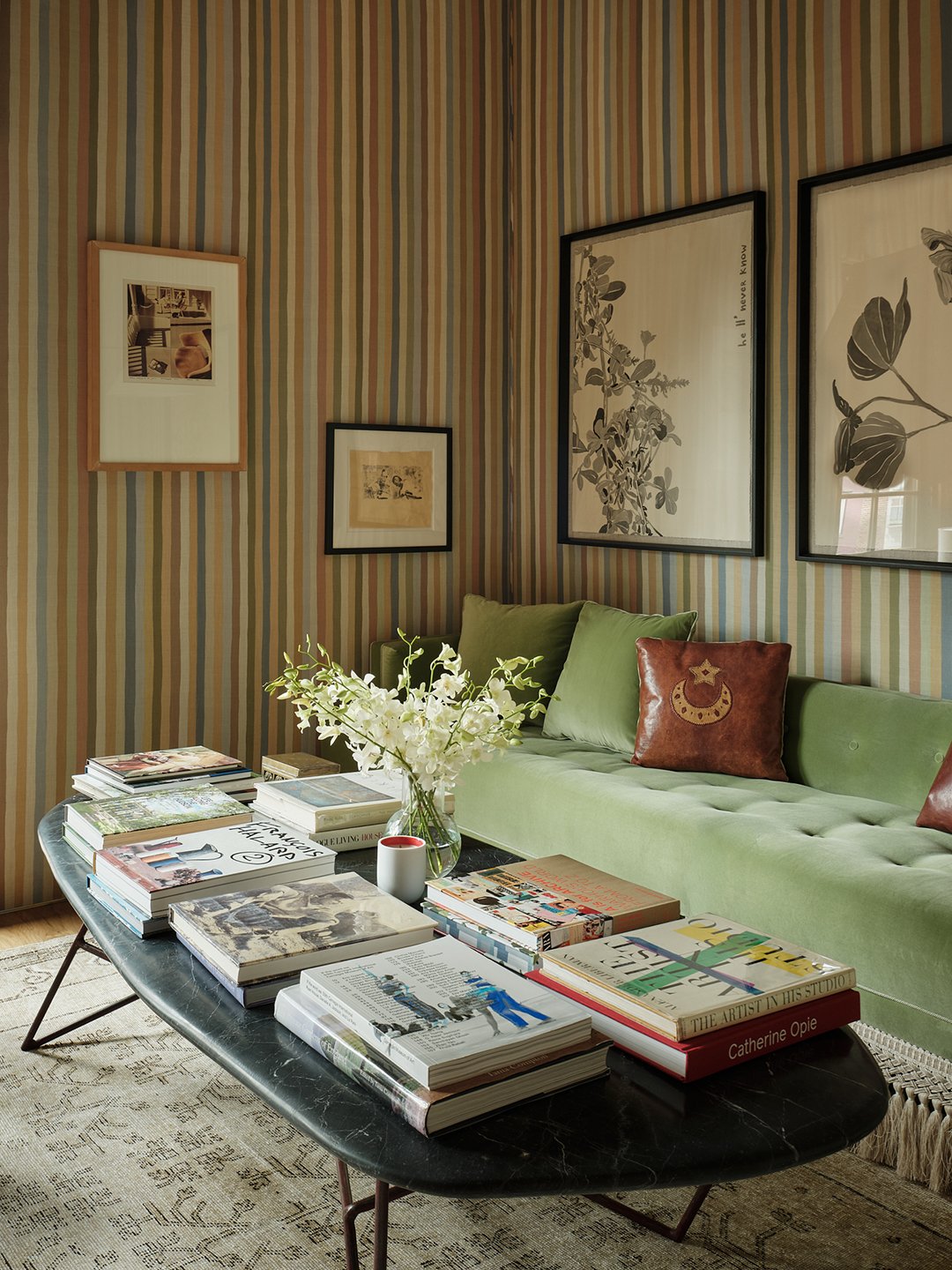
“The mix gives the room an eclectic vibe intended to bridge the distinguished, landmarked exterior and the modern interior architecture,” Dunham explains.
Combine Thick and Thin
According to Dunham, successful interior design relies heavily on striking the right balance between what he colloquially terms “the pudding-y and the bony.” The “pudding-y” elements represent the substantial, heavily upholstered, or softly sculptural centerpieces of the room, such as the plush green velvet sofa. Conversely, the “bony” components comprise the visually lighter, more linear, and wiry pieces, such as a vintage twig chair and sleek wall-mounted lighting fixtures.
Balancing these contrasting silhouettes is vital to preventing visual clutter. Dunham emphasizes that a room must possess a sufficient foundation of substantial, soft pieces while avoiding an excess of wiry elements, which can cause shapes to compete aggressively for visual dominance and overly complicate the spatial dynamic.
Lay Down One Giant Rug
When dealing with expansive rooms, designers frequently attempt to carve out functional zones by layering multiple smaller rugs across the floorboards. Dunham, however, rejected this approach for his New York pied-à-terre.
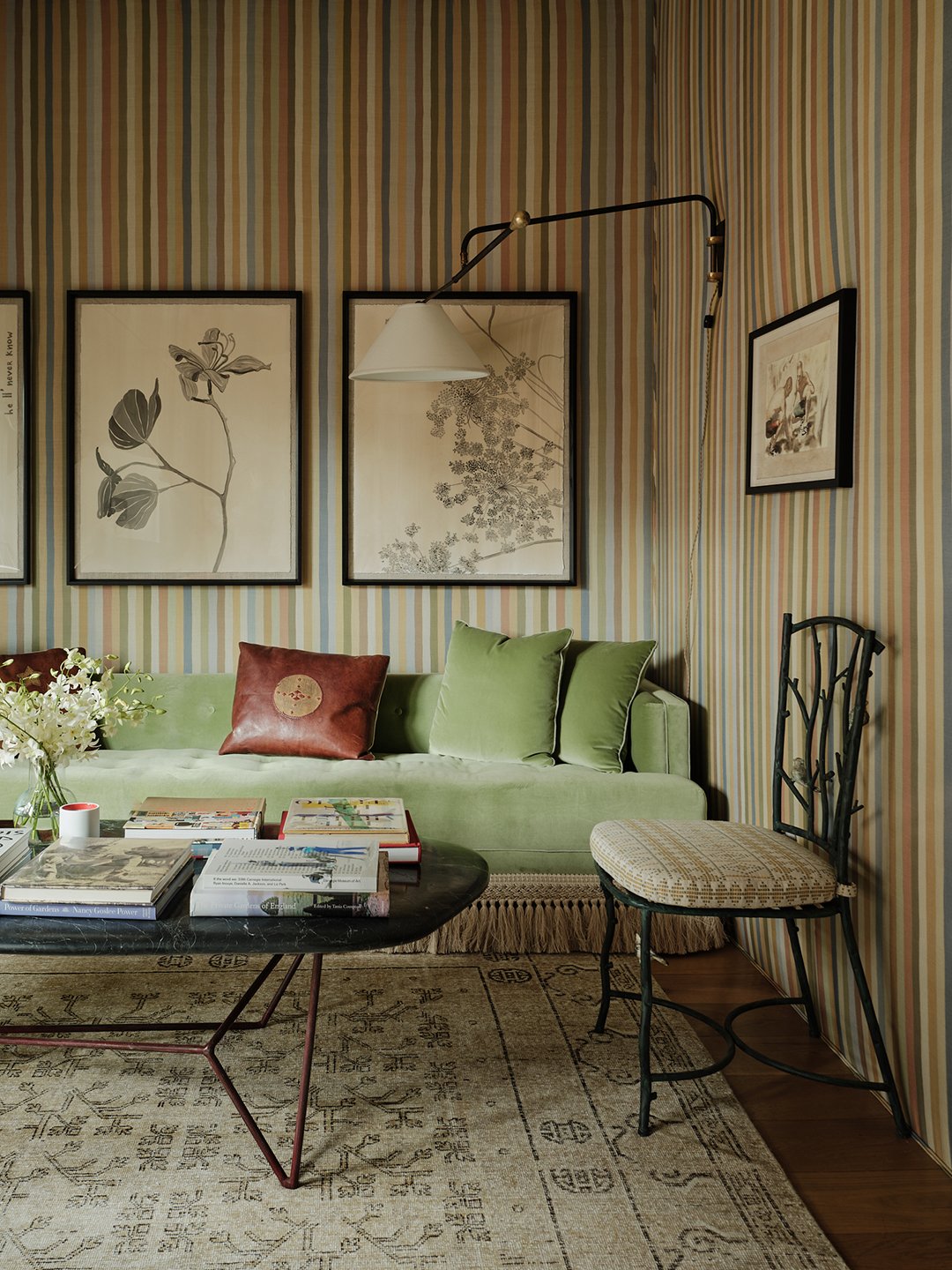
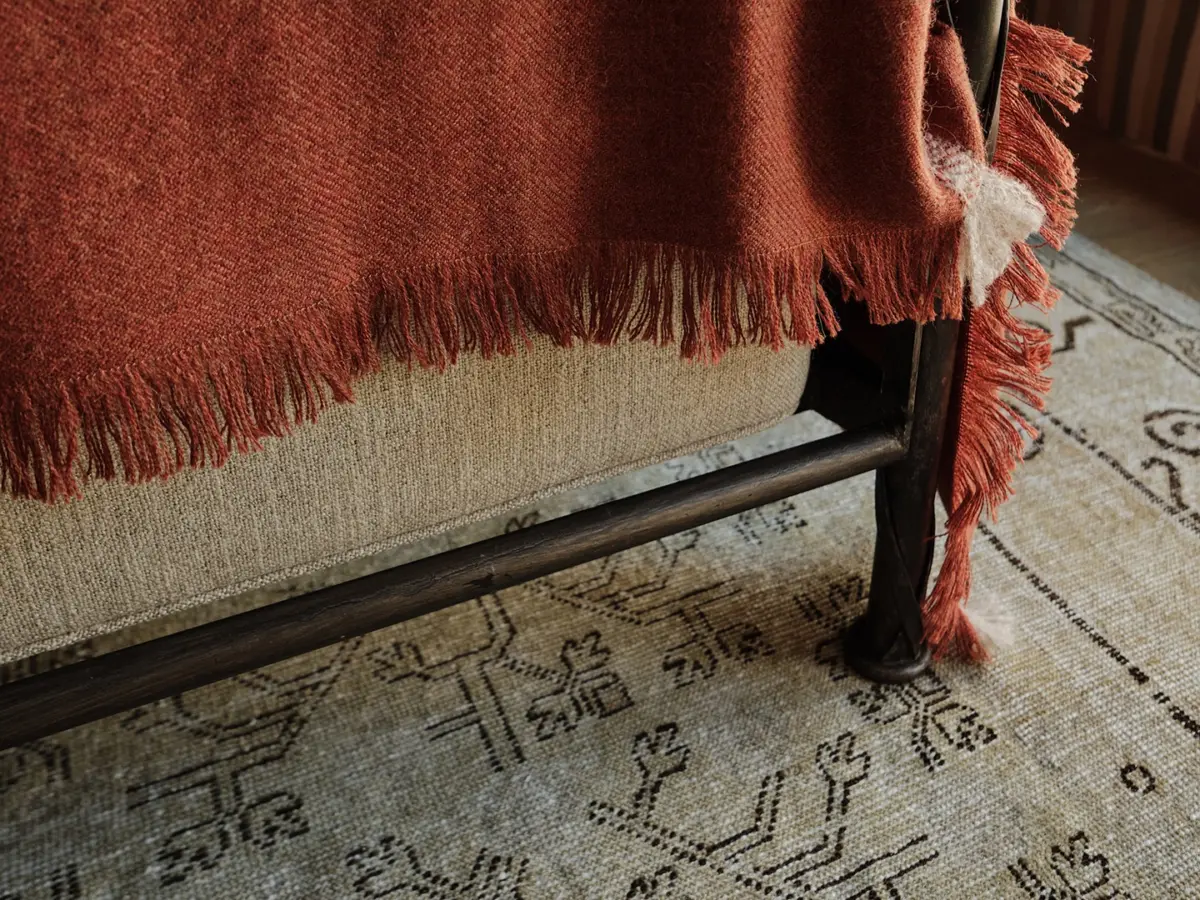
Opting for simplicity and spatial continuity, he chose a single, magnificent early Khotan carpet sourced from Marc Phillips. “I wanted one big rug because two rugs would have shrunk the room a bit,” Dunham notes. Unifying the entire floor plan with one oversized textile allowed the distinct seating and living areas to feel connected and expansive rather than fragmented.
Save Precious Inches With Roman Shades
Addressing the architectural integrity of the building’s original windows required a window treatment that was both highly tailored and space-conscious, particularly given that the room measures a modest 10 and a half feet in width. Dunham ultimately selected custom Roman shades for their precision and functional agility, purposefully bypassing traditional drapery.
Opting out of floor-length curtains was a deliberate spatial decision to protect the room’s limited square footage. Traditional drapery panels consume an extra six to eight inches of precious depth along the perimeter, space that Dunham preferred to keep open and airy.
Try a Grand Bed in a Tiny Room
One of the more counterintuitive lessons Dunham has applied throughout his career is the scaling of furniture in compact spaces. Rather than opting for diminutive furniture to make a small room feel larger, he champions the opposite approach.

“I think the smaller the room, the more of a case you have to make for a canopy bed,” Dunham says.
It is a lesson he learned firsthand from an earlier chapter in his life when he lived in an apartment featuring a remarkably small bedroom and made the bold decision to install a chunky, architectural Georgian four-poster bed. That single, grand piece fundamentally transformed the character of the space, elevating what could have felt like cramped quarters into an intimate, architecturally interesting environment.
Use Fabric Instead of Wallpaper
Rather than utilizing conventional wallcoverings, Dunham chose to envelop the room’s vertical surfaces in textiles, a technique he frequently favors for urban residences.
“I love to do upholstered walls in New York because it absorbs sound and gives that extra layer of coziness,” he explains.
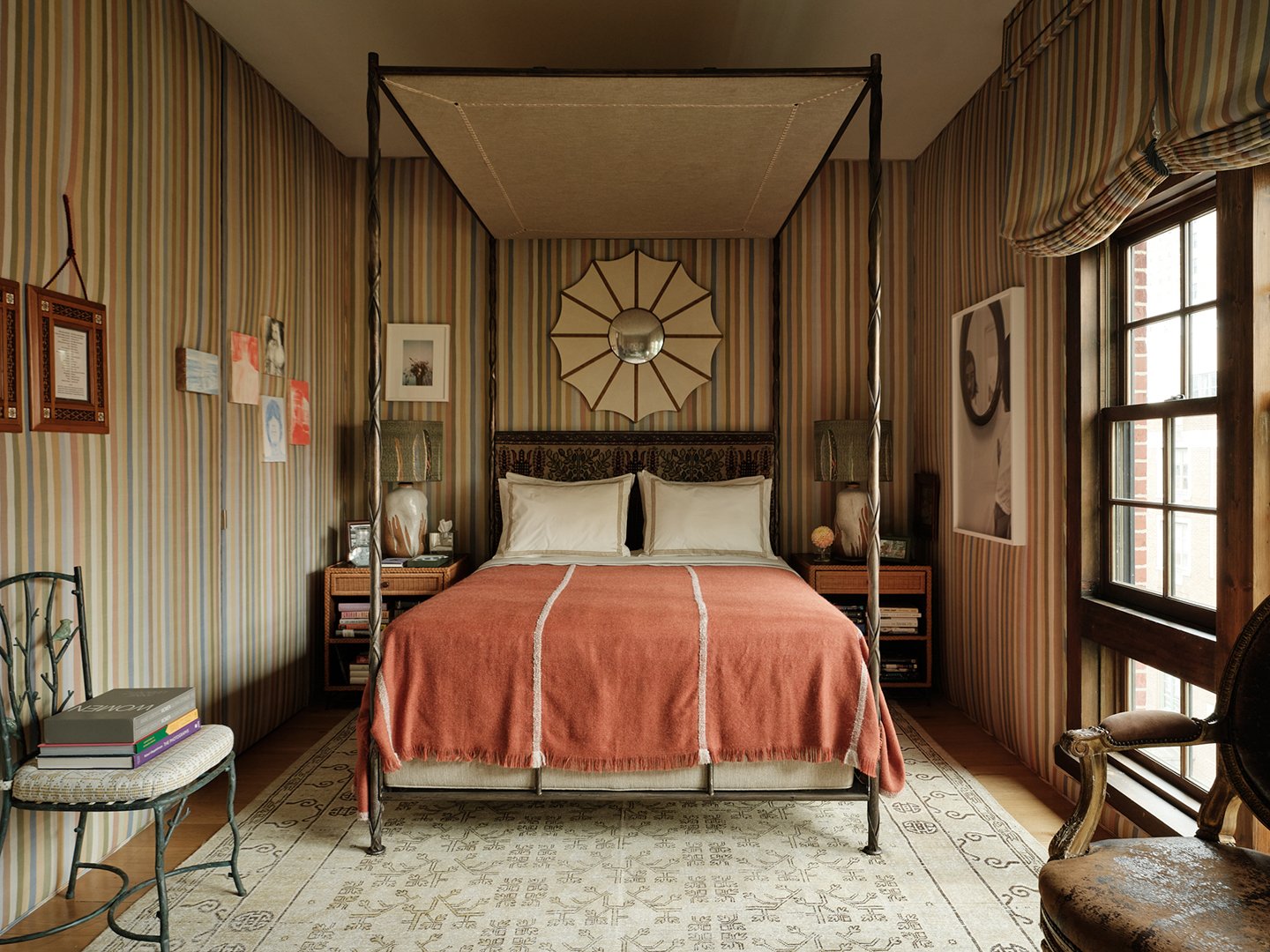
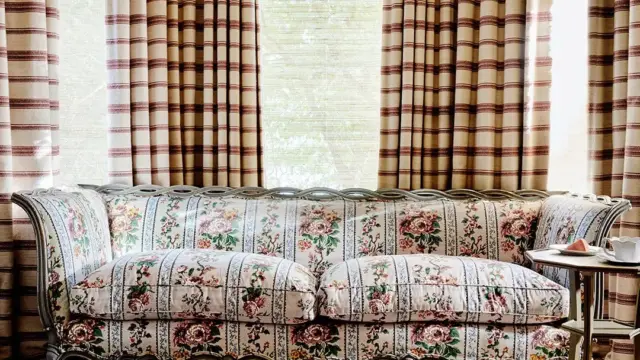
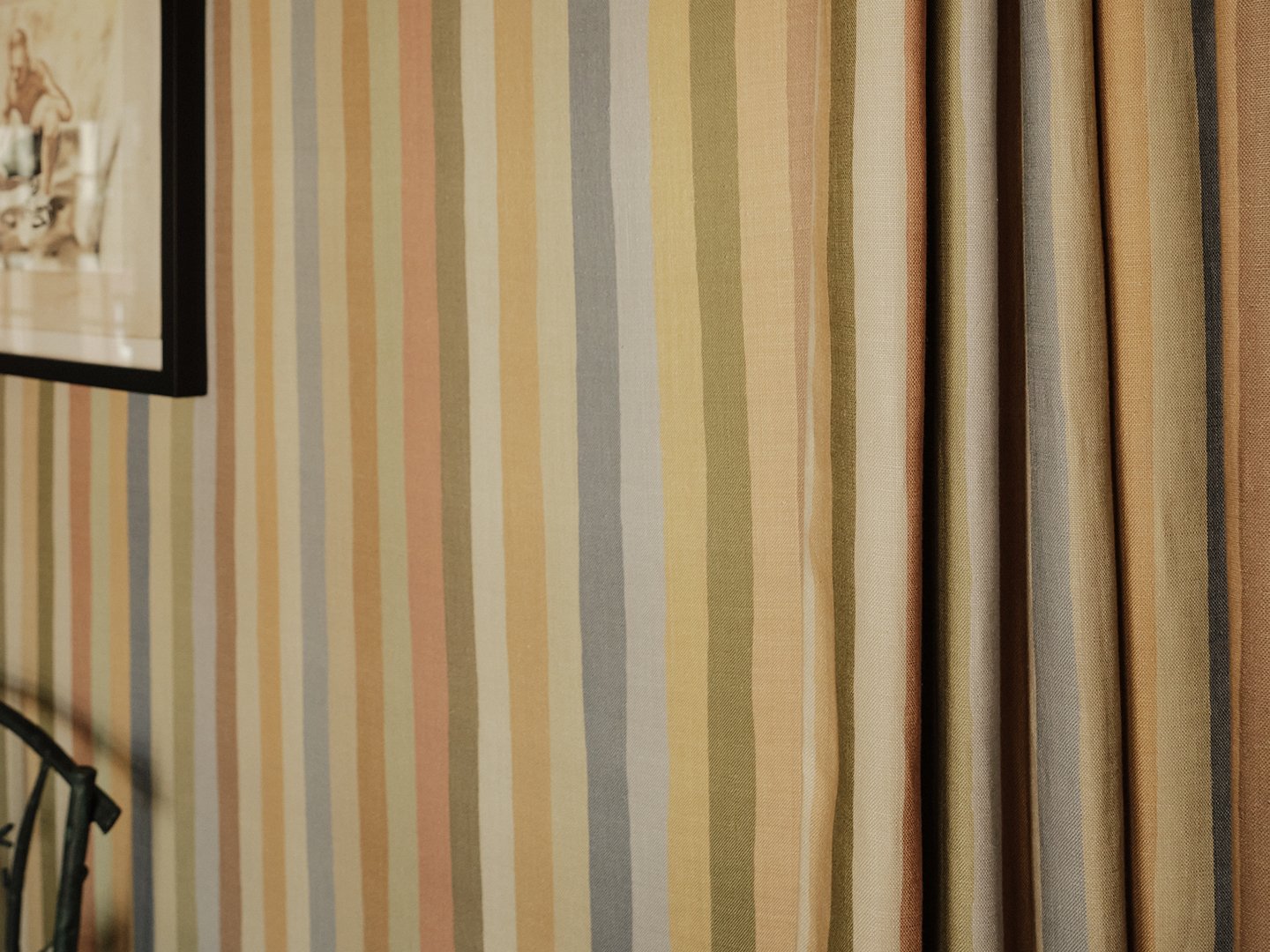
For this installation, the walls were wrapped in Jacob’s Stripe, a multicolor linen print from his own textile collection. To achieve a seamless, 360-degree environment, Dunham coordinated with The Shade Store to create contiguous window treatments and doorway drapes utilizing the same fabric motif. While some designers fear that matching walls and window treatments can overwhelm a space, Dunham believes the opposite is true if handled with intention.
“People think it’s too much, if you do the window treatments and the walls the same, but if you do something else—something contrasting—it actually makes the wall pattern stronger,” Dunham notes. “If you want to have a very encompassing, almost soothing feel, do it all the same.”
Don’t Forget the Art
The transformative power of art became starkly apparent during the final phases of installation. When Dunham’s team initially finished setting up the furniture and textiles, he admits he felt a sense of hesitation, briefly worrying the space felt slightly subdued. However, that perception shifted the moment the final artworks were hoisted into place.
“I thought, ‘The room’s okay, maybe a bit dull,’ but then I came back and the art had been hung,” Dunham recalls. “It lifted everything. Everything popped. Everything was in conversation with each other. It made the room literally come alive.”
Curating the artwork exclusively from Los Angeles-based creators, Dunham selected pieces by prominent artists including James Cherry, David Hockney, Paul Mpagi Sepuya, Joey Strella, Konstantin Kakanias, and Catherine Opie. He notes that the framing strategy required equal deliberation to ensure the collection felt cohesive without appearing overly uniform or discordant.
Add Some Intrigue With Custom Touches
To achieve a deeply atmospheric environment that resists a generic retail aesthetic, Dunham incorporated several bespoke elements. He constructed the striking showhouse bed by combining a vintage frame with an antique English textile for the headboard and a newly upholstered panel positioned at the top. Similarly, he fashioned custom lampshades using a vintage Japanese obi to top off lamps by Natan Moss.
“To create atmosphere in a room and to be able to really personalize it, you need things that you can’t just go out there and buy from a big retailer,” Dunham says, summarizing his philosophy on bespoke interiors. “You need things that stop you in your tracks and say, ‘Oh, that’s cool. Where did that come from?’”
Upholster Your Box Spring
As the tour of the completed space concluded, Dunham highlighted a subtle yet meticulous detail that easily escapes casual observation: the custom upholstery of the bed’s Saatva box spring.
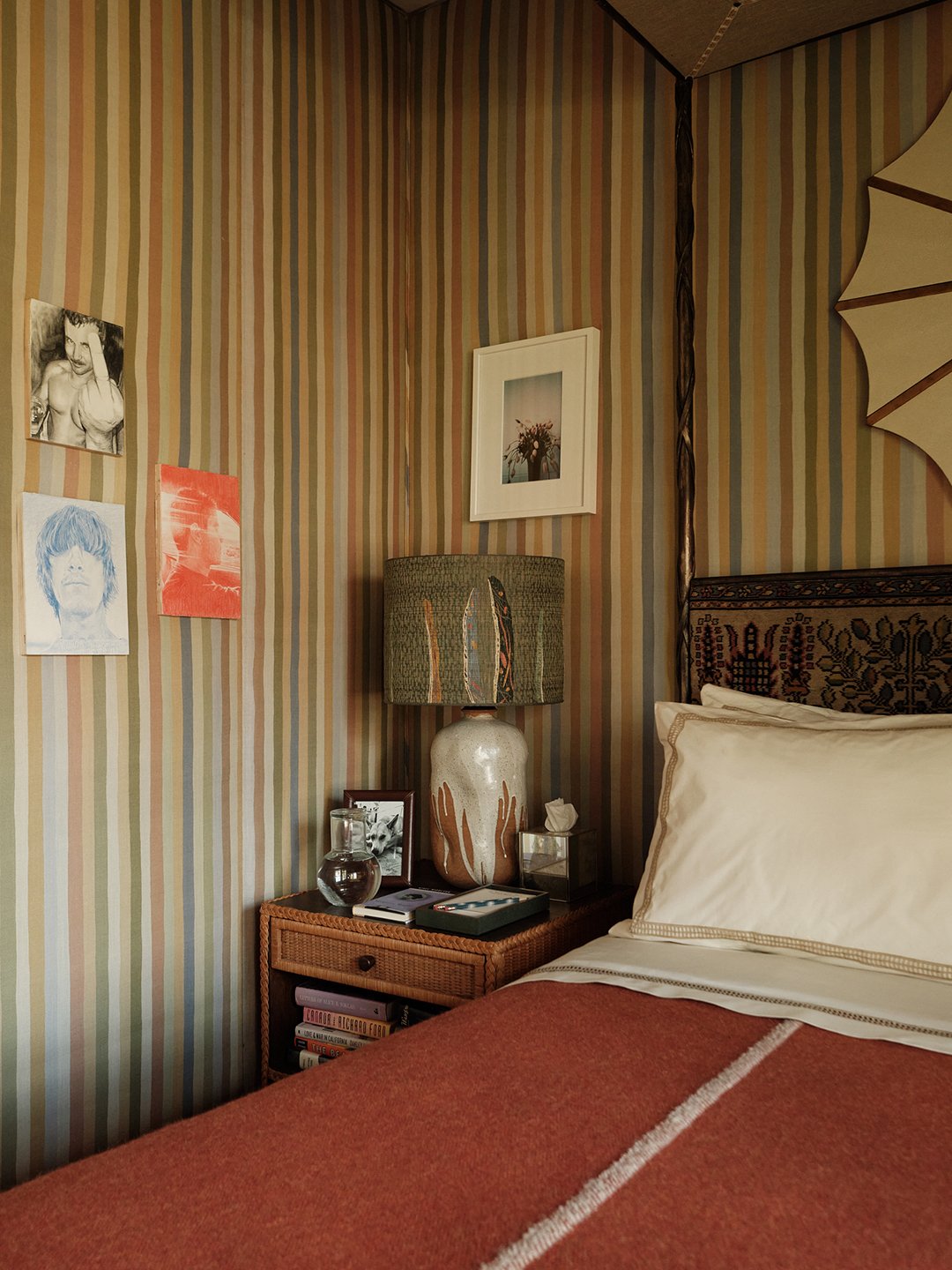
“When you see the box spring, I always like to upholster it,” Dunham concludes. “We did the same fabric for the underneath of the canopy as we did for the box spring for kind of a tailored, consistent look.”