
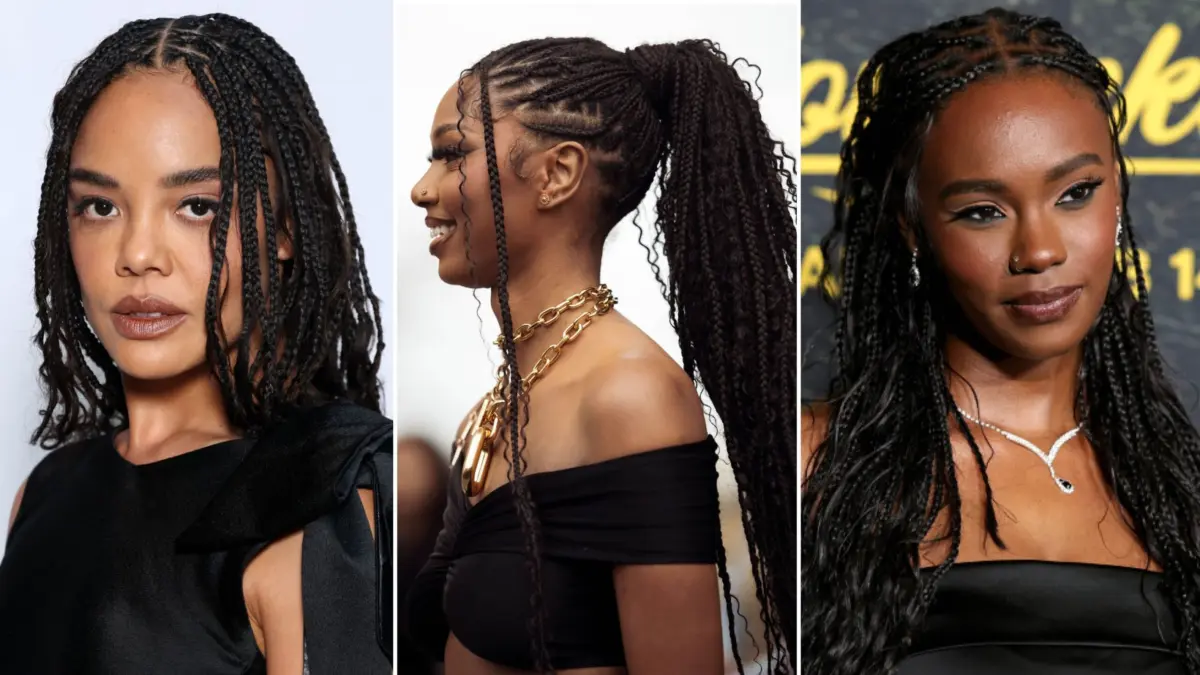

Before exploring their widespread popularity, it helps to understand what exactly defines goddess braids, though the answer often depends on who you ask. Unlike traditional cornrows or two-strand twists, which carry clear and specific definitions, the category of goddess braids remains somewhat nebulous in the modern hair community. Professional braiders frequently note that the terms "goddess braids" and "boho braids" are often used interchangeably, and their precise meanings can vary significantly from one braider to another.

While both styles are fundamentally knotless installations featuring loose human or synthetic curls braided into some or all of the plaits, the debate typically centers around the quantity of loose hair used and its exact placement. According to New York City-based braider Susy Oludele, goddess braids traditionally incorporate only a select few curls, allowing the individual braid to stay clearly defined for a clean finish. In contrast, she notes that boho braids utilize a much higher volume of hair where the curls carry the entire style to create a bold, highly textured look.

Other professionals hold an entirely different perspective. London-based braider Jess Rutana, who operates Zuri Hair Studio, explains that at her salon, goddess braids actually contain significantly more loose human hair. This approach creates a much fuller finish where the underlying braids are far less visible. This divergence in technique highlights how adaptable and personalized the style can be depending on individual preferences and regional styling traditions.

Regardless of curl count and exact placement, beauty industry professionals unanimously agree that goddess braids are experiencing a major cultural and aesthetic moment. Shanna St. Cyr Alexander, a braider based in New York, attributes this surge in popularity to the hairstyle’s remarkable versatility, impressive longevity, and the added dimension it provides compared to traditional knotless braids.

The knotless installation method offers significantly lower tension than the thick, heavy plaits that dominated the 1990s, which were typically attached directly to the root using traditional knots. Modern installations mean less weight, less pressure on the scalp, and drastically reduced tension on delicate hair edges. Stylists point out that after years of watching heavy hairstyles damage hairlines over time, clients are intentionally moving away from high-tension methods. Meanwhile, the integrated loose curls add fullness and provide dynamic visual movement, delivering a full and polished look without causing the lingering scalp discomfort commonly associated with tighter, traditional installations.

When it comes to the technical process of bringing these styles to life, the foundation remains rooted in healthy hair care practices. The natural hair is first thoroughly cleansed, deep-conditioned, and either stretched or blow-dried before any braiding begins. The braider then systematically feeds in the braiding hair and loose curls, with the overall volume adjusted to match the client’s desired finish. The curly pieces are worked directly into the braid progressively as the service advances, utilizing synthetic hair, human hair, or a custom combination of both depending on the braider’s technique and the client’s preference.

Pricing for goddess braids generally ranges from $300 to $500, though costs fluctuate based on regional market rates, salon positioning, and the quality of hair materials selected. Using exclusively synthetic hair tends to lower the overall cost, while premium human hair options increase the investment. Stylists routinely advise clients to clarify whether hair extensions are included in the initial price quote before booking to prevent unexpected expenses at the register.

Maintaining goddess braids requires a dedicated regimen to preserve both the scalp and the hair extensions. Scalp care is paramount, with professionals recommending oiling the scalp two to three times a week and washing the hair every two to three weeks using a diluted shampoo applied via an applicator bottle, focusing strictly on the scalp rather than the length of the braids. A clean scalp prevents the accumulation of buildup that can lead to breakage. Specialized strengthening oils infused with soothing ingredients like rosemary and peppermint, along with clarifying shampoos containing antibacterial and antimicrobial properties like apple cider vinegar and aloe, are frequently recommended by top stylists.

Clients who opt for human hair extensions must commit to a slightly more involved maintenance routine, as loose human strands are more prone to tangling if neglected. Stylists suggest gently separating the loose strands and using a soft-bristled detangling brush, starting from the ends and working upward while holding the hair close to the braided section to avoid pulling on the natural hair. Leave-in conditioners and lightweight serums can be utilized to maintain moisture, enhance shine, and prevent matting over time.

Nighttime routines are equally critical for longevity. Experts advise sleeping on a satin pillowcase while wearing a satin scarf or a large satin bonnet, and optionally dividing the hair into two sections secured loosely into braids or twists to minimize friction and tangling. While protective styles can sometimes tempt wearers to keep them installed for months, professionals emphasize that braids should be taken down after six to eight weeks to ensure the natural hair remains healthy and strong.

As the style continues to evolve, clients showcase goddess braids in a wide array of lengths and configurations. Small goddess braids offer exceptional versatility and longevity, allowing wearers to easily sweep them into polished updos while keeping the style looking neat for extended periods. Smedium braids provide a middle ground that delivers a fuller appearance while requiring less installation time than smaller micro-variations. Classic half-up, half-down arrangements remain a favorite for keeping hair off the face while offering an opportunity to accessorize with decorative claw clips. High ponytails create a regal silhouette when braids are wrapped around the base, and shorter lob variations prove that protective styling can effortlessly adapt to trend-forward shorter haircuts.