The introduction of the feature has caused some minor confusion among users due to nomenclature. Garmin Epics should not be confused with the company’s older watch line, the epix, which is spelled with an "x" and uses lowercase letters. The new feature is explicitly named Epic, with a "c." Because the names are nearly identical, online searches for one frequently surface the other, prompting device owners to verify their software spelling before navigating the Garmin ecosystem.
What is a Garmin Epic?

At its core, a Garmin Epic is a digital travel journal designed to aggregate a user’s activities, maps, photos, and key health and performance metrics into a single, interactive timeline. This timeline can be easily revisited by the user or shared with others. With the release of the Fenix 9 smartwatch, users gain the ability to create and initiate an Epic directly from the wrist. However, owners of older Garmin watch models are not left out; they can construct and manage Epics directly within the Garmin Connect mobile application.
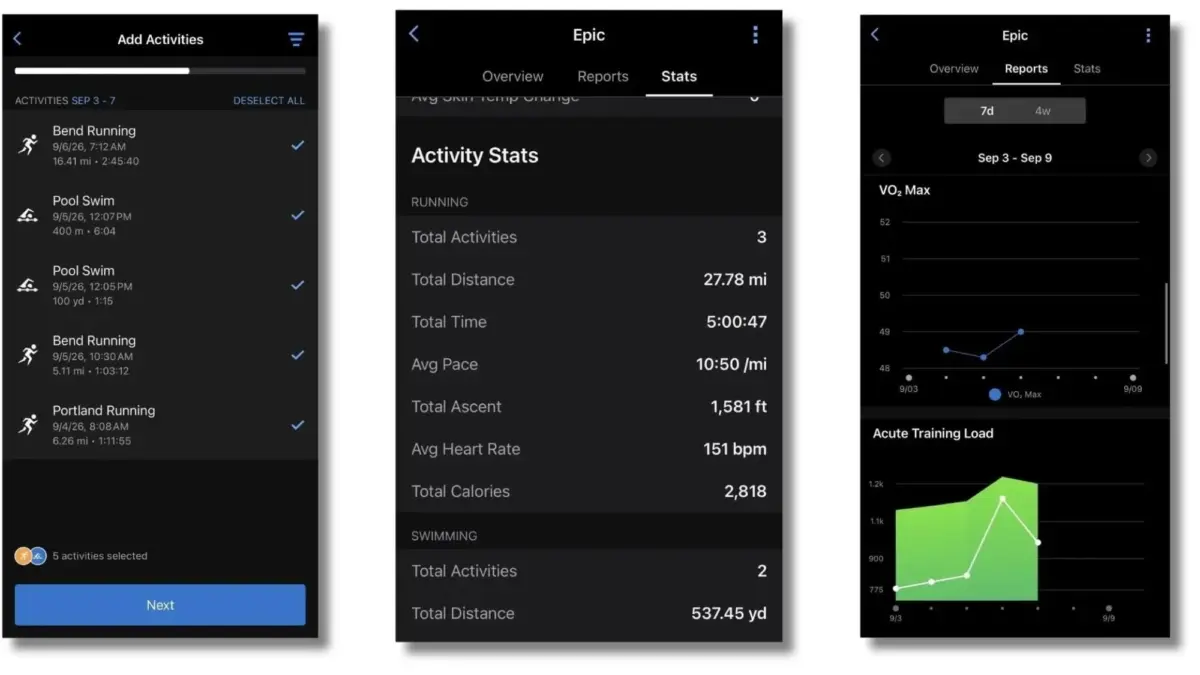
Once an Epic is generated, it compiles all related activities onto a unified map alongside user-uploaded photos, an activity feed, daily personal notes, and selected performance and health reports spanning the entire duration of the selected timeframe. During Garmin’s public launch demonstration, the interface highlighted a dedicated Reports tab that integrated critical physiological metrics, including sleep scores, resting heart rate trends, and heart rate variability (HRV status), all aligned across the exact same calendar dates.
While the feature debuted alongside the Fenix 9, hardware exclusivity is not a barrier to entry. Users do not need the newest flagship smartwatch to take advantage of Epics within the Connect app, where the tool is conveniently housed under the standard Activities menu. Furthermore, the platform allows users to group past activities into an Epic retroactively. This retrospective capability is precisely what unlocks its potential as a powerful training-analysis tool, enabling athletes to evaluate completed blocks of work long after the workouts have concluded.
Viewing the Bigger Picture in Endurance Training

An individual Epic can span a duration of up to 92 days, accumulating total distance and caloric expenditure alongside sleep trends, recovery metrics, and HRV tracking over that period. Spanning roughly 13 weeks, this window neatly aligns with a standard, structured training block for a half-marathon or marathon level event.
Traditionally, platforms like Garmin Connect provide deep dives into individual workouts—breaking down splits, heart rate zones, and power outputs for a single Tuesday interval session or a long Sunday run. While these granular insights are vital for day-to-day progress, coaches and athletes have long noted the challenge of stepping back to evaluate the broader macrocycle. Reviewing three months of training often requires jumping between separate reports for sleep, training load, and performance condition.
By condensing up to three months of data into a single, cohesive narrative timeline, Epic bridges the gap between raw data collection and holistic performance review. Athletes can visually correlate periods of high training stress with corresponding dips in sleep quality or HRV status, identifying patterns that might otherwise be lost amid a continuous stream of daily notifications.
Although Garmin Epic was primarily designed as a consumer-facing tool to relive outdoor adventures and share memorable expeditions with friends or followers, its structural capabilities offer a secondary benefit for dedicated athletes. By shifting the perspective from individual sessions to multi-month timelines, the feature provides a fresh lens for athletes preparing for their next major racing season.