
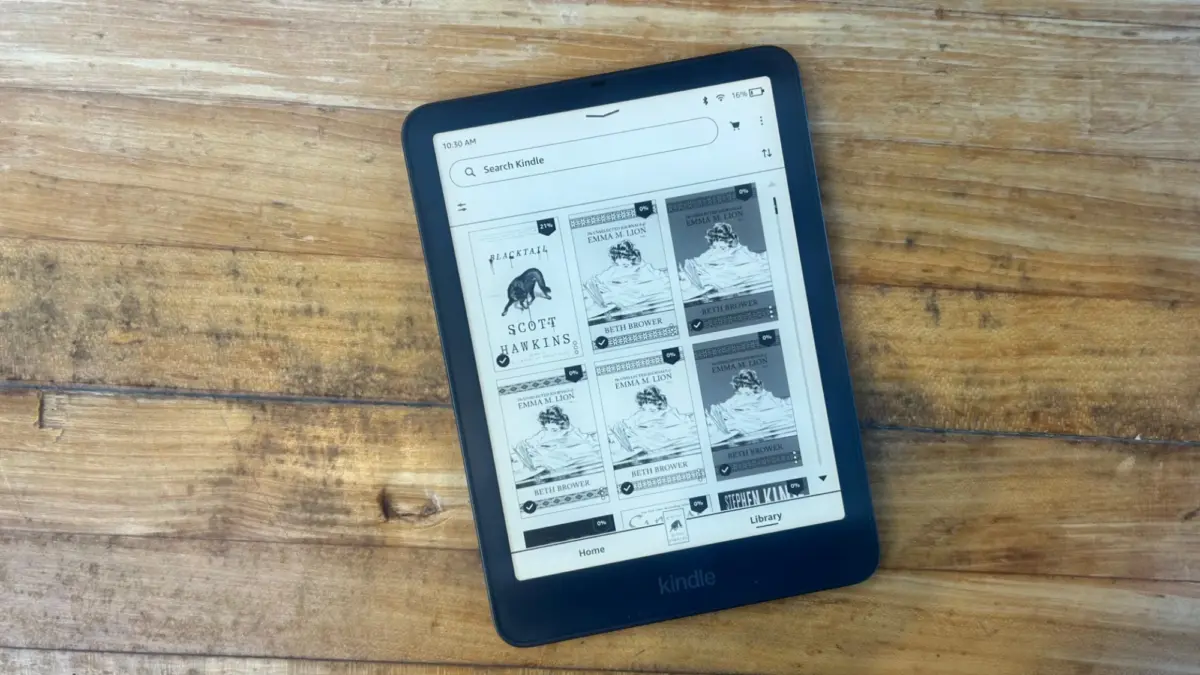
Yet, Amazon remains the undisputed heavyweight champion of the e-reader market in terms of sheer market share. Even as the tech giant unveiled a comprehensive redesign of its entire Kindle lineup, the core philosophy remained largely untouched. The company introduced a sleek, flush-front display, boasting a fresh manufacturing process that applies colored bezels directly onto the outer glass screen via specialized painting techniques. But with competitors having offered flush designs for years, these cosmetic tweaks alone risked falling into the familiar pattern of iterative, uninspiring updates. Novelties like an $80 case attempting to reintroduce the physical page-turn buttons once standard on older models, or firmware updates enabling Bluetooth page-turn remotes, did little to shatter the mold.
However, a closer examination of the 2026 Kindle lineup reveals one notable shift in Amazon’s strategy: the $50 premium charged for the top-of-the-line Signature Editions of the Kindle Paperwhite and the Kindle Colorsoft finally feels genuinely justified.

The Signature Edition Finally Offers Irresistible Upgrades
When Amazon first rolled out the "Signature Edition" moniker for the Kindle Paperwhite back in 2021, the 25% price increase was a tough sell for many consumers. While it bumped the internal storage up to 32GB—triple the capacity of the base model—the utility of such a massive storage jump on an e-reader was questionable at best, given that standard text-based e-book files take up virtually no space. Even with 32GB, a reader could store upward of 6,000 books, a threshold far exceeding the lifetime reading habits of even the most dedicated bibliophiles. Other perks included wireless charging and an auto-adjusting front light, features that appealed only to a specific segment of buyers, while the removal of lock-screen advertisements was viewed by many as standard housekeeping rather than a premium benefit.
The latest iteration of the Signature Editions for both the Kindle Paperwhite and the Kindle Colorsoft, however, bridges the value gap far more effectively. While the foundational internal specifications largely mirror those of their standard counterparts, the higher-tier devices introduce substantial hardware and design improvements that change the calculus for prospective buyers.
Most prominently, the Signature Editions feature an entirely redesigned all-metal rear panel. This upgrade gives the devices a noticeably more sophisticated look and a tactile feel that aligns with a truly premium price point, adding only a minimal amount of weight. While the standard plastic models tip the scales at roughly 7.2 ounces, the metal-backed Signature Editions weigh in at 8.1 ounces, striking a balance that feels substantial without causing hand fatigue during long reading sessions.

Beyond the exterior redesign, the feature set is rounded out by practical additions. Wireless charging and auto-adjusting front lighting return, alongside the expanded 32GB of storage. While still arguably excessive for plain text, the extra capacity proves genuinely worthwhile for users who prefer to load their devices down with hefty audiobooks or, in the case of the Colorsoft model, space-intensive color graphic novels and comics.
Furthermore, the inclusion of an integrated accelerometer allows the display to auto-rotate seamlessly when the device is flipped upside down, offering greater flexibility in how it is held. This is particularly useful when paired with modular accessories like the new Page-Turn Cover, which effectively channels the spirit of the beloved and long-discontinued Kindle Oasis by bringing back physical navigation buttons. Additionally, Amazon has introduced a gesture-based control scheme allowing users to advance pages simply by double-tapping the bottom sides or the back of the device, minimizing the need to touch the screen directly, though this feature is currently restricted to moving forward through a text.
Only the Signature Edition Gets the Best New Accessories
The hardware differentiation extends directly into Amazon’s ecosystem of new accessories. Consumers interested in utilizing hardware enhancements such as the Page-Turn Cover or the upcoming Charging Stand must opt for a Signature Edition model, as these peripherals rely on a built-in magnetic pogo pin connector found exclusively on the premium variants. While standalone accessories like the Kindle Click page-turn remote maintain compatibility with broader Kindle hardware released from 2024 onward, the most integrated physical add-ons remain walled off inside the Signature tier.

Aesthetics also play a differentiating role. For buyers keen on specific colorways, the Signature Editions offer exclusive options, such as Seaglass Green for the Paperwhite and a deep, reddish-purple Plum for the Colorsoft, setting them visually apart from the standard lineup.
Otherwise, It Is Mostly Still a Kindle
Stripping away these hardware-level extras, the 2026 Kindle models function fundamentally similarly to their 2024 predecessors. Amazon markets them as the fastest Kindles ever produced, but in practical terms, this performance metric borders on marketing hyperbole. Any recent Kindle turns pages with enough swiftness that the marginal speed improvements on the newest processors are difficult to perceive during normal use.
All models continue to run on identical firmware, presenting both familiar advantages and persistent limitations. On the positive side, Amazon’s software ecosystem makes discovering, purchasing, and syncing books and audiobooks directly on the device remarkably frictionless. Robust library management tools, sorting options, and quality-of-life integrations like the "Send to Kindle" email feature remain exceptionally convenient. On the other hand, it reinforces the reality of being deeply locked into Amazon’s proprietary ecosystem.

The New Flush-Front Design Won’t Please Everyone
A sweeping hardware change across the entire 2026 Kindle generation has also sparked considerable debate within the user community. Discussions across online forums like Reddit highlight a division among readers regarding the adoption of a completely flush-front screen design. By eliminating the raised bezels that surrounded the display on previous iterations, Amazon has introduced a thin layer of protective glass directly over the e-ink screen.
For discerning readers, this architectural shift introduces a trade-off. The addition of a glass layer slightly increases the distance between the user’s eyes and the underlying electronic ink, which can marginally impact text clarity and contrast due to minor light refraction and glare. While casual users may not notice the difference—particularly given that Kindle displays still maintain sharp typography and even front illumination compared to many competing Android-based e-readers—the design choice has drawn criticism from purists accustomed to the recessed screens of older generations.
The Bottom Line
When evaluating any annual technology refresh, the central question for consumers always boils down to whether the improvements justify an upgrade. For owners of a functioning Kindle purchased after the widespread adoption of temperature-adjustable front lighting, the answer remains firmly negative. The 2026 models are undoubtedly refined pieces of hardware, but they do not introduce paradigm-shifting capabilities that render older, healthy devices obsolete, particularly in the face of rising price points.

However, for buyers currently entering the market for a new e-reader, the choices have sharpened. Standard entry-level models continue to feature smaller screens and lack warm-lighting options, making the Paperwhite tier a more sensible baseline investment. For those leaning toward the Paperwhite or Colorsoft, the calculus has finally shifted in favor of the top tier: for the first time, the Signature Edition’s price premium delivers enough substantive hardware improvements to make the extra investment worthwhile.