Originating in Japan in the mid-2000s, traditional washi tape is crafted from washi, a sustainable plant-fiber paper derived from natural sources such as the bark of the gampi tree, mitsumata, or mulberry. Known for its remarkable lightness, durability, and a distinct degree of transparency, washi tape quickly established itself as a staple in traditional and contemporary Japanese crafts. Its defining characteristic is the ease with which it can be torn cleanly by hand, combined with a gentle adhesive quality that allows it to adhere securely to various surfaces while remaining repositionable.
Commercially, these decorative rolls are produced in a multitude of widths, featuring everything from minimalist geometric lines to intricate illustrations designed by renowned artists. While authentic Japanese imports tend to occupy a higher price point due to their superior craftsmanship and crisp aesthetic, crafters in the United States and other Western markets now have access to a wide array of reliable, high-quality domestic and international alternatives at accessible price points.

Essential Materials for Precision Washi Tape Art
Working successfully with washi tape in detailed artistic projects requires careful consideration of materials. Not all adhesive tapes are manufactured with the same level of tackiness or transparency. Experimenting with a few different brands allows artists to determine which varieties offer the ideal balance of adhesion and translucency for their specific aesthetic goals.
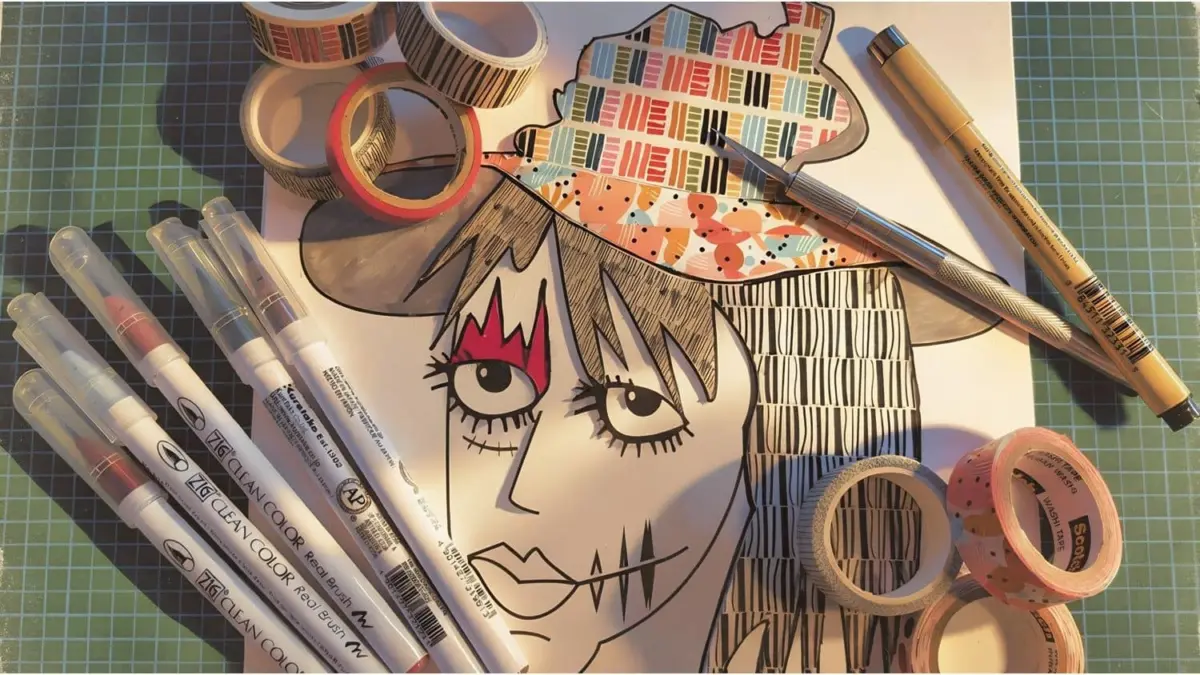
Precision is paramount when incorporating tape into a drawn composition, making a sharp craft knife an indispensable tool. The blade must be exceptionally keen to slice through the layered tape cleanly without snagging or pulling at the fibers of the underlying drawing surface.
Equally important is the selection of the base paper. Standard printer paper is generally too thin to withstand the rigorous scoring and cutting required in this technique. Instead, artists rely on medium-weight cardstock, typically around 65 pounds. This heavier stock provides a sturdy foundation that accommodates various printing methods while offering enough structural integrity to resist tearing under the pressure of a craft knife. The resulting piece maintains its rigidity and crispness, ensuring a polished final product. For minor touch-ups or defining borders, a black fineliner marker serves as a reliable secondary tool.

Managing Adhesive Challenges and Working Techniques
A common hurdle encountered by artists working with decorative adhesive tapes is that many commercially available products are engineered primarily for decorative stationery rather than fine art applications. Consequently, some variants possess an adhesive backing that is overly aggressive, risking damage to delicate paper surfaces when removed.
To overcome this issue, experienced crafters often employ simple preparatory techniques to reduce tackiness before application, ensuring the tape can be lifted cleanly without tearing the paper beneath. This technical adjustment opens up broader possibilities for layering and rearranging patterns within a single composition.
The foundational process begins by preparing a base using a simple line drawing, which can either be hand-drawn or printed onto the cardstock substrate. Artists then apply strips of washi tape across specific segments of the composition that require filling, allowing the strips to slightly overlap to ensure complete coverage of the designated area.

Once the desired sections are masked with tape, the artist uses a precision craft knife to cut meticulously along the visible outlines of the original drawing. Because the tape often possesses a degree of transparency, the underlying black lines remain visible as a guide. Applying light, controlled pressure is crucial during this phase to score only the tape and the surface layer without puncturing completely through the cardstock foundation.
After the cutting process is complete, the excess tape is gently peeled away from the unselected regions, leaving behind a patterned, textured fill that adheres precisely to the contours of the drawing. This leaves the remaining paper exposed for subsequent coloring.
Expanding Artistic Expression Through Mixed-Media Integration
The final stages of the process invite a broad range of artistic mediums to complete the composition. Once the patterned washi tape elements are revealed, the remaining white or unmasked spaces of the cardstock can be filled using traditional or digital tools, including markers, watercolors, colored pencils, or digital drawing applications.

Collaborative projects and shared family crafting sessions demonstrate the flexibility of this technique across different age groups and skill levels. Whether utilizing bold, saturated markers or delicate watercolor washes, artists find that incorporating subtle shading techniques during the coloring phase adds depth and dimension, preventing the flat appearance that can sometimes accompany mixed-media works.
As a final touch, fine liners or markers can be used to reinforce faded outlines or add hand-drawn details that tie the tape patterns and the colored elements into a cohesive whole. By blending traditional drawing with the tactile qualities of Japanese washi tape, creators continue to discover new avenues for visual storytelling and imaginative design.