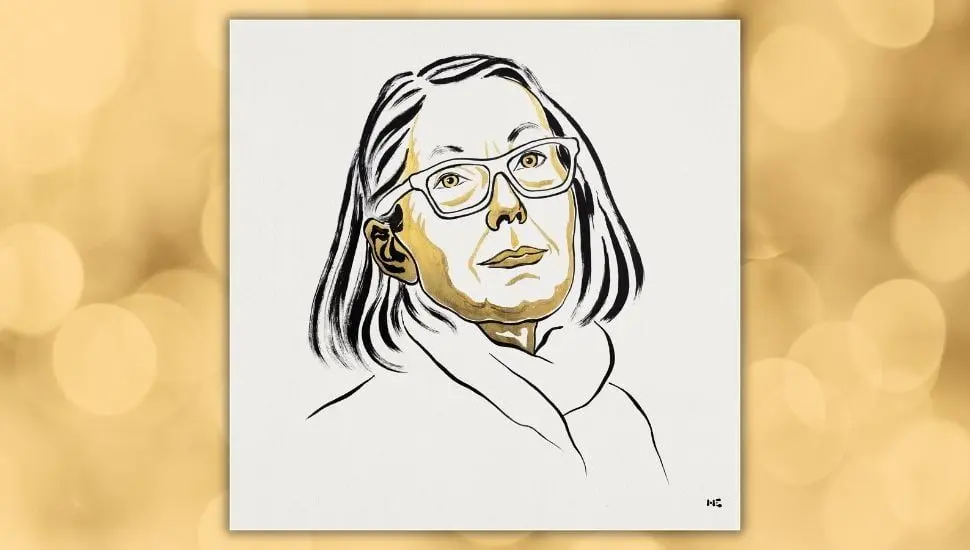
The announcement places Carson among the most celebrated literary figures in history, cementing her legacy as a writer who continually pushes the boundaries of form, language, and artistic expression. Known for seamlessly blending poetry, essay, translation, and visual art, Carson has long been a favorite among critics, fellow writers, and dedicated readers around the world. Her ability to channel ancient Greek and Roman antiquity into modern emotional landscapes has earned her a distinct place in the literary canon.
Upon learning of her victory during an interview with an Icelandic broadcast, Carson offered a characteristically witty and understated response to the life-changing news. Reacting to the Nobel Committee’s decision, she remarked, “Crazy, I think they’re all crazy,” a sentiment that quickly resonated with fans and admirers who appreciate her sharp humor and lack of pretension.
The Nobel Prize in Literature is widely regarded as the pinnacle of a writer’s career, celebrating a lifetime of work rather than a single publication. For Carson, this recognition honors decades of groundbreaking output that has consistently defied categorization. Whether through book-length poems, translations of classical tragedies, or hybrid works that incorporate visual elements and philosophical inquiry, Carson has consistently challenged what literature can look like and how it can make readers feel.
While many Nobel laureates are met with formal or deeply reflective statements, Carson’s brief and humorous remark captures the idiosyncratic charm that defines her persona and her writing. Rather than offering a grand philosophical pronouncement on receiving one of the world’s highest cultural honors, she met the gravity of the Swedish Academy’s decision with a dose of deadpan reality. This sharp, unvarnished wit is a hallmark of her poetry, where devastating emotional vulnerability often sits side-by-side with dry irony and intellectual rigor.
The Swedish Academy’s citation highlights Carson’s deep engagement with the classical tradition, a foundational element of her work. Before achieving widespread acclaim as a contemporary poet, Carson worked extensively as a classicist, teaching ancient Greek and immersing herself in the works of antiquity. This deep scholarly background permeates her writing, allowing her to converse across centuries with figures like Sappho, Euripides, and Longinus. However, her work is never dryly academic; instead, she uses antiquity as a mirror for modern human experiences, including love, grief, longing, and artistic creation.
Works such as Autobiography of Red, a novel in verse that reimagines the myth of Geryon and Herakles in a contemporary setting, exemplify her ability to merge ancient myth with modern sensibilities. The book became a critical sensation upon its publication, praised for its lyrical intensity, psychological acuity, and radical structural inventiveness. Similarly, projects like Nox, an elegiac, accordion-fold book created in memory of her brother, showcase her insistence on testing the physical and conceptual limits of the book format itself. Nox combines translation, photography, dictionary entries, and handwritten fragments to grapple with the impossibility of fully knowing or mourning a loved one.
By choosing Carson, the Nobel Committee has recognized an artist who refuses to stay within traditional literary boundaries. Her writing moves fluidly between poetry and prose, fiction and scholarship, visual art and philosophy. This fluidity has opened doors for a new generation of writers who are eager to escape rigid genre classifications and explore the spaces where different artistic mediums intersect.
As news of the 2026 Nobel Prize spread globally, literary communities celebrated the recognition of an author whose work demands active engagement and rewards careful reading. From academic halls to independent bookstores, readers and writers alike have praised the decision to honor a voice as singular and uncompromising as Carson’s. Her influence on contemporary poetry is immeasurable, and this latest accolade serves as a powerful testament to the enduring impact of her imaginative vision.
With the announcement now echoing across the international literary landscape, Carson joins a prestigious lineage of Nobel laureates, bringing renewed attention to the power of poetry and the enduring relevance of classical dialogue in modern literature. As her readers continue to revisit her vast and varied bibliography, the celebration of her work reaffirms the vibrant, unpredictable future of contemporary writing.