
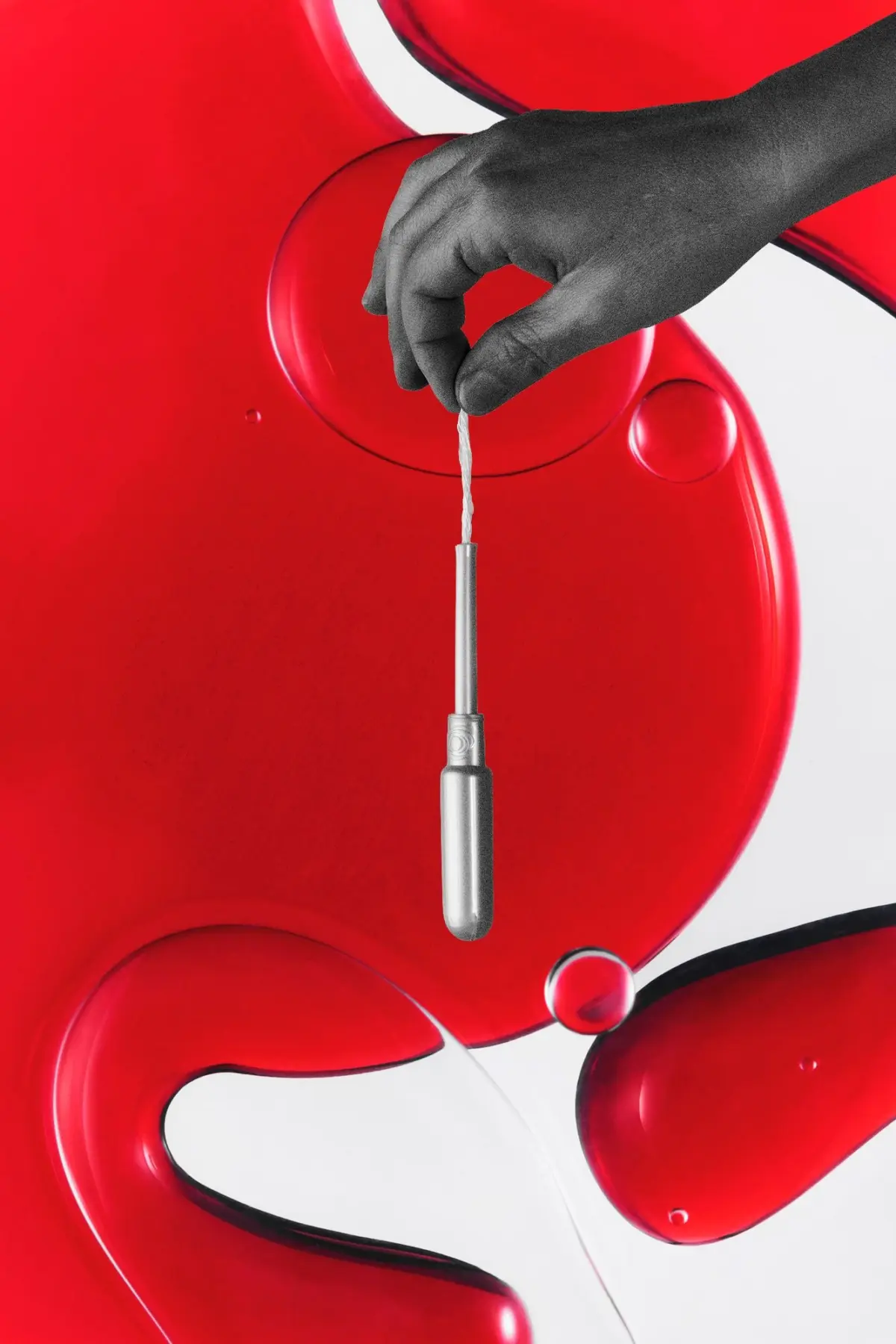
Known in medical literature as effluent, menstrual blood contains a wealth of unique, high-resolution health information that no other bodily fluid can provide. Far more than just typical blood, effluent comprises shed uterine lining, cellular components, vaginal and cervical secretions, and active stem cells. Previous studies have demonstrated that menstrual blood features more than 1,000 distinct proteins, 385 of which are completely absent from systemic blood samples drawn from veins.
"There’s a whole host of potentially really important information about the health of the uterus itself and also our body’s broader health and wellbeing," says Dr. Gemma Sharp, a professor of epidemiology at the University of Exeter in England and director of the Menarche Menstruation Menopause and Mental Health Consortium. Dr. Sharp is currently collaborating with a multidisciplinary team to construct a large-scale menstrual fluid biobank, serving as part of a wider, federally and institutionally backed initiative to identify the underlying causes of and more effective treatments for heavy menstrual bleeding.
Dr. Sharp’s entry into menstrual health research was fueled largely by the glaring reality that the field has been profoundly overlooked across clinical practice, academic research, and broader societal frameworks for generations. "I was really interested to find out why that is," Dr. Sharp explains, noting that the medical community faces a massive clinical deficit simply because researchers have historically failed to examine this biological medium.
Much of this neglect stems from a deeply ingrained, male-centric baseline in modern health care. Women were systematically excluded from clinical trials prior to 1993, the landmark year when the National Institutes of Health’s Revitalization Act mandated their inclusion in future federally funded studies. Consequently, how various medical treatments, pharmaceutical medications, and complex diseases impact women writ large has only been subjected to rigorous scientific scrutiny for slightly more than three decades, leaving the medical establishment with an immense amount of catching up to do.
Another significant roadblock unique to menstrual research is the widespread lack of comprehensive education regarding menstruation, a knowledge gap that extends even to trained medical professionals. Ridhi Tariyal, co-founder of NextGenJane, an Oakland-based women’s health care and biotechnology firm that has pioneered collecting health data via mailed-in, menstrual-blood-soaked tampons, experienced this firsthand. When she initially pitched her diagnostic concept to a male oncologist, she quickly realized she needed to explain the basic physiological mechanics of the menstrual cycle.
"The oncologist was really excited about the idea and said, ‘OK, so you’re going to use the tampon that a woman puts in her body at the beginning of her period and takes out at the end and sequence it,’" Tariyal recalls. "I remember replying flatly, ‘Actually, there’s not just one tampon during a period, we change it every few hours.’ And he was like, ‘Really?’ This was a great doctor and a smart scientist, but neither his lived experience nor his medical school training gave him any knowledge about the menstrual regimen."
Layered on top of institutional neglect and educational deficits is the persistent cultural "ick factor." Society’s collective belief that menstrual blood is inherently dirtier or more grotesque than other bodily fluids remains deeply entrenched across numerous global cultures. "It has always had a social stigma," notes Dr. Christine Metz, head of medicinal biochemistry and a professor at the Feinstein Institute for Medical Research. "I don’t know of any culture other than the indigenous population that embraces menstrual blood. Everyone else says, ‘We don’t talk about that stuff.’"
Popular culture has long reflected and reinforced this shame, from the famous "curse of blood" portrayal in horror classics like Carrie to fleeting, often juvenile television references over subsequent decades. Although modern media portrayals have evolved significantly through shows like Broad City and animated features like Turning Red, and period products have advanced to include leak-proof underwear, menstrual cups, and specialized cycle support brands, the underlying stigma has not entirely vanished. Yet, as researchers point out, society is arguably more prepared than ever to unlock menstrual blood as a transformative key to women’s health. As Dr. Metz aptly summarizes, "We study spit, we study poop, we study urine. Nobody’s studying menstrual blood."
The Crime Scene Origins of Period Blood Research
At present, the conversation surrounding menstrual blood is largely driven by two distinct groups: academic scientists racing to understand conditions that exclusively or disproportionately impact women, and fem-tech startups eager to capitalize on an entirely new diagnostic paradigm. Interestingly, the person who first stumbled upon this diagnostic potential was not a women’s health specialist, but a forensic scientist working within crime scene investigations.
Back in 2012, Donald Siegel, then employed as a forensic scientist by New York City’s Office of the Chief Medical Examiner, was investigating ways to counter a recurring legal argument known as "the menstrual blood defense." Defense attorneys would frequently argue that bloodstains found at a violent crime scene were merely the result of routine menstruation or free bleeding rather than a struggle. To refute these claims, laboratory researchers needed a reliable method to distinguish menstrual blood samples from systemic, venous blood.
Once Siegel and his colleagues successfully established clear biochemical differences—specifically identifying the hundreds of unique proteins exclusive to menstrual fluid—scientists quickly shifted their focus toward broader medical applications. Researchers began asking whether health metrics typically detected in whole blood through traditional lab draws could be assessed more conveniently via menstrual fluid.
The earliest commercial validation of this concept involved hemoglobin A1C, a standard clinical marker used to track blood sugar levels in patients managing diabetes. Traditionally, diabetes patients require regular venous blood draws or frequent at-home fingerstick tests. Seeking a less invasive alternative, California-based health tech company Qvin, founded in 2014 by Dr. Sara Naseri and Soren Therkelsen, commercialized a specialized sanitary pad featuring a removable collection strip that users could mail in for evaluation. In 2024, the Q-pad secured clearance from the U.S. Food and Drug Administration to measure and monitor hemoglobin A1C levels.
While demonstrating technical feasibility, researchers note that mailing a bloody pad may not always offer a vastly superior user experience compared to a simple at-home finger prick. However, the application of menstrual diagnostics to other areas—such as human papillomavirus (HPV) testing—presents a much more compelling value proposition. Conventional HPV screening requires an in-person speculum examination, a procedure many patients find uncomfortable or intimidating. Qvin has since pivoted its focus toward HPV detection, securing regulatory approval for its diagnostic pads from Thailand’s Food and Drug Administration.
Much of the current wave of academic research is concentrated on what menstrual effluent can reveal about reproductive organs and region-specific pathologies. "Menstrual blood is distinct in that it’s a proxy for the endometrium, the innermost lining of the uterus, so we get insights into the uterus itself," explains Irma Vlasac, a researcher at the Geisel School of Medicine at Dartmouth. Vlasac points out that specific immune cells reside uniquely within the uterus. "In conditions such as endometriosis and reproductive tract cancers, menstrual effluent may help us gain better insights than traditional blood samples."
Inflammation, a foundational driver of numerous gynecological disorders, has been the primary focus of Dr. Metz’s career. Recognizing that menstrual blood possesses unique inflammatory biomarkers like urocortin 3, Dr. Metz’s research team established a dedicated sample biobank, providing an unprecedented lens into real-time uterine activity and laying the groundwork for powerful new diagnostic instruments.
How Period Blood Could Transform Endometriosis Diagnoses
For Kelly Lacob, co-founder and CEO of Xella Health—a precision healthcare and concierge care startup tailored for women—the diagnostic value of menstrual blood served as a guiding principle. Xella operates as a private telehealth provider utilizing comprehensive laboratory results to deliver personalized treatment recommendations across various life stages, including fertility planning and perimenopause management. While the company currently relies on standard venous blood draws processed through facilities like Quest Diagnostics, leadership plans to introduce a swab-based menstrual fluid collection method as an optional add-on.
Lacob emphasizes the inherent biological advantages of targeting reproductive fluid directly: "Whenever you’re trying to look at a particular system, the closer you get to the source, you’re going to see things sooner and in higher concentrations, and the higher quality your data’s going to be."
The primary target for Xella and several other research initiatives is endometriosis, a debilitating chronic condition characterized by severe pelvic pain, cramping, extreme fatigue, and fertility challenges. Affecting more than six million women in the United States alone, endometriosis currently lacks a simple diagnostic test, frequently resulting in a diagnostic delay spanning a decade or more. At present, the only medically accepted diagnostic standard requires invasive laparoscopic surgery, a procedure that studies show successfully detects only about 70 percent of all active cases. Consequently, the development of an accurate, non-invasive diagnostic test represents a monumental medical breakthrough.
Dr. Metz initiated the ROSE (Research Outsmarts Endometriosis) study in 2013 alongside Dr. Peter Gregerson, a geneticist and professor of molecular medicine, with the explicit goal of gathering menstrual specimens to improve diagnostic timelines and therapeutic options. Over the past decade, the ROSE study has enrolled nearly 4,000 participants. Its most significant milestone to date involves identifying specific cells within menstrual blood that express inflammatory biomarkers capable of predicting endometriosis.
Furthermore, the ROSE team determined that collection methodology is critical for accurate molecular analysis. Absorptive commercial products like standard pads and tampons tend to degrade delicate tissues and cellular structures, disrupting downstream laboratory measurements. Consequently, researchers have found that silicon menstrual cups provide the optimal collection environment, yielding the necessary volume of peak-flow fluid without compromising biological integrity. Earlier this year, the ROSE study received an $850,000 grant from the National Institutes of Health, signaling a major institutional endorsement of its clinical potential.
Independent research groups worldwide are actively pursuing similar validation pathways. NextGenJane has completed a pilot study focused on endometriosis using tampon-based collections and is actively enrolling participants for subsequent studies targeting female infertility, as well as autoimmune and inflammatory disorders like lupus and hidradenitis suppurativa. Meanwhile, researchers at Endogene.bio in Barcelona are investigating diagnostic markers for endometriosis using menstrual samples, engineers at ETH Zurich in Switzerland have developed early-stage diagnostic sanitary pads capable of detecting cancer and inflammation markers, and MIT established the Fairbairn Menstruation Science Fund to support gynecological and systemic inflammatory disease research.
Beyond endometriosis, researchers suggest that similar diagnostic frameworks could eventually be deployed to evaluate uterine fibroids, endometrial hyperplasia, adenomyosis, premenstrual dysphoric disorder (PMDD), autoimmune conditions, and fertility parameters. Lacob envisions future menstrual fluid assays providing critical visibility into the ovarian environment, offering precise insights into both the quantity and quality of eggs—a persistent blind spot in modern reproductive medicine.
Despite this immense promise, the rapid commercialization of emerging diagnostic tools has sparked caution among academic researchers. Some express concern over the integration of artificial intelligence models within platforms like Xella, which utilizes automated algorithms to ingest patient lab work and generate clinical recommendations before human physician review. Critics note that artificial intelligence models are fundamentally limited by the volume and quality of training data available, and comprehensive medical literature regarding menstrual blood proteomics remains sparse. Conversely, company leadership maintains that their algorithms are strictly trained on verified female-specific clinical guidelines, published medical literature, and validated diagnostic benchmarks to flag anomalous lab values and clinical patterns.
Comparisons to past biotech controversies are perhaps inevitable whenever revolutionary, needle-free blood testing claims emerge, but veteran scientists emphasize that the biological foundation of menstrual blood research is remarkably sound. Moreover, the scientific implications extend far beyond diagnostics. Menstruation serves as a natural model system for understanding human tissue regeneration and injury repair. Every month, the human uterus successfully sheds and regenerates its inner lining without forming scar tissue, demonstrating a flawless transition from natural injury to regenerative healing.
"Menstruation is a model system for understanding how the body naturally repairs and responds to injury," Tariyal notes. "This process inherent to female biology is fascinating in that it gives you an opportunity to observe how the body moves from injury to repair without fibrosis. We have just not spent enough time studying it."
Translating this immense biological potential into clinically validated diagnostic products will require strict adherence to rigorous scientific standards. Dr. Metz stresses that large-scale clinical trials proving absolute reproducibility, analytical accuracy, precision, and robustness are non-negotiable. "I think we’re on the right track, but I feel very strongly that until these diagnostics are really solid, you can’t promise anything," she warns. "Investors are wary as it is and if there’s something that fails, it’s going to really hurt the women’s health field as a whole."
As fem-tech innovators continue pushing menstrual health conversations into the cultural mainstream, researchers emphasize that commercial tools must never outpace foundational scientific validation. Dr. Sharp suggests that the ultimate path forward lies in bridging the gap between commercial scale and academic rigor. "If we can combine those two things and get the rigor and the scale, then I actually think that the innovations will come thick and fast," she predicts.
Achieving that future, however, requires closing a staggering research funding gap. In 2020, just 5 percent of global research and development funding was allocated toward women’s health. Of that fraction, only 1 percent targeted women-specific conditions like menopause, endometriosis, contraception, and maternal health, with a mere quarter of that 1 percent restricted to fertility research. Directing capital not solely toward commercial startups, but directly into foundational scientific investigations led by academic researchers, remains the essential catalyst to ensure that human menstrual blood is no longer wasted, but fully leveraged for human health.