
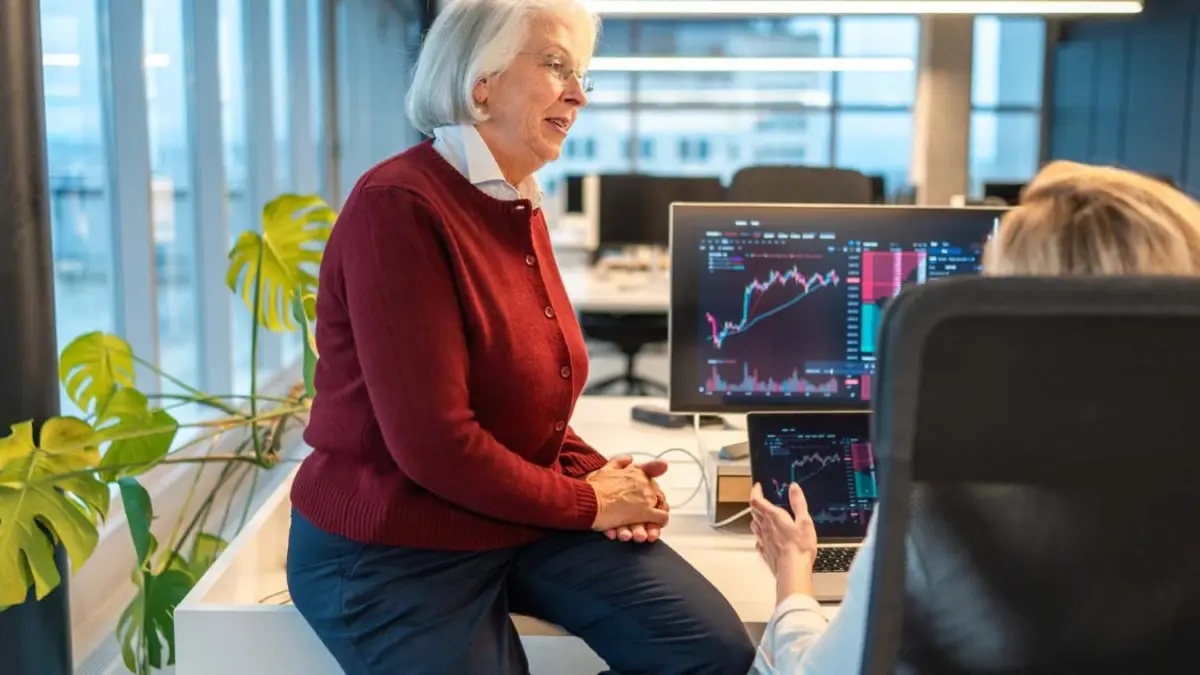
And yet, in a paradox that grows more glaring by the day, just as a woman’s experience reaches its absolute deepest point, her voice frequently becomes less visible in the broader public discourse.
In the eyes of mainstream culture, women over sixty are routinely spoken about as a monolithic demographic. They are categorized as a market segment or a niche audience—a convenient cohort to be targeted with specialized products for joint pain, retirement planning, or intensive wrinkle creams. But this commercial reductionism misses a much larger and more vital truth: women over sixty are not a niche market. They are an enormous, dynamic reservoir of lived expertise, and at present, a staggering amount of that expertise is going entirely unused by the institutions, communities, and workplaces that need it most.
Experience Is a Form of Expertise
Modern culture has developed a narrow vocabulary when it comes to authority. We tend to reserve the word "expert" almost exclusively for individuals who hold formal credentials, prestigious titles, or advanced academic degrees. While those markers of achievement matter deeply within their respective spheres, they represent only one dimension of human capability. There is another kind of authority—one rooted in lived reality—that is rarely acknowledged in boardrooms, policy discussions, or media panels: the profound understanding of what a human experience actually feels like from the inside.
Consider the intricate nuances of modern life. A woman who has spent years caring for an aging parent understands the operational, emotional, and systemic gaps of elder care in ways that no policy document, white paper, or theoretical framework can ever fully capture. A woman who has been forced to completely rebuild her life and identity in the aftermath of a divorce understands the mechanics of starting over with a clarity born of survival. A woman who spent thirty years navigating corporate hierarchies and managing people knows precisely what makes a workplace humane, what fosters genuine collaboration, and what quietly destroys organizational morale.
A woman who has raised children, changed careers midway through life, survived severe financial setbacks, cared for a sick partner, built a business from the ground up, mourned someone she loved, or simply navigated six decades of being female in a rapidly changing world possesses an immense body of knowledge that truly matters. Crucially, that knowledge does not become obsolete simply because a person reaches a certain milestone birthday. In many ways, it becomes exponentially more valuable as the decades accumulate.
Moving Beyond the Pressure to Influence
When contemporary discussions turn toward the concept of "finding your voice," they often carry a heavy, commercialized subtext. In the digital age, it can easily sound as though every individual is expected to start a podcast, build a sprawling personal brand, or attract thousands of online followers to be considered relevant. Fortunately, making a meaningful and lasting contribution to society does not require any of these modern spectacles. A lifetime of experience can be deployed in remarkably ordinary, grounded, and deeply effective ways.
A woman can choose to mentor a younger professional entering her field, bringing steady guidance to someone just starting out. She can serve on the board of a local nonprofit, lend her administrative insight to a community initiative, or advocate for policy changes she understands firsthand. She can volunteer in local government, teach, write, organize, coach, or speak up decisively at a crowded community meeting. She can support a political candidate, help another woman navigate a difficult professional or personal transition, or simply become the steady, anchoring person in a room who calmly states, "I have seen this before." In moments of organizational or social crisis, that single sentence can be extraordinarily valuable.
One of the undeniable advantages of advancing age is that many women find themselves naturally less impressed by superficial appearances and far more interested in what actually works in practice. Having watched brilliant theoretical ideas fail because planners neglected basic human behavior, and having witnessed institutions repeat the same historical mistakes, older women possess vital context. They have seen waves of fashionable trends in parenting, business, relationships, health, and culture arrive with immense corporate fanfare, only to quietly disappear when reality sets in. Context is precisely what a culture obsessed with novelty and instant gratification desperately needs.
The Shift Away From Waiting for Permission
There remains a significant obstacle to this cultural integration, and it is one that belongs partly to women themselves. For generations, women have often been socialized and conditioned to wait for formal permission. They have learned to wait patiently to be invited onto the committee, asked for their professional opinion, offered the leadership role, encouraged to write the book, or reassured by others that their experience is relevant and welcome.
At this mature stage of life, however, a more liberating question emerges: What happens if nobody asks? Does the knowledge a woman holds suddenly become less valuable because an institution failed to extend an invitation? Of course not.
One of the quiet freedoms of getting older is the realization that the barrier of "permission" is frequently an imaginary construct. An individual does not need to be officially appointed or anointed by a gatekeeper before they begin to contribute. If a woman cares deeply about a social issue, a community challenge, or a professional standard, and if she understands it thoroughly through years of observation and practice, she can simply begin the work.
Translating Personal History Into Advocacy
There is a vital distinction to be made between merely telling our personal stories and actually putting those stories to work. Personal experience becomes truly powerful when an individual stops and asks a transformative question: What can someone else possibly learn from what I have been through?
The point of sharing history is rarely just to declare, "This happened to me." Instead, the far more interesting and productive question is, "Because this happened to me, what do I now understand that might actively help someone else navigate their own path?" That realization serves as the bridge connecting private experience to public contribution.
A difficult divorce might teach a woman invaluable lessons about the mechanics of financial independence. A grueling caregiving journey might expose critical, overlooked gaps in the healthcare system. Decades spent navigating corporate structures might reveal the subtle, systemic mechanisms by which women are quietly pushed out of leadership pipelines. The experience of starting over at sixty can demonstrate firsthand that loneliness and profound personal freedom can temporarily coexist. Through this lens, personal biography ceases to be merely a private archive; it transforms directly into effective advocacy.
The Importance of Institutional Memory
Every emerging generation naturally benefits from fresh perspectives, new ideas, and youthful energy. Yet, a thriving society also requires people who actively remember what came before—those who hold the thread of continuity.
Women over sixty have lived through monumental, seismic shifts in women’s rights, workplace dynamics, marriage structures, motherhood, sexuality, medical technology, and cultural expectations surrounding what a woman’s life should look like. They remember eras when certain choices were legally or socially unavailable, and when certain conversations could not be had openly in public spaces. Many of these women now possess enough historical distance to look back and evaluate which past battles genuinely changed women’s lives for the better, and which problems merely changed their outward appearance.
That sophisticated perspective deserves an active, permanent place in public conversations, modern workplaces, family structures, community organizations, and major institutions. The ultimate goal is not to insist that aging automatically makes a person wiser about every single topic—it does not. Rather, the goal is simply to stop the pervasive cultural pretense that decades of lived experience somehow render a woman less relevant to the world around her.
At sixty-two and beyond, women are not standing on the outside of culture looking in. They are living, breathing repositories of institutional memory. And perhaps this stage of life is ultimately less about shouting louder just to be heard, and much more about becoming deeply intentional regarding where those hard-earned voices can truly matter.