Towards the conclusion of their Malaysian adventure, Ó Briain offered an observation that captured the essence of the nation’s cultural landscape. Comparing the country to an expansive buffet of diverse traditions that could be seen reflected directly on the plate, he remarked that anyone wishing to experience the entirety of Asia need only visit Malaysia. True to comedic form, the punchline followed as they prepared to depart for neighboring Thailand, where he quipped that travelers would find a culinary scene dedicated entirely to Thai food.
While the remark was made in jest at Thailand’s expense, it carried a deeply perceptive underlying truth. Food is rarely confined to the simple act of sustenance; rather, it serves as an edible archive, offering profound insights into a nation’s history, the waves of people who settled its lands, the cultures they carried with them, and the ways those traditions have mutated and evolved across generations.
Malaysia provides a particularly compelling case study in this culinary evolution. For travelers and prospective expatriates seeking to witness centuries of active trade, migration, and cultural synthesis reflected in everyday meals, few locations offer a richer starting point than the island of Penang.
Penangites Take Their Food Seriously
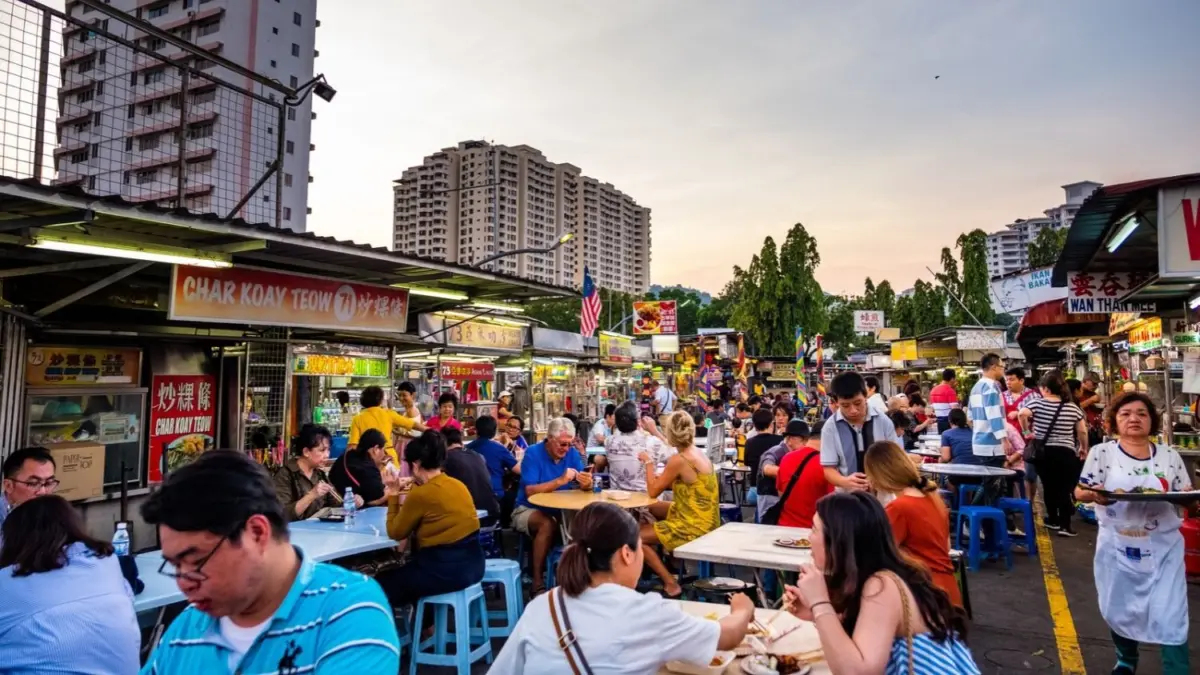
As is true across much of Malaysia, everyday dining in Penang orbits around bustling hawker centres and traditional open-air coffee shops known locally as kopitiams. Long queues routinely form outside the most popular stalls, with patrons willing to wait patiently for the specific specialty that a particular hawker has spent a lifetime perfecting.
This dynamic highlights a fascinating contrast with contemporary Western dining culture. In a typical Western restaurant, diners generally encounter a broad, diverse menu spanning numerous categories. At a Malaysian hawker stall, however, the approach is often inverted. A single individual, or sometimes an entire family working in tandem, will spend decades—spanning multiple generations—refining a microscopic menu of just one or two core items.
The offering might be a plate of char kway teow, consisting of flat rice noodles aggressively wok-fried over intense heat, or Penang’s iconic assam laksa, a sharply spicy, sour fish and tamarind noodle soup. While numerous surrounding stalls may sell superficially similar dishes, local purists and food enthusiasts hold fierce opinions regarding which vendor achieves the definitive version. This passionate curation drives the legendary queues.
Yet the inherent beauty of the hawker center lies in its collective architecture. While individual stalls maintain narrow specialties, the collective environment delivers an extraordinary breadth of culinary options capable of satisfying even the most reluctant or selective eaters.
Beyond the gastronomy itself, these hawker centers function as vital social infrastructure. They accommodate a diverse spectrum of dining styles with effortless inclusivity. Whether a patron arrives as a couple or dines entirely alone, finding an empty table to enjoy a meal while observing the rhythms of daily life is remarkably straightforward. Alternatively, for those feeling more socially inclined, sharing larger communal tables opens the door to spontaneous conversations with fellow diners, frequently initiated by the simple, universal icebreaker of asking what someone else has ordered.
For individuals navigating the transition to a new country later in life—particularly those establishing roots during retirement—these informal avenues for organic social interaction carry substantial value. There is no prerequisite requirement to formally join a club or organize a structured gathering; one can simply arrive, secure a meal, and allow the surrounding conversation to unfold organically. Against this social backdrop, the food of Penang tells a story that stretches back centuries.
A Little History Served on a Plate
Long before the British East India Company established George Town as a free port in 1786, the Strait of Malacca served as a vital maritime highway for international trade. The subsequent colonial administration swiftly attracted an influx of merchants, laborers, and settlers hailing from China, the broader Malay Archipelago, India, and beyond.
These diverse populations brought with them their native languages, religious practices, distinct social customs, and, inevitably, their culinary heritage. Chinese immigrant communities introduced specialized cooking techniques and foundational dishes that gradually adapted to incorporate local ingredients and flavor profiles. Indian traders and settlers established their own deep-seated culinary traditions, while indigenous Malay cooking already possessed a robust, sophisticated foundation rooted in local flora and fauna.
Over generations, these distinct cultural inputs resisted rigid isolation. Instead, they adapted, borrowed liberally, and occasionally blended to forge entirely new culinary categories unseen in their respective countries of origin. This ongoing synthesis aligns naturally with a nation that celebrates multiple distinct new year festivals, each bringing its own ancestral traditions and associated celebratory foods to the public table.
Char kway teow offers a clear window into this evolution, tracing its technical lineage to Chinese stir-fry traditions while developing a distinctly local Penang character characterized by the prized wok hei—the breath of the wok. Similarly, nasi kandar—a dish closely linked to Penang’s historic Indian Muslim community—presents a bed of steamed rice accompanied by an array of robust curries and side dishes, reflecting another distinct chapter in the island’s multicultural formation.
Perhaps the most culturally intricate example is Peranakan, or Nyonya, cuisine. Born from generations of intermarriage and cultural exchange, particularly between immigrant Chinese merchants and local Malay populations, this culinary tradition synthesizes ingredients, complex spice pastes, and preparation methods into a style that is intensely localized and deeply celebrated.
More Than Just Something to Eat
For observers of Malaysian society, the cultural prominence of food extends far beyond its ingredients, residing instead in the central role dining plays in everyday community life.
Eating out is rarely treated as an exclusive luxury reserved strictly for milestones or special occasions. Instead, it forms the structural fabric of daily routines. It encompasses early morning breakfasts before the workday commences, casual midday lunches with office colleagues, relaxed evening meals shared among extended family members, or simple late-afternoon gatherings where friends meet over drinks and small plates.
A typical morning might begin with nasi lemak—fragrant rice cooked in rich coconut milk, traditionally accompanied by spicy sambal, crisp anchovies, roasted peanuts, and a boiled egg—or roti canai, an Indian-influenced flaked flatbread served alongside a bowl of savory dhal or curry, all washed down with a tall glass of teh tarik, Malaysia’s ubiquitous pulled tea blended with sweet condensed milk.
These foundational dishes transcend individual ethnic communities, weaving a shared culinary language across demographic lines. Recognizing the depth of these communal ties, UNESCO officially inscribed Malaysia’s breakfast culture onto its Representative List of the Intangible Cultural Heritage of Humanity, honoring not merely the physical dishes themselves, but the rich network of social traditions and shared spaces that surround them.
Naturally, Malaysia’s multicultural mosaic does not mean that every resident consumes the same diet. Religious laws, specific dietary restrictions, and deeply held family traditions continue to shape individual eating habits and dictate where and with whom people dine. Yet this coexistence highlights a broader societal reality: food serves as a mirror reflecting both the traditions communities choose to share and the distinct cultural boundaries they maintain. Crucially, it demonstrates that shared understanding often requires little shared vocabulary when mediated by a well-prepared meal.
From Being a Visitor to Becoming a Regular
For individuals contemplating an international retirement relocation, the cultural weight of food takes on a profound practical dimension.
During a brief holiday, food functions primarily as an exploratory adventure. Visitors seek out acclaimed restaurants, sample headline-grabbing local specialties, and return home with a handful of memorable dining experiences. However, transitioning to permanent residency fundamentally alters that dynamic.
As a resident, an individual ceases to be a detached observer merely sampling local novelties and begins integrating into the repetitive, comforting routines that anchor daily life. Discovering a preferred morning breakfast vendor, identifying the noodle stall that executes a dish precisely to one’s preference, or becoming a familiar, recognized face at a neighborhood kopitiams yields a quiet sense of belonging. For retirees embarking on an unfamiliar chapter abroad, those incremental moments of routine familiarity can make a critical difference in successful adaptation.
Furthermore, food serves as one of the most accessible entry points for engaging with a new culture. Through daily purchasing and consumption, expatriates gradually learn to identify native ingredients, comprehend local social customs, and acquire conversational phrases in the nation’s various languages—even though English remains widely spoken across urban and commercial centers.
Naturally, this transition is not uniform. Not every expatriate embraces unfamiliar flavors with equal enthusiasm. Dietary restrictions, personal preferences, sensitivities to spice, and moments of nostalgia for the comforting tastes of home remain common realities. Nonetheless, culinary culture merits deliberate consideration when evaluating potential retirement destinations, given that daily dining will form an unavoidable component of daily life abroad.
What Does Your Plate Tell You?
While Malaysia presents a particularly vibrant illustration of culinary pluralism, it is part of a global pattern. Nations around the world possess distinct culinary histories shaped by geography, historical migration routes, international trade, religious mandates, and evolving domestic tastes. Sometimes those historical layers are transparently obvious; in other instances, they remain quietly embedded in recipes whose ultimate origins are debated even by lifelong residents.
For prospective retirees evaluating new horizons, looking beyond curated tourist itineraries and mainstream restaurant reviews can offer a clearer preview of daily life. Spending time in a municipal market, sitting quietly in a neighborhood coffee shop, observing how local residents interact, and imagining oneself embedded within that social ecosystem provides vital data. Assessing personal comfort levels with independent dining and envisioning a future as a regular patron can reveal more about a country’s livability than traditional relocation metrics alone.