The story dates back to the 1980s and 1990s, a turbulent era marked by geopolitical tensions involving North Korea that unfortunately manifested as localized prejudice and hostility against ethnic Koreans living in Japan. During this period, female middle and high school students attending Korean schools—who traditionally wore the distinct chima jeogori (the national attire of Korea) as their school uniform—became targets of verbal abuse, harassment, and physical assault. In the most shocking of these occurrences, known widely as the "chima jeogori slashing incidents," perpetrators intentionally sliced open the traditional garments of young female students in public spaces using knives or scissors.
It was during one such harrowing incident that Norihisa Koyama, then a Japanese high school student, witnessed the aftermath of an attack. Walking through a public area, he noticed a young female student crouching on the ground in distress.
"A female student was crouching down and crying," Koyama recalled years later, reflecting on the moments that unfolded. "I knew something was seriously wrong."
Upon closer inspection, Koyama realized that the student’s uniform jacket had been deliberately slashed open. Overcome with concern for her safety and dignity, the teenager did not hesitate. He immediately took off his brand-new winter coat—a recent purchase bought for him by his parents—and placed it over her shoulders. The heavy wool garment allowed her to cover the damage to her traditional attire, maintain her dignity, and return home safely.
Having offered his assistance in a moment of crisis, the young Koyama thought little more of the interaction as he went about his life. But for the recipient of his kindness, the moment was indelible. The young student carefully preserved the black winter coat, which still bore Koyama’s full name written on the label, guarding it as a tangible symbol of human warmth during a period of intense social alienation.
For three decades, the coat remained safely stored. Then, earlier this year, the woman—now an adult—came across a newspaper article detailing community charity work and recognized a familiar name: Norihisa Koyama. Realizing that the good Samaritan who had rescued her from vulnerability all those years ago was continuing a life dedicated to helping others, she tracked down a way to return the cherished garment.
Now 50 years old, Koyama’s early inclination toward supporting those in need has materialized into his life’s vocation. Today, he works actively with a Japanese nonprofit organization dedicated to supporting single mothers and disadvantaged families. Those who know him note that his lifelong commitment to uplifting struggling populations appears to have been foreshadowed by the compassion he showed as a teenager. Over the decades following the incident, Koyama also cultivated deep, enduring relationships with Korean residents in Japan, building bridges where societal friction once existed.
Inspired Artist Captured the Events 30 Years Ago
The societal wounds inflicted during the chima jeogori slashing incidents did not go unnoticed by the artistic community. At the time, Park Chung-moon, a Korean artist residing in Japan, was deeply moved by the targeted attacks against ethnic Korean students. Much like the prejudice faced by Japanese-Americans during World War II, the political flare-ups of the era had created a hostile environment for innocent youths simply wearing their cultural heritage.
Driven by a desire to process and reinterpret these events, Park took to the canvas. Rather than framing the torn garments solely as monuments to suffering and victimization, his artistic vision sought to transform the memory into an effort of mending, healing, and moving forward from the trauma.
When Park learned of the miraculous reunion between Koyama and the student who had preserved his coat, he reached out. In June, the 80-year-old artist invited Koyama to his Tokyo office to formally commemorate the return of the historic garment.
During the emotional meeting, Koyama brought the preserved wool coat with him. The two men sat together to discuss not only the historical context of Park’s 1990s paintings but also a brand-new art project inspired by their remarkable story of enduring gratitude and solidarity.
"He is like a treasure to us Koreans, a representative of the Japanese people," Park told the Japan-based newspaper Choson Sinbo during the commemoration. "I am so grateful that he warmly extended a helping hand to the students of the Korean school."
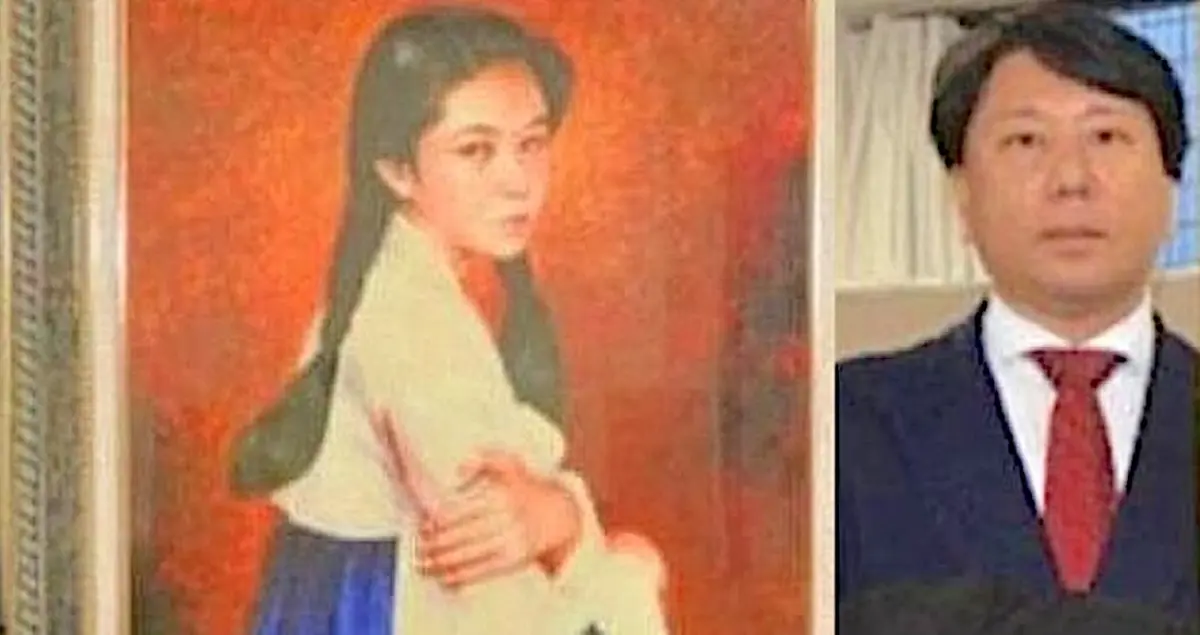
Park’s acclaimed masterwork, Chogori, which has previously been exhibited in the Korean Art Museum, captures the enduring spirit of the era. The painting depicts a young girl wearing her traditional national dress with a sleeve visibly torn, yet her expression remains resolute as she looks toward the future.
Following the recent reunion, Park Jung-moon’s studio launched a collaborative artistic initiative aimed at transforming this shared historical memory into a modern symbol of cultural solidarity. The project seeks to ensure that the legacy of the hanbok—and the quiet, courageous acts of ordinary individuals who defended those wearing it—will be passed down to younger generations.
What began as an anonymous act of teenage empathy during a dark chapter of social tension has, after more than thirty years, blossomed into a testament to human kindness, preserved through time by a grateful recipient and brought back into the light through art and community connection.