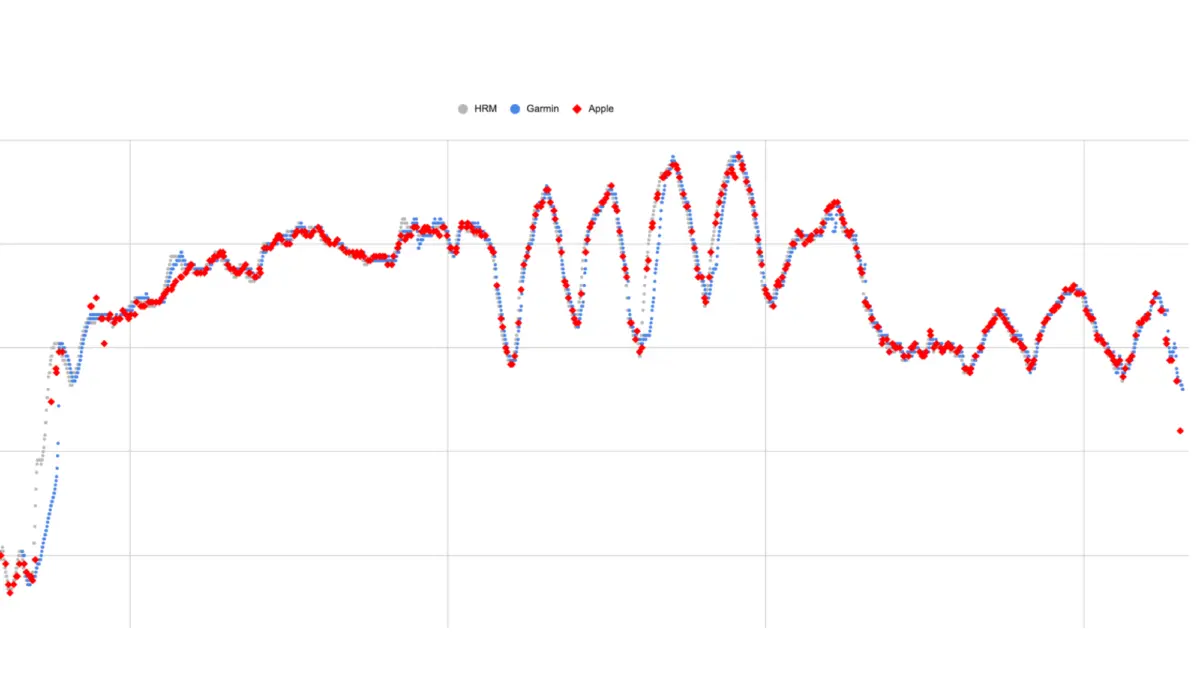
To determine whether Apple’s latest hardware adjustments live up to the marketing hype, intensive multi-week testing was conducted, putting the Apple Watch Series 12 head-to-head against the industry-standard Garmin Forerunner 570 and an electrical chest strap acting as the gold-standard reference. The results reveal a significant evolution in Apple’s tracking capabilities, marking a turning point for the tech giant’s fitness ecosystem, even if a definitive crown remains up for debate.
What Apple Says About Their Heart Rate Sensor, and Why I Doubted It

Apple’s confidence stems from a major hardware overhaul. The company redesigned its optical heart rate sensor by incorporating larger LEDs and arranging them in a tighter circular configuration. To back its claims, Apple published an extensive research study comparing seven recent competing devices across a wide array of activities. However, critics noted that the study lacked granular, real-world behavioral data, presenting simplified metrics that made it difficult to assess how each device handles sudden physiological shifts during actual workouts.
Skepticism surrounding Apple’s claim was grounded in years of comparative testing. While early models like the Apple Watch Series 4 outperformed many competitors of their era, subsequent iterations failed to keep pace with rapid advancements made by Garmin and Google’s Pixel Watch. Devices like the Garmin Forerunner 570 established a reputation for top-tier accuracy, regularly earning high marks among fitness purists, whereas models like the Apple Watch Series 10 and 11 often fell into a middle tier of performance. Informal commentary highlighting these historical shortcomings frequently met pushback from loyalists, but objective field testing consistently demonstrated that Apple’s wrist sensors were merely average compared to dedicated sports watches.
To test the new hardware under rigorous conditions, a methodical testing protocol was established. Wearing the 42-millimeter size of both the Apple Watch Series 12 and the Garmin Forerunner 570 on opposite wrists—ensuring an equally snug fit without discomfort—both devices were paired simultaneously with an electrical chest strap. The evaluations encompassed a diverse mix of workouts, including treadmill runs, outdoor trail runs, rowing sessions, and strength training. These activities were specifically chosen because rapid intensity spikes, ambient temperature changes, and the physical grip required for equipment handles frequently expose the limitations of optical wrist sensors.
The Results

Initial testing during interval runs highlighted distinct operational personalities for both devices. The Garmin Forerunner 570 occasionally exhibited a minor lag at the start of high-intensity intervals before rapidly locking onto the correct heart rate. Conversely, the Apple Watch Series 12 avoided this initial delay but occasionally missed the absolute peak values during sharp, rapid spikes in exertion. Overall, these early running tests resulted in a functional tie between the two platforms.
As testing expanded to trail runs and treadmill sessions, a consistent pattern emerged. Both watches maintained accurate tracking for the majority of each workout, yet each retained unique quirks. Garmin remained slightly more prone to missing the very beginning of heart rate spikes, whereas the Apple Watch showed a higher tendency to drop data points entirely, particularly during the opening phases of a session.
Gym-based workouts further illuminated the performance differences between the two ecosystems. During a combined session featuring a treadmill run, a rowing workout, and a strength training circuit—which included overhead barbell presses, front squats with a clean grip, and dumbbell curls—the limitations of wrist-based tracking became starkly apparent.
Both watches performed admirably on the treadmill, handling minor glitches gracefully. On the rowing machine, however, the Garmin struggled more noticeably, missing a significant portion of a secondary interval. The Apple Watch was not entirely immune to error, occasionally overestimating exertion levels or failing to track the lowest recovery values between intervals.

The strength training session proved difficult for both devices. The Garmin frequently recorded readings that were too low, while the Apple Watch occasionally skewed high and reported a significantly sparser overall number of data points. When examined closely through raw data plotting, it became clear that the Apple Watch frequently omits readings it deems uncertain. Rather than recording a potentially erroneous data point, the device simply leaves gaps in the tracking chart.
So, Is Apple’s Sensor Really the Most Accurate in a Wearable?
The evaluation yields a clear primary takeaway: Apple is no longer lagging behind the competition in heart rate accuracy. The Series 12 represents a dramatic improvement over the Series 10 and Series 11, proving that Apple has engineered a remarkably capable heart rate sensor worthy of serious athletic consideration.
Yet, declaring it definitively as the absolute best sensor on the market remains complex. While the Apple Watch successfully held its ground against Garmin’s premier sensor and frequently supplied plausible values when Garmin stumbled, it lacked the flawless, near-perfect fidelity that Garmin occasionally achieves on its best days. The tendency of the Apple Watch to leave sparse gaps in its data sets suggests an aggressive filtering algorithm designed to suppress uncertain readings. While this approach prevents wildly inaccurate data points from appearing on a chart, it also results in missing information during volatile workout phases.

Furthermore, any discussion regarding the "most accurate wearable" must account for electrical chest straps. Worn on the body like watches, chest straps utilize electrical impulses rather than optical light and remain objectively superior to any wrist-based optical sensor currently manufactured.
Ultimately, the Apple Watch Series 12 successfully ascends to the upper tier of fitness tracking, matching the performance benchmarks established by Garmin’s finest hardware. While crowning a single device as the undisputed champion remains a subjective exercise, Apple has unquestionably closed the gap, delivering a sensor that stands proudly alongside the industry’s best.