The strain, designated MCH1-7, was first uncovered by researchers from the Smithsonian Marine Station back in 2018. During field observations, scientists identified the strain on a wild coral colony that had naturally and remarkably resisted a devastating outbreak of stony coral tissue loss disease, a condition that has ravaged large swathes of the Florida Reef Tract and the wider Caribbean. While scientists have previously tested the bacterial probiotic on adult corals with varying degrees of success, they have now published fresh research in the journal Frontiers in Marine Science examining how this powerful probiotic could limit disease spread in younger corals and protect entire structures over extended periods.
At the center of the investigation is a compound known as tetrabromopyrrole, or TBP, which is naturally produced by the MCH1-7 bacteria. Researchers are closely studying how this organic compound interacts with marine life and how it may ultimately safeguard entire coral colonies from succumbing to the fatal tissue loss syndrome.
"If TBP is a natural settlement cue, and if bacteria that also produce this compound protect corals from disease, it makes sense that larvae would settle where those compounds are being produced," Jennifer Sneed, a biologist at the Smithsonian Marine Station, explained in a public statement regarding the research. "More of them would survive to be able to recognize the compound."
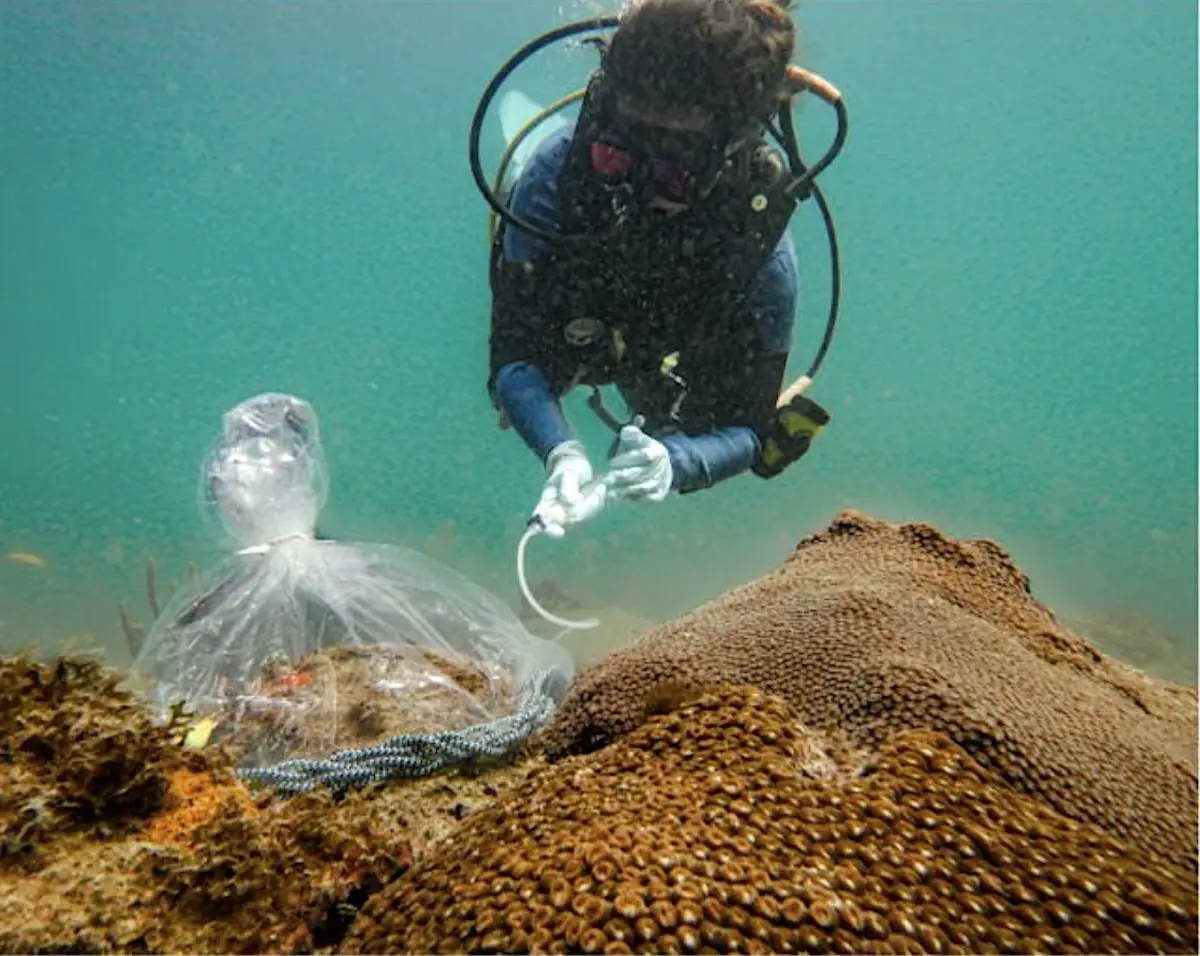
To rigorously test the protective capabilities of the compound, researchers applied the probiotic to great star coral, scientifically known as Montastraea cavernosa, utilizing two distinct experimental methods. The first approach involved injecting the probiotic directly into seawater contained within a specially weighted bag placed snugly around the coral colony. This technique, often referred to as a whole-colony bagging method, allowed scientific observers to evaluate whether the treatment could effectively protect an entire coral structure rather than just isolated areas. The second method utilized a medicinal paste applied directly to active disease-related lesions on the surface of the coral.
Following the initial applications, the scientific team closely monitored the treated corals and systematically tested coral tissue samples over an intensive two-and-a-half-year period to measure long-term efficacy and safety.

As recent reporting by Mongabay News has highlighted, the results of the long-term study were notably striking. The great star coral colonies treated via the whole-colony bagging method lost only about 7% of their living tissue to the disease over the monitoring period. By comparison, untreated control corals lost an average of 35% of their total tissue to stony coral tissue loss disease. These protective results proved durable, with the probiotic treatment successfully slowing the rate of disease spread for the full two-and-a-half years following the initial application.
However, the alternative method involving the direct application of a paste to individual lesions did not yield similarly effective results, demonstrating that localized treatment alone may not be sufficient to halt the systemic progression of the disease across a mature colony.
Building upon these encouraging findings, the researchers successfully determined a practical way for scientific divers to safely apply the whole-colony probiotic treatment while operating underwater on scuba gear. Furthermore, the team confirmed through rigorous observation that this deployment method would not disrupt or harm other healthy Caribbean coral species inhabiting the same marine environment. This crucial safety verification paves the way for what could eventually become a highly useful, targeted treatment for full coral colonies throughout the region in the future.
"While the whole-colony bagging method does involve more material transport by divers and more time for deployment and retrieval, its performance at treating stony coral tissue loss disease and promoting long-term resistance outweigh these costs and is therefore the recommended application method of those we tested for probiotic treatments such as the MCH1-7 strain," the authors wrote in their published study.
Despite the highly promising data gathered during the multi-year study, the authors strongly emphasized that a great deal of additional research remains necessary before this experimental approach can transition from a laboratory and field study into a widely available management tool. Furthermore, they noted that parallel studies must be conducted to uncover and test additional treatments capable of addressing the wide variety of other coral species that are simultaneously vulnerable to the deadly stony coral tissue loss disease.
"It’s important to understand that this is the very beginning," Kelly Pitts, lead author of the study and a researcher at the Smithsonian Marine Station, told Mongabay News. "This is definitely not a cure-all, but we’re definitely moving in the right direction."