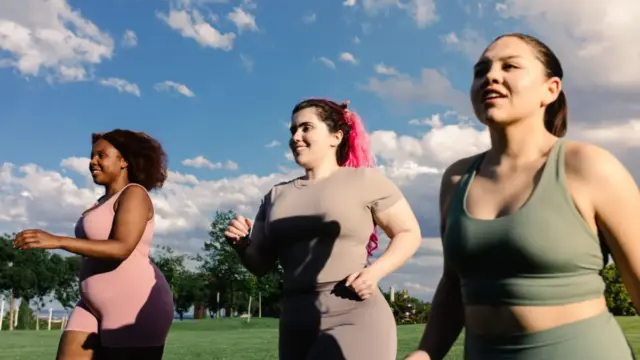

"I’ve become like the person at the train station saying, ‘Have you heard the word of God recently?’ Except I’m like, ‘Have you thought of strength training recently?’" the 34-year-old resident of Severna Park, Maryland, explains.
Mendoza got serious about weightlifting in 2024, right around the time her physician prescribed the GLP-1 receptor agonist medication Zepbound to support her broader weight-loss journey. Rather than viewing the medication as a standalone solution, she recognized that preserving her physical health required a proactive strategy.
"I wanted to sustain this weight loss long term, and I wanted to manage metabolic illnesses like type 2 diabetes, high cholesterol, and high blood pressure that I was genetically predisposed to, and the answer to that was really building muscle," she says.
Mendoza is far from an outlier. Across the United States, a growing cohort of individuals are taking to the weight room shortly after beginning a regimen of GLP-1 medications. This shift is leaving a tangible footprint on fitness facilities nationwide. Industry data underscores a profound change in consumer behavior inside commercial gyms and health clubs.
Between 2024 and 2025, the usage of free-weight equipment experienced a marked increase across fitness facilities in the United States. According to a forthcoming report from the Health & Fitness Association, a prominent fitness-industry trade organization, gym members are now 6.7% more likely to utilize dumbbells, 3.8% more likely to incorporate barbells, and 3.6% more likely to pick up kettlebells during their workouts. When compared to 2021—the historic year when the weight-loss drug Wegovy secured formal approval from the U.S. Food and Drug Administration—dumbbell utilization alone has surged by an impressive 28%.
"Available data suggest that the growing interest in strength training is part of a structural, long-term trend, which in part is accelerated by GLP-1s’ increasing popularity," says Anton Severin, vice president of research at the Health & Fitness Association.
Industry experts emphasize that pharmaceutical weight-loss treatments are not operating in a vacuum. Broader cultural conversations surrounding longevity, healthy aging, and functional strength were already steering a larger percentage of the population toward resistance training. However, the widespread adoption of GLP-1 medications has introduced an element of clinical urgency. Clinical data consistently associates rapid weight loss with a reduction in lean muscle mass, a side effect that consistent resistance training can actively help mitigate.
Why Strength Training Is Nonnegotiable on a GLP-1
To understand the physiological mechanics at play, it helps to examine what happens during accelerated weight loss. Any significant reduction in body weight—whether achieved through strict dietary modifications, bariatric surgery, or advanced pharmaceutical intervention—invariably leads to some degree of muscle mass reduction alongside fat loss, notes Dr. Jyotsna Ghosh, an obesity medicine physician at Johns Hopkins Medicine.
"The most protective things we can do to prevent a higher percentage of muscle-mass reduction are eating enough protein and resistance training consistently," Dr. Ghosh explains.
This medical imperative is tied directly to overall health outcomes. Extensive scientific literature establishes a clear correlation between adequate muscle mass and long-term vitality, a factor that becomes exponentially more critical as individuals advance in age.
Consequently, medical professionals are actively updating their guidance for patients undergoing medical weight loss. Dr. Ghosh routinely advises her patients to incorporate resistance training into their schedules at least twice a week, aligning closely with physical activity benchmarks established by the Centers for Disease Control and Prevention. The federal agency also recommends accumulating 150 minutes of moderate-intensity or 75 minutes of vigorous-intensity cardiovascular exercise on a weekly basis.
While some individuals successfully execute resistance training routines at home using resistance bands and adjustable dumbbells, many of Dr. Ghosh’s patients choose to join traditional fitness facilities. Mendoza, for instance, initially joined Planet Fitness and later transitioned to her local YMCA to gain access to the varied equipment necessary for her routine.
To ensure continuous physical improvement, Mendoza lifts heavy weights and structures her workouts to progressively increase in difficulty over time—a foundational exercise methodology known as progressive overload. Because these specialized routines demand specific hardware and heavier loads, utilizing commercial fitness centers has become a cornerstone of her routine.
How Medicine and Science Shape Exercise Recommendations
The intersection of modern medicine and popular fitness culture is not a recent phenomenon. Throughout modern history, major scientific discoveries and shifting medical consensus have fundamentally altered how the public is advised to exercise and how individuals actually spend their time inside gym facilities.
"The fields of health and medicine are always shaping how we are recommended to exercise and how we actually do exercise," notes Natalia Mehlman Petrzela, a history professor at The New School and author of Fit Nation: The Gains and Pains of America’s Exercise Obsession.
Major scientific breakthroughs have consistently triggered massive cultural shifts in physical culture. Petrzela points to the landmark medical revelations of the late 1960s, which definitively demonstrated that cardiovascular exercise improves heart health and does not pose a fatal risk to the cardiovascular system. That discovery sparked a massive cardio boom that dominated the subsequent decades, cementing high-energy activities like dance aerobics as staples of fitness culture, particularly among women throughout the 1970s and 1980s.
Eventually, the cultural pendulum swung again. Strength training surged into mainstream popularity during the 1990s and 2000s as clinical researchers published compelling evidence linking resistance training to improved bone mineral density and the prevention of conditions like osteoporosis. Now, more than twenty years later, the explosive rise of GLP-1 medications is once again acting as a powerful accelerator for muscle-building workouts.
How Gyms Are Adapting to Changing Member Habits
Fitness facility operators across the country are actively reconfiguring their physical spaces to accommodate this evolving demographic of exercisers. Petrzela notes that many commercial gyms are quietly clearing out underutilized traditional cardio equipment to install expansive new weight racks and functional training turf.
Severin echoes this observation, pointing out that membership metrics indicate traditional cardio machines are simply not seeing the same volume of use as they once did. That reality has "led many gym operators to rethink how space is allocated, with more emphasis being put on strength equipment," he says. Alongside spatial overhauls, personalized coaching services are also experiencing a surge in demand, with personal training utilization climbing 22% between 2024 and 2025.
Forward-thinking fitness chains and boutique facilities are also investing in targeted staff education to better understand the unique physical and physiological needs of clients utilizing GLP-1 medications.
Kelvin Gary, a certified personal trainer, CEO, and head coach at Body Space Fitness—a semiprivate personal training facility in New York City—has embraced this proactive approach. His coaching staff receives specific education regarding these medications, which he views as a valuable component of a holistic weight-loss strategy when paired with intelligent strength programming.
"The key for us is helping [these clients] maintain lean muscle mass," Gary explains. "Our point is making sure that everyone has a sound understanding of the importance of maintaining their lean muscle mass, and when you’re not eating as much that might mean we need to modify your workout a little bit."
Gary notes that workout modifications may include dialing back intensity, particularly because GLP-1 medications can present side effects such as nausea that directly impact an individual’s physical capacity on any given day.
Larger commercial fitness brands are implementing parallel strategies on a broader scale. Two years ago, national fitness chain Equinox rolled out a specialized, research-backed protocol designed specifically for personal trainers working with clients using GLP-1 medications.
Other major health and wellness companies are forging direct corporate partnerships with telehealth providers. Life Time launched Miora, a specialized longevity and performance clinic offering medical oversight alongside personal training and recovery therapies. Meanwhile, budget-friendly fitness giant Planet Fitness announced a strategic partnership with Ro, a telehealth provider specializing in the direct-to-consumer distribution of GLP-1 injections and oral pharmaceutical treatments.
GLP-1s Allow Exercise to Have New Meaning
For decades, physical activity has been marketed to the public primarily as a tool for weight loss and caloric expenditure. However, as millions of people turn to pharmaceutical interventions to manage their weight, cultural attitudes toward exercise are undergoing a profound transformation.
"If people are using GLP-1s as their primary strategy to lose weight, fitness is going to be for accomplishing all sorts of other things, whether that’s building muscle, finding community, or cultivating discipline and newer healthy habits," Petrzela observes.
Medical practitioners report witnessing this paradigm shift directly within their clinical practices. Dr. Ghosh notes a noticeable cultural evolution among her own patients, particularly regarding female attitudes toward physical strength. The historical anxiety among women that lifting heavy weights would cause them to develop an excessively "bulky" physique has largely faded into obsolescence.
For Mendoza, offloading the burden of primary weight loss onto a pharmaceutical prescription provided her with the psychological bandwidth to conceptualize exercise entirely anew.
"Zepbound helped me clear away space in my brain to actually focus on the evidence-based journey for strength training," she reflects.
Although Mendoza eventually transitioned off the medication itself, she has maintained her commitment to resistance training with no intention of stopping. Industry professionals hope this trajectory becomes the standard for patients who discover the gym through pharmaceutical support.
"There is the longevity part of strength training that I think people are going to realize, Yes, we do feel better. We’re at a lower risk for injury," Gary notes.
Mendoza offers a similarly resolute perspective on the long-term value of her new lifestyle. "If we want to live independently in our old age, especially women, building muscle is so important," she says. "It has really become a huge part of my life."
For individuals inspired to embark on their own resistance training journeys, medical professionals recommend employing straightforward, low-barrier strategies to build consistency. Physicians often suggest navigating the intimidating weight-room floor alongside a supportive friend or family member, or utilizing introductory personal training sessions offered by local facilities to master foundational movements.
Experts also emphasize the importance of starting gradually, prioritizing consistency over heavy loads or complex routines to mitigate the risk of early injuries that can derail long-term adherence. Treating workouts with the same scheduling rigor as professional appointments and visiting fitness facilities during less crowded off-peak hours can also ease the transition into a sustainable, lifelong strength-training habit.