
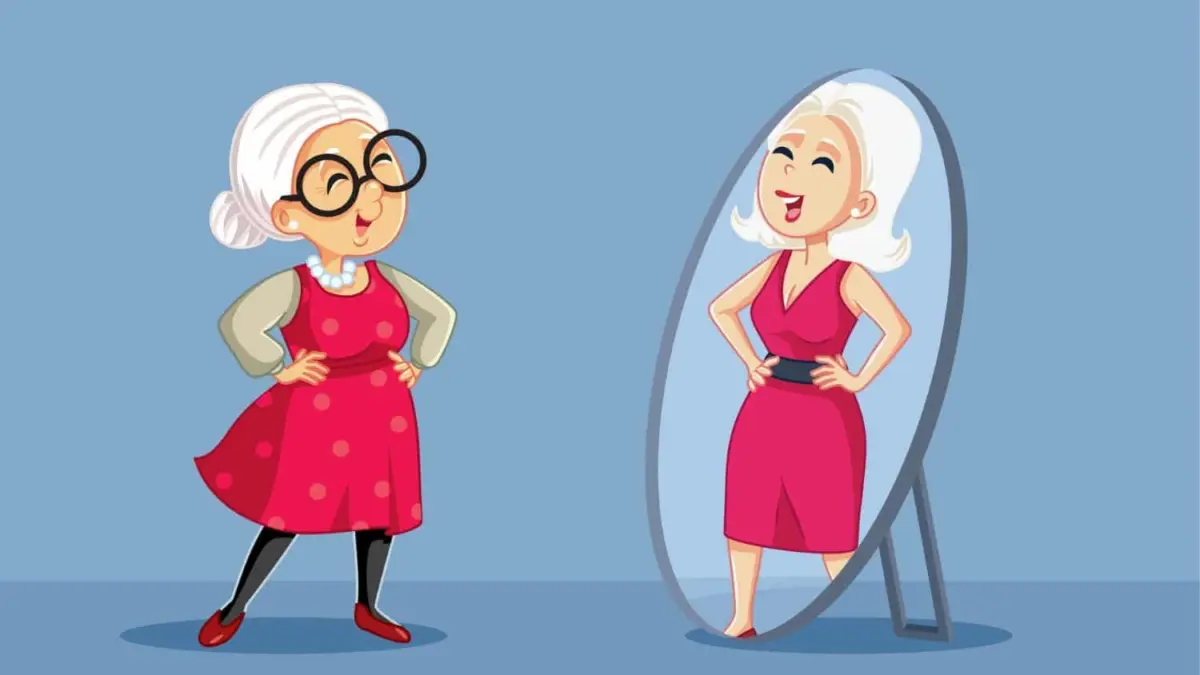
While many older adults—particularly those who limit their engagement with social media and thus avoid the daily habit of direct comparison—might not experience this realization with acute grief, it arrives with a lingering sense of detachment. The physical years have quietly left their indelible imprint on the face and the body, while the inner mind feels remarkably lively, vibrant, and far younger than the visual evidence suggests. It often feels as though the consciousness simply picked an age decades ago and chose to stay there. The reflection hurts not because of vanity, but because the mirror captures only the way time has caught up with the physical form, failing entirely to reflect the dynamic, ongoing life experienced within.
Self-Perception and the Lagging Inner Portrait
There is a profound wish among many aging adults that the mirror could display the entire truth of a life—what a person has lived through, survived, loved, and built over decades. The way individuals see themselves rarely matches what is instantly visible on the surface. Self-perception develops gradually, woven from a complex tapestry of memories, lived experiences, long-standing relationships, societal roles, and the feedback received from others over a lifetime.
Yet, that intricate inner portrait does not update automatically. Much like a person who was once heavier continuing to view themselves as round long after losing weight, identity and self-image change at a much slower pace than the physical body. The body shifts continuously, while the self-concept lags behind.
Compounding this disconnect is the reality that the reflected image is rarely static; it fluctuates based on mood, self-esteem, old memories, past criticisms, trauma, cultural norms, and even current levels of fatigue or anxiety. On a lonely or exhausted day, the exact same face can appear remarkably harsher than it did under the gentle morning light of the day before.
Beauty as Social Currency and the Invisible Tax
The modern landscape of aging is further complicated by cultural expectations surrounding appearance. Decades ago, cultural theorists such as Umberto Eco explored beauty not as a timeless, objective truth, but as a fluid concept shaped by history, culture, and power dynamics. In today’s digital landscape, beauty functions overtly as a form of social currency.
A conventionally attractive person frequently receives countless micro-advantages in daily life: a quicker smile from a stranger, more attentive service, heightened social tolerance, and easier entry into social spaces. While beauty can open doors, it also carries an invisible tax—the persistent cultural expectation that a person, particularly a woman, will perpetually preserve it, display it, and remain visually pleasing. As they grow older, many individuals experience the heavy emotional toll of this tax, grappling with the societal demand to remain attractive while simultaneously being sidelined by age.
The Illusion of Perfection in the Age of Digital Enhancement
From childhood onward, human beings learn who they are partly through the reactions of others. Affection, criticism, silence, and judgment form an alternate kind of mirror. In the contemporary era, social media dramatically amplifies this dependence on external approval. Digital platforms frequently reward appearance, youth, and performance far above authenticity, inviting individuals to compare their real, unedited bodies against images that have been filtered, digitally retouched, carefully curated, medically altered, or artificially enhanced.
Historically, individuals compared themselves primarily to people they knew personally or to celebrities featured in glossy magazines. Today, that comparison is relentless and inescapable. People are constantly exposed to filtered images and retouched faces across multiple devices. This pervasive exposure breeds a quiet, persistent anxiety: Will an ordinary appearance ever be deemed good enough, and to whom must one prove it? Many reject the premise of an "improved" or corrected version of themselves, whether digital or physical.
Sociological perspectives highlight a startling new reality: the natural human face has begun to look defective simply because it is constantly measured against an artificial standard that has never actually existed in physical reality. Ordinary faces struggle to compete with the flawless, poreless perfection of heavily manipulated images. Ultimately, this visual standardization shifts expectations of what a human face should look like, turning natural textures, asymmetries, and signs of aging into perceived visual irregularities. Yet, an excess of digital perfection often breeds a subtle psychological discomfort, as people instinctively seek out the warmth, vulnerability, and reality of an actual human presence.
The Double Bind: Invisible Yet Forbidden to Look Old
Older adults frequently find themselves caught in a classic sociological double bind—a communication trap where conflicting messages are delivered simultaneously, ensuring that no matter what choice is made, the individual faces criticism.
For older women, this manifests as a dual penalty. If a woman chooses not to alter her face or conceal her years, she may be unfairly accused of having "let herself go." Conversely, if she alters her appearance through cosmetic procedures, she risks being mocked for looking unnatural or desperate. Society demands that she age, yet simultaneously commands that the evidence of aging must remain entirely invisible.
The consequences of this double bind are far-reaching and well-documented among mental health professionals. They include weakened self-esteem, heightened anxiety around being photographed, significant financial expenditures on cosmetic interventions, social or professional withdrawal, and a painful sense of becoming socially invisible. The issue is not a condemnation of individuals who choose aesthetic treatments, but rather an acknowledgment of the immense pressure and structural contradictions placed upon aging populations.
The Face as an Open Work
Applying cultural analysis to the physical self offers alternative ways to interpret the aging face. A heavily standardized, frozen face can be viewed as a closed work of art—one designed to produce an immediate, predictable response, such as admiration, approval, or digital engagement. In a modern economy where attention is monetized, the frozen, youthful face remains a marketable commodity.
In contrast, the aging face can be understood as an open work, rich with expressions that contain multitudes of lived experiences. Its irregularities invite narrative and interpretation, with every line and physical shift bearing the authentic trace of a life fully lived. Rather than viewing the face merely as a surface meant to seduce or conform, it can be appreciated as a living archive of human history.
Reframing the Physical Reality of Aging
While cultural narratives often push a rigid mandate that older adults must age cheerfully, gracefully, and without complaint, the reality is often more nuanced. Discomfort with physical change is normal, but it does not need to manifest as personal drama or a harsh internal verdict. Repairing the relationship with one’s self often begins with a simple shift in perspective.
Practical adjustments—such as maintaining healthy lifestyle choices, wearing clothing tailored to one’s current body, standing upright, practicing positive self-talk, and focusing on genuine personal well-being—offer tangible ways to inhabit the present body with care. Embracing the unique qualities that differentiate an individual from dominant cultural ideals allows older adults to draw upon the grounded complexity, resilience, and serenity earned over a lifetime.