
The single largest factor driving this distinction is practicality. Because modern readers are pressed for time, they frequently search for immediate, actionable ideas and advice that promise swift solutions or life-changing transformations. When writing does not offer an obvious, immediate utility, its audience naturally narrows. Spending valuable time learning about concepts that lack instant practical application often feels counterintuitive to busy individuals who simply want to know what steps to take next.
However, relying primarily on narrow "advice" or "tips" can be deeply counterproductive for anyone genuinely interested in long-term usefulness. Instead of chasing a constant stream of specific tactics, individuals achieve far better and more enduring results by investing their time in learning fundamental principles.
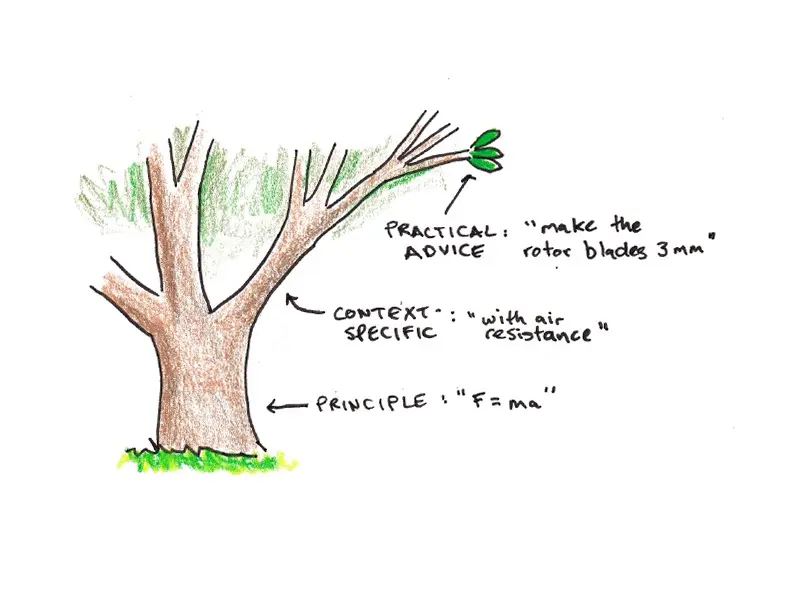
To understand why foundational concepts prove superior to quick fixes, it helps to visualize knowledge as a massive tree. At the absolute base of this metaphorical tree lie the foundational principles. These are the core truths that are least dependent on specific states of the world and remain broadly consistent across varying circumstances. Classic examples include foundational physical laws like F = ma or the fundamental conservation of momentum and energy.
By themselves, these universal principles are often insufficient for navigating complex, real-world situations. Designing a modern rocket ship or a sturdy bridge requires significantly more than just recalling the basic equation of force equals mass times acceleration. Moving upward from the base along the trunk reveals branching points that represent various splits in the state of the world.
For instance, while it remains a physical truth that heavy and light objects fall at the same speed under ideal conditions, different domains emerge where air resistance is either negligible, such as comparing a lead ball to a solid gold ball, or highly noticeable, such as dropping a feather versus a rock. As learners delve deeper into their specific, concrete circumstances, the pathways branch outward repeatedly until they finally reach the outermost leaves of the tree.
These leaves represent practical advice. They are the tactical tips handed to beginners who lack deep domain knowledge and simply want a prescribed action to take, such as shaping a propeller blade in an exact geometric configuration to minimize drag. Because the number of leaves vastly exceeds the trunk and major branches, and because each individual leaf only covers an extraordinarily narrow subset of possible scenarios, mastering practical advice requires collecting a massive volume of distinct tips for countless distinct cases.
Consequently, anyone looking to maximize the breadth and durability of their useful knowledge—expanding the number of concrete situations their learning actually applies to—is far better off studying closer to the root of the tree, focusing on foundational ideas that resist shifting with every minor change in circumstances.
Examining Real-World Applications Across Disciplines
Applying this arboreal analogy to everyday goals reveals distinct layers of knowledge, ranging from immediate tactics to bedrock principles. Consider the widespread ambition of getting into physical shape. At the outermost level, the leaves consist of specific workout routines or rigid exercise plans designed by fitness influencers. Moving down the primary branches reveals more universal training principles, such as progressive overload and the vital importance of physiological recovery. Deeper still, near the trunk, lie the foundational sciences of energy metabolism, muscle mechanics, and cardiac physiology.
Following a specific workout routine is entirely acceptable provided the individual’s personal circumstances closely mirror those of the athlete for whom the plan was originally written. Yet complications arise when a routine built for a twenty-year-old competitive athlete is given to a fifty-five-year-old recovering from a joint injury. In such cases, the rigid plan typically fails and may even cause physical harm. In contrast, an understanding of basic physiological principles remains applicable across diverse contexts, successfully steering the individual toward appropriate adaptations on a different branch of the knowledge tree.
A parallel dynamic unfolds when launching a new business venture. The leaves of entrepreneurial knowledge include hyper-specific tactics, such as purchasing targeted advertisements on a single social media platform or cold-calling purchasing managers at mid-sized regional firms. For entrepreneurs operating in the exact same niche as the advice giver, these tactics may prove effective.
However, entrepreneurs facing different market conditions often find that such tactics backfire. Focusing instead on concepts closer to the trunk—such as achieving product-market fit, developing a minimum viable product, and conducting rigorous market research—yields a more robust foundation. At the absolute base lie timeless economic drivers like the fundamental laws of supply and demand.
The same hierarchical structure applies directly to effective learning, a subject that frequently commands attention in educational research. Students studying for a high-stakes academic examination often seek out specific strategies for passing that exact test, representing the leaves of the tree. Moving inward along the branches reveals broader tactics for organizing study materials or tackling multiple-choice questions. Reaching the trunk uncovers bedrock cognitive principles like the spacing effect and retrieval practice. While these deep psychological principles leave some ambiguity regarding how to handle every unique test environment, they remain universally applicable across virtually every subject of study.
Addressing Common Objections to Foundational Learning
Despite the efficiency of focusing on principles, several common objections frequently arise among learners and practitioners.
The first major objection argues that principles alone fail to sufficiently constrain decision-making. Critics point out that learning a deep, abstract principle rarely hands a person all the necessary information to determine the single best course of action in a chaotic, real-life scenario, where countless competing considerations demand attention.
This critique holds merit. Principles rarely suffice on their own; they must be supplemented with specific contextual knowledge to arrive at the correct operational answer. Returning to the arboreal analogy, imagine searching for a small bird hidden within a massive tree. Being told that the bird is located on the third major branch from the right does not reveal its exact leaf, but it provides an invaluable starting location. Conversely, knowing whether the bird is on one specific leaf is only helpful if it happens to be perched precisely on that leaf; otherwise, that narrow piece of data fails to guide the search. Specific advice only serves a purpose when it matches the exact situation at hand.
A second common objection suggests that theoretical principles often fail to accurately describe the messy reality of the world. Critics argue that academics invent elegant-sounding concepts that struggle to translate into useful, real-world guidance. While this discrepancy certainly occurs, it more frequently stems from the reality that foundational principles remain undiscovered in certain fields, or that existing theories simply cannot constrain complex problems tightly enough.
In terms of the tree analogy, this resembles viewing an array of scattered leaves while remaining blind to the hidden branches beneath the thick canopy. Guesses can be made about the missing structure, but those guesses carry a high risk of error. Existing knowledge remains accurate as far as it reaches, but it may not extend far enough to solve every immediate problem. In domains where principles tightly dictate practical outcomes—such as physics and engineering—mastering foundational laws is essential. In fields where principles only weakly determine practical outcomes, such as entrepreneurship or foreign language acquisition, foundational concepts remain valuable but must be heavily reinforced with situation-specific advice.
A final objection involves the sheer difficulty of figuring things out from fundamental principles, rendering the process practically intractable for everyday decision-makers. Moving closer to the trunk demands significantly more cognitive effort to trace branch points and predict where practical applications will land. This challenge explains why hierarchical domains exist in human knowledge. For exceptionally complicated fields, individuals occasionally require specialized guidance from higher up the tree to make fundamental principles operational. Nevertheless, because the explanatory span of a single principle is so vast, foundational learning remains remarkably efficient overall.
Practical Takeaways for Daily Life
Recognizing that the study of fundamental principles is inherently more efficient than collecting endless practical tips carries profound implications for how individuals approach self-improvement, professional development, and reading habits.
Consider the massive volume of published material dedicated to productivity, dieting, and personal finance. The market is constantly flooded with newly popularized diet regimens promising dramatic weight loss within a fortnight, rigid daily schedules attributed to successful authors, or hyper-specific financial retirement blueprints.
For someone seeking quick answers to an immediate, narrow problem, a single practical book may occasionally provide utility if their life circumstances happen to mirror the author’s exact scenario. However, for those planning to read widely across a subject, starting with the outer leaves of practical advice is rarely the optimal strategy.
When exploring a field largely rooted in an academic discipline—such as human nutrition or behavioral psychology—learners benefit most from opening a standard textbook. When exploring professional practices outside academia, seeking out unbiased overview texts that outline the fundamental architecture of the trade provides a far stronger foundation.
Making it a personal maxim to invest time in understanding the intellectual trunks of various domains ensures that when complex, practical problems eventually arise, the hardest part of the educational journey is already complete.