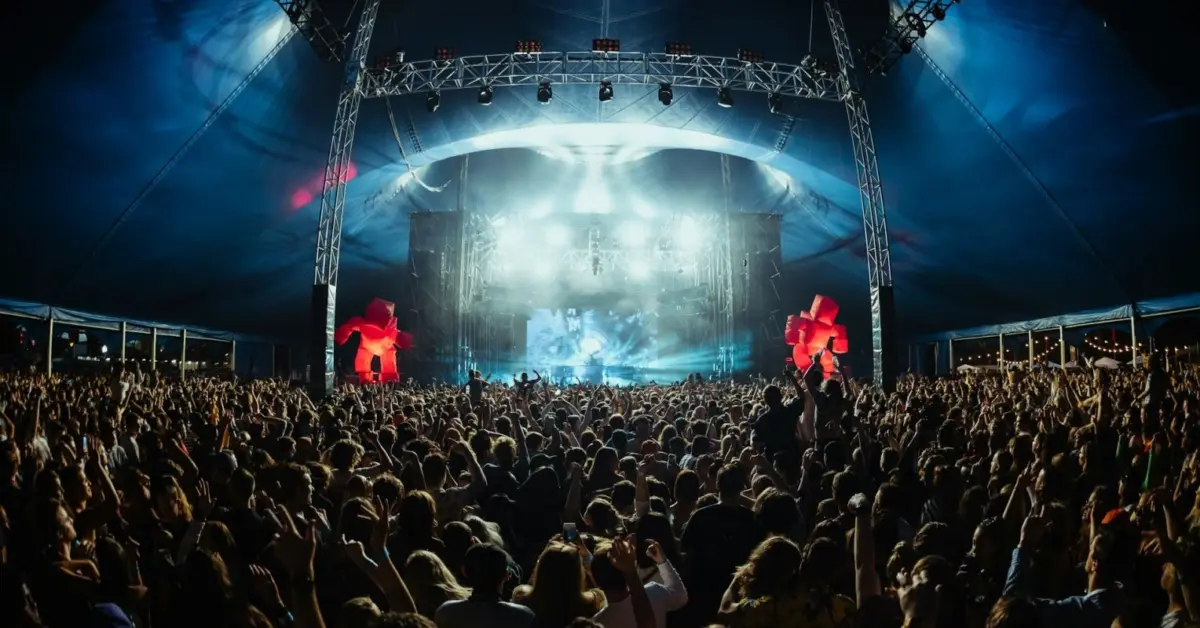
As we slowly circled the perimeter of the venue while navigating the dense throngs of ticket-holders, the opening act was already playing in the distance. At first, the audio reached us at what seemed to be a perfectly reasonable, comfortable volume—a gentle introduction to the evening’s festivities. But then we rounded the final corner, moving directly toward our designated seats closer to the stage.
BLAST!
The transition was so sudden and violent that we physically recoiled, stepping backward as if we had been struck by an invisible physical force. Without a second thought, we ducked behind a concrete stadium wall to frantically pull our protective headphones from our bags and snap them securely into place. They stayed snugly over our ears for the remainder of the night, allowing us to enjoy the performance without flinching.
Yet, when we looked around the packed seating section, scanning the faces of thousands of ecstatic fans, we could not spot a single other person wearing hearing protection. It was a jarring disconnect. Why do millions of people enthusiastically pack music venues, knowing full well the acoustic risks, while stubbornly refusing to protect their hearing when the danger is so obvious and immediate?
The Risk Is Real and Measurable
To understand the scope of the hazard, one only has to look at the hard data. During the height of the show, the digital decibel reader on my Apple Watch hovered stubbornly between 90 and 100 decibels. Many live music concerts, particularly indoors or near massive line-array speaker stacks, are frequently even louder, pushing well past safety thresholds.
According to guidelines from the National Institute on Deafness and Other Communication Disorders, exposure to sound levels reaching 100 decibels can begin to cause measurable, permanent hearing damage in as little as 14 minutes.
The tragedy of this exposure lies in its permanence. Once human hearing is damaged by acoustic trauma, it does not return. Modern medical science and biological research have not yet found a reliable way to regenerate or repair the delicate inner ear hair cells—microscopic structures that are easily battered and destroyed by excessively loud sounds.
Yet, despite the irreversible nature of noise-induced hearing loss, the solution is remarkably simple and accessible, and the science proves it works. In a randomized clinical trial conducted at a major music festival in Amsterdam where sound levels averaged around 100 dBA, researchers found that 42 percent of unprotected ears exhibited temporary hearing loss immediately following the performances. In stark contrast, only 8 percent of ears that were shielded by specialized musician earplugs suffered the same temporary impairment. Furthermore, distressing symptoms like acute ringing in the ears, known as tinnitus, were far less common among those who wore protection.
Why We Skip the Earplugs
Given that protective earplugs are remarkably inexpensive, highly effective, and widely available, the obvious question remains: why are they still so rarely used by the general public? The psychological and social barriers run much deeper than mere ignorance or a lack of information.
The first major hurdle is denial. When you are young, healthy, and feeling invincible, hearing damage feels like a distant, abstract problem that only affects older generations. If the music sounds fantastic and your ears are not immediately throbbing with pain after a song, it is remarkably easy to assume that everything is fine. The biological consequences of acoustic overexposure are often cumulative and silent, failing to become apparent until years or decades later when age-related hearing loss sets in prematurely.
Another powerful deterrent is the simple fear of social awkwardness. Human beings are deeply influenced by social norms. When you look around a crowded amphitheater and notice that virtually no one else is wearing earplugs, putting them in can feel isolating and conspicuous. It requires a conscious effort to stand out, making it vastly easier to simply go along with the crowd and accept the invisible risk.
Compounding these social anxieties is the persistent worry that wearing earplugs will ruin the acoustic experience. Many concert-goers fear that inserting foam or silicone barriers into their ears will drastically muffle, distort, or muddy the intricate music they paid hard-earned money to hear. Others harbor anxieties about how they might look to their peers, or whether wearing bulky or visible protection will feel uncomfortable over a multi-hour event.
How to Make Hearing Protection the Norm
In the hyper-charged environment of a live music concert, simply turning down the master volume or physically moving farther away from the massive speaker arrays is rarely a practical option. The crowd density, assigned seating, and sheer scale of modern productions lock attendees into their spaces. That spatial restriction makes proactive hearing protection especially vital. Yet, bridging the gap between intellectually knowing that you should wear protection and actually pulling the trigger to put it on remains a persistent behavioral challenge.
Live music remains one of life’s great communal joys, offering a visceral, emotional connection to art and community that recorded tracks can rarely replicate. Proactively protecting your hearing is a fundamental part of ensuring that you can continue to safely enjoy those experiences for decades to come. And if you happen to look around your section and notice that no one else around you is wearing ear protection, consider taking the initiative to be the first. By normalizing the sight of protective earplugs in public spaces, you just might make it a little bit easier for someone else in the crowd to do the same.
Copyright: Shari Eberts. A version of this post also appears on LivingWithHearingLoss.com.