
Upon arriving at her destination, she settled into a sparsely furnished rental apartment designed to make the transition as simple as possible. Surrounded by minimal stock furniture, she spent her first afternoon organizing her belongings into a fraction of the space she was accustomed to. Living in such a stripped-down environment quickly offered unexpected insights into the psychology of clutter and minimalism—lessons that contrasted sharply with her previous experiences of living in a tightly packed home.
One of the first habits Mia confronted was the psychological impulse to hold onto minor, low-quality items out of a sense of scarcity. Part of the furnished apartment experience includes stocking hotel-sized portions of everyday products. Having brought her own toiletries and cleaning supplies from home, she viewed these complimentary items as mere extras. In the past, she admitted, she would have fallen victim to a hoarding mentality, saving tiny containers for some hypothetical future scenario where miniature toiletries might prove useful.
This time, however, she adopted a strict "use it up" philosophy. Recognizing that these were often the lowest-quality versions of everyday goods and that saving them would do nothing to enrich her daily life, she committed to using them first. Once emptied, the containers were immediately tossed. The result was a subtle yet profound shift: fewer items taking up physical real estate in her temporary home and less mental clutter weighing on her focus. The experience transformed her into an even more ardent proponent of intentional depletion over passive hoarding.
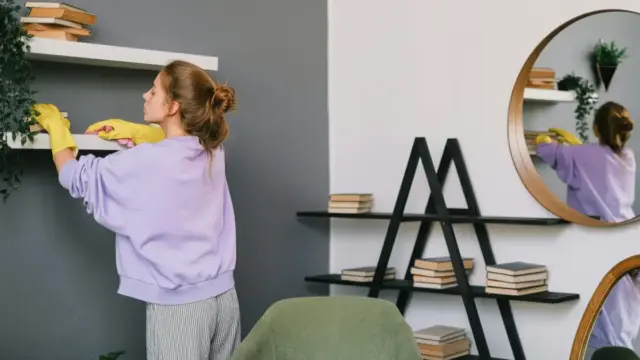
As a self-described homebody, being displaced from her permanent residence and familiar belongings presented an emotional hurdle. To combat feelings of homesickness without reintroducing clutter, she experimented with what she calls functional decor. Rather than tucking her few personal mementos away in drawers, she integrated them purposefully into the living space. A colorful throw blanket was draped casually over the couch instead of being folded away out of sight, and her favorite books were propped up on surfaces around the apartment rather than stacked clumsily on a bedside table.
While displaying too many objects in a small space can easily cross the line into visual clutter, keeping only a handful of cherished items created a warm, lived-in atmosphere. By styling the apartment with functional items she already owned, those possessions served a dual purpose: they made an unfamiliar space feel like home without contributing to unnecessary waste or disarray.
This minimalist philosophy extended to her kitchen utensils, a subject brought into sharp focus around the time of her birthday. Visited by a close friend who gifted her a small, perfectly sized wooden spoon, Mia found an unexpected solution to a long-standing personal challenge. Dealing with sensory issues that make the sound of clinking silverware deeply unpleasant—often to the point of nausea—she had resorted to saving plastic cutlery from takeout orders during her first days in the apartment to avoid using the metal utensils provided by the landlord.

The handmade wooden spoon, however, changed her routine entirely. Evoking fond memories of her friend every time she looked at it, the spoon quickly became her primary utensil, paired simply with a set of chopsticks. The rest of the apartment’s utensil drawer was rendered entirely obsolete. The experience reinforced the idea that owning a single item capable of serving its purpose perfectly—especially one that brings genuine joy—is vastly superior to maintaining a drawer full of mediocre alternatives.
Beyond physical possessions, the relocation drastically altered Mia’s daily routine and social calendar. While her social circle in the new city was limited compared to the robust community she left behind, the resulting solitude proved surprisingly energizing. Though she deeply values her friendships and admits to an ongoing internal tug-of-war between her desire for constant social connection and her psychological need for solitude, the quiet environment unlocked unexpected productivity.
With her schedule freed from constant social obligations and a living space that required minimal maintenance, daily life simplified dramatically. Morning gym visits became effortless, her temporary apartment remained spotless, and she found herself dedicating significantly more time to cooking nutritious, healthy meals. Furthermore, she found herself getting so far ahead on work tasks—including the operation of a business she acquired a few months prior—that she finally uncovered the mental space and free time necessary to write and publish reflections on her blog.
While she intends to reintroduce social activities and hobbies into her routine as she settles in—including game nights with friends back home and picking up martial arts training now that her energy levels have rebounded—she acknowledges that the extended period of solitude provided a vital reset.
Yet, the experiment also highlighted how quickly the physical tide of consumer culture can turn. After just three weeks in the apartment, Mia noted the immediate, subtle creep of impending clutter. Celebrating her birthday meant welcoming new gifts into her space—items that brought genuine happiness but nevertheless claimed physical room, culminating in a small trampoline resting beside her as she typed. Even driving cross-country with virtually no belongings had not protected her from the natural accumulation of modern life; within weeks, a kitchen cabinet had filled entirely with saved plastic food containers.
Observing the steady, one-way flow of goods into American households, she underscored the necessity of establishing an intentional flow outward to prevent permanent accumulation. To combat this, she quickly reinstated her regular decluttering practices, utilizing passive maintenance techniques to stay ahead of the curve before disorder could take root.
As for the core question driving her cross-country journey, the experiment has yielded promising results. Her health has shown its first real, measurable improvement in years—a development that offers profound relief, even as it complicates her long-term living situation. Realizing that her previous environment was actively undermining her well-being means confronting the reality of her permanent home, a challenge she now has the mental clarity and energy to address. For now, the experiment continues, alongside preparations for upcoming community projects like the annual holiday decluttering challenge.