
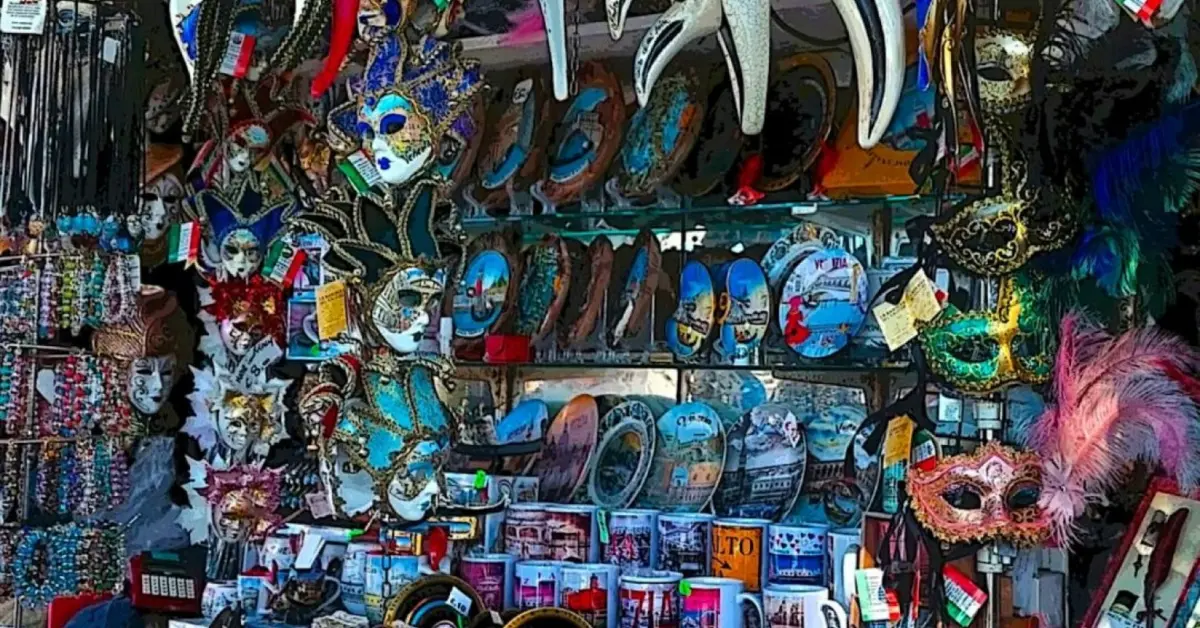
The journey began during the heat of the summer on the opening day of the trip. Eager to bypass the thick crowds of tourists and the endless rows of gaudy souvenir stalls overflowing with mass-produced plastic trinkets, the traveler hurried toward a destination synonymous with authentic artistic expression—the Ca’ Pesaro International Gallery of Modern Art. The objective was clear: to immerse oneself in the acclaimed exhibition by contemporary artist Hernan Bas.
Portraiture is a genre that many modern observers dismiss as traditional, constrained by history, and seemingly exhausted of fresh narrative possibilities. However, encountering Bas’s canvases instantly dismantled those preconceptions. Rather than painting classical aristocracy or abstract figures, Bas turned his keen eye toward the very tourists milling about the city and the cheap, commercial souvenirs that line the canal-side stalls. In the hands of Bas, miniature plastic gondolas, glowing LED masks, and flashy plastic trinkets were elevated from mere clutter into compelling subjects worthy of serious artistic contemplation.
The brilliance of the work lay not in inventing a completely alien concept, but in an unexpected synthesis. Bas took two elements that many might casually dismiss as thoroughly mundane—traditional portraiture and the tacky ephemera of modern mass tourism—and fused them together. The resulting perspective forced viewers to reconsider what they thought they knew about both art forms.
Stepping back out into the sun-drenched streets of Venice after the gallery visit, the city appeared fundamentally altered. The very souvenir stalls that had been briskly ignored earlier in the day suddenly commanded attention, resembling miniature anthropological museums documenting contemporary human desire. They were no longer viewed simply as cheap, disposable clutter; instead, they stood as physical manifestations of identity, place, memory, and nostalgia. The commercial items that the traveler had previously avoided were now rich landscapes waiting to be explored.
First Glance vs. Second Glance
This sudden shift in perception highlights a fundamental aspect of human psychology regarding how individuals process the visual world. Human beings rarely look at their surroundings in a truly neutral manner. The human brain is an exceptionally complex filtering machine, constantly sorting through an overwhelming flood of sensory information to determine what requires immediate attention and what can be safely ignored. Without this constant triage, navigating daily existence would be utterly impossible, as the sheer volume of sensory detail would cause debilitating cognitive overload.
Psychologists frequently categorize this dual-processing mechanism through the framework of System 1 and System 2 thinking. System 1 operates automatically and at lightning speed, requiring little to no conscious effort. It allows individuals to make rapid, split-second judgments—such as walking past a crowded tourist stall and instantly categorizing it as unworthy trash without stopping to inspect a single item. This cognitive shortcut is not a sign of laziness; rather, it is an essential survival mechanism designed to prevent mental exhaustion. However, the sheer speed of System 1 comes with a distinct trade-off: it frequently traps observers on the surface level of reality, blinding them to deeper nuances.
In contrast, System 2 thinking demands a slower, more deliberate, and highly analytical approach. It requires individuals to step off their cognitive autopilot and invest genuine mental effort into active attention. Taking that vital second look is System 2 operating at full capacity. It is the moment an observer pauses, steps back, and asks the critical question: "Wait, what am I actually seeing here?" That simple inquiry has the power to dismantle old assumptions and entirely rewrite an individual’s understanding of their environment.
At the beginning of the Venetian journey, the souvenir stalls were dismissed as mere visual clutter, processed entirely through the rapid, dismissive lens of System 1. But the exposure to Hernan Bas’s artwork forced the mind to switch gears, engaging System 2. Suddenly, those same stalls transformed into profound commentary on contemporary tourism, collective memory, and individual identity.
In a similar vein, portraiture was initially written off as an archaic and exhausted artistic discipline. Yet, through the prism of modern critique, the intersection of tourism, desire, and cultural myth revealed itself to be a deeply fertile ground for creative exploration. This realization underscores a central truth about the creative process: true innovation frequently does not happen during the initial, knee-jerk observation, but rather in the vital space between the first glance and the second.
Look Again
Modern professional culture is practically obsessed with the pursuit of the novel. Professionals across every imaginable industry pack auditoriums for innovation conferences, devour bestselling books on disruptive thinking, and scour digital landscapes in a relentless hunt for the next big idea—something entirely unprecedented that no one else has ever witnessed. The underlying assumption is always that inspiration lives somewhere over the horizon, hidden in a distant market or a foreign methodology.
Yet, as the Venetian experience demonstrates, the most transformative creative breakthroughs often require no travel at all. Sometimes, the most imaginative act an individual can perform is to stop chasing distant novelties and instead cast a renewed, inquiring gaze upon what is already sitting directly beneath their nose.
Consider the mundane professional routines executed day after day without a second thought. Think about the product line that internal teams have long overlooked, the corporate rulebook that everyone follows blindly without a single question, the persistent operational problem that has already been universally written off as impossible to solve, or the ordinary object, service, or concept that was long ago categorized as boring, cheap, obvious, or utterly unimportant.
The initial glance provides a quick, convenient answer that satisfies the brain’s need for closure. The second glance, however, introduces a compelling question. True creative thinking almost invariably begins the moment an individual develops genuine curiosity about that very question.
Hernan Bas did not physically alter the souvenir stalls lining the Venetian canals, nor did he invent a new category of consumer goods. Instead, his work successfully demonstrated that the observer simply had not looked closely enough in the first place. Ultimately, the most valuable creative habit may not be the endless, exhausting search for something entirely new, but rather the acquired discipline of learning to see the familiar world with entirely fresh eyes.
Have you ever experienced a sudden, unexpected revelation simply by taking a deliberate second look at something you initially chose to ignore?